

EV maker Lucid becomes first global automotive manufacturing company to join ‘Made in Saudi’ program

1 / 4
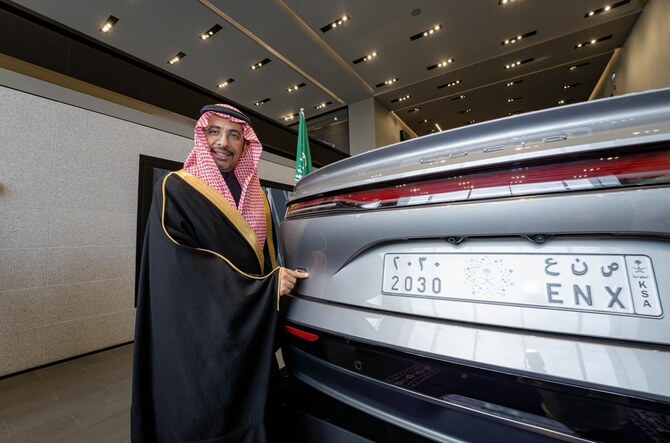
Lucid Motors joins ‘Made in Saudi’ program to boost the Saudi Arabia’s leadership in electric vehicle manufacturing. X/@BAlkhorayef
2 / 4
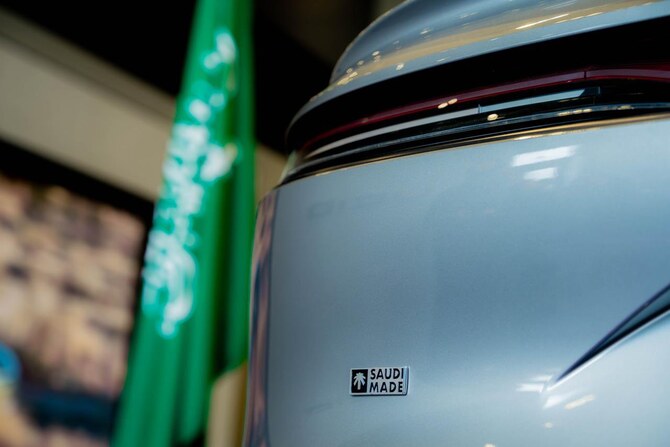
Lucid Motors joins ‘Made in Saudi’ program to boost the Saudi Arabia’s leadership in electric vehicle manufacturing. X/@BAlkhorayef
3 / 4
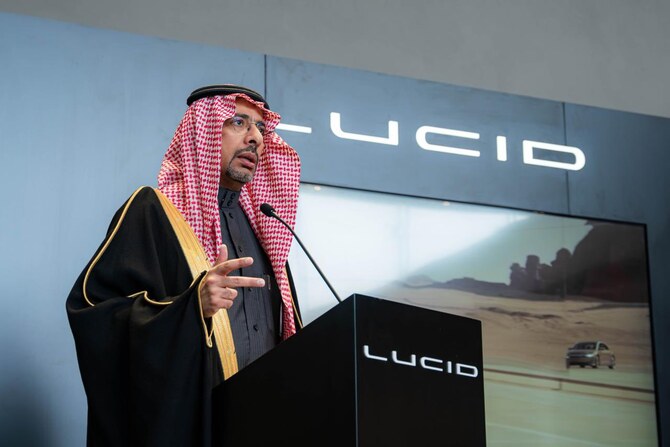
Lucid Motors joins ‘Made in Saudi’ program to boost the Saudi Arabia’s leadership in electric vehicle manufacturing. X/@BAlkhorayef
4 / 4
Lucid Motors joins ‘Made in Saudi’ program to boost the Saudi Arabia’s leadership in electric vehicle manufacturing. X/@BAlkhorayef
Short Url
Updated 03 April 2025
Follow

EV maker Lucid becomes first global automotive manufacturing company to join ‘Made in Saudi’ program

  • Aims to increase industrial sector’s contribution to GDP to at least 20% by 2025
  • Move seeks to attract additional investments, enhance non-oil exports, and create sustainable job opportunities

RIYADH: Electric vehicle manufacturer Lucid Motors has become the first global automotive company to join the Kingdom’s “Made in Saudi” program as the country continues strengthening its industrial capabilities. 

The milestone grants Lucid the right to use the “Saudi Made” label on its products, symbolizing the nation’s focus on quality and innovation. 

The strategy aims to increase the industrial sector’s contribution to the gross domestic product to at least 20 percent by 2025, tripling the current industrial base. 

It also seeks to attract additional investments, enhance non-oil exports, and create sustainable job opportunities, aligning with Vision 2030’s economic diversification goal.

“This is a step that represents a strong push to enhance the image of the national industry and attract investments and global companies, which consolidates the Kingdom’s position as a global center for innovative manufacturing,” Minister of Industry and Mineral Resources Bandar Alkhorayef said in a post on his X account. 

In a separate statement, the minister said that Lucid Motors’ inclusion in the program underscores Saudi Arabia’s strategic transformation toward creating a fully integrated electric vehicle manufacturing ecosystem. 

The minister added that this initiative aligns with the objectives of the National Industrial Strategy, which focuses on empowering promising sectors and attracting high-value investments in advanced industries.

Lucid’s participation in the program follows the launch of its first international manufacturing plant in Saudi Arabia in September 2023. 

Located in King Abdullah Economic City, the facility is the Kingdom’s first-ever car manufacturing plant and represents a key milestone in its efforts to build a domestic automotive industry. 

The facility can currently assemble 5,000 Lucid vehicles annually during its first phase. Once fully operational, the complete manufacturing plant, including the assembly line, is expected to produce up to 155,000 electric cars per year. 

Saudi Arabia is aggressively promoting the adoption of electric vehicles as part of its Vision 2030 strategy, which aims to achieve net-zero carbon emissions by 2060. 

A critical target of the initiative is for 30 percent of all vehicles in Riyadh to be electric by 2030, contributing to a broader goal of reducing emissions in the capital by 50 percent. 

To support the transition, the Public Investment Fund — a major backer of Lucid Motors — has been instrumental in establishing a domestic EV manufacturing sector. 

In addition to its stake in Lucid Motors, PIF has launched Ceer, the Kingdom’s first locally branded electric vehicle manufacturer, as part of its efforts to bolster the industry. 

Infrastructure development is also a core focus, with the Kingdom planning to deploy 5,000 fast chargers across Saudi Arabia by 2030 to facilitate the adoption of EVs. 

Consumer interest in EVs is steadily growing, with over 40 percent of Saudi consumers considering purchasing an electric vehicle within the next three years, according to a 2024 report by London-based professional services network PwC. 

Faisal Sultan, vice president and managing director for the Middle East at Lucid Motors, expressed the company’s pride in joining the program, saying: “We are delighted to join the ‘Made in Saudi’ program and have the honor of using the ‘Saudi Made’ label, which represents quality and excellence.”

He added: “We are committed to embodying the values of this national identity, such as sustainability, innovation, and excellence. With the increasing focus on electric vehicles in the Kingdom, we aim to deliver an advanced and unique experience to our customers.”

The minister said that Saudi Arabia has emerged as a central hub for electric vehicle production, supported by modern infrastructure, incentivizing policies, and a highly skilled workforce. 

He also said that major players like Lucid Motors strengthen the Kingdom’s position as a global center for future-focused industries while contributing to increased local content, non-oil exports, industrial localization, and knowledge transfer. 

Launched in March 2021, Saudi Arabia’s Made in Saudi program promotes domestic products and services, encouraging local consumption and boosting non-oil exports. 

The move aligns with Saudi Arabia’s broader industrial strategy, which aims to increase the sector’s gross domestic product contribution to 20 percent by 2025 and drive investments in advanced industries. 

It also supports Vision 2030’s goal of reducing the nation’s reliance on oil by fostering high-value sectors like electric vehicle manufacturing.


India and US release a framework for an interim trade agreement to reduce Trump tariffs

Updated 07 February 2026
Follow

India and US release a framework for an interim trade agreement to reduce Trump tariffs

  • Under the deal, tariffs on goods from India would be lowered to 18 percent, from 25 percent, after Indian Prime Minister Narendra Modi agreed to stop buying Russian oil, Trump had said.

NEW DELHI: India and the United States released a framework for an interim trade agreement to lower tariffs on Indian goods, which Indian opposition accused of favoring Washington.
The joint statement, released Friday, came after US President Donald Trump announced his plan last week to reduce import tariffs on the South Asian country, six months after imposing steep taxes to press New Delhi to cut its reliance on cheap Russian crude.
Under the deal, tariffs on goods from India would be lowered to 18 percent, from 25 percent, after Indian Prime Minister Narendra Modi agreed to stop buying Russian oil, Trump had said.
The two countries called the agreement “reciprocal and mutually beneficial” and expressed commitment to work toward a broader trade deal that “will include additional market access commitments and support more resilient supply chains.” The framework said that more negotiations will be needed to formalize the agreement.
India would also “eliminate or reduce tariffs” on all US industrial goods and a wide range of food and agricultural products, Friday’s statement said.
The US president had said that India would start to reduce its import taxes on US goods to zero and buy $500 billion worth of American products over five years, part of the Trump administration’s bid to seek greater market access and zero tariffs on almost all American exports.
Trump also signed an executive order on Friday to revoke a separate 25 percent tariff on Indian goods he imposed last year.
Indian Prime Minister Narendra Modi thanked Trump “for his personal commitment to robust ties.”
“This framework reflects the growing depth, trust and dynamism of our partnership,” Modi said on social media, adding it will “further deepen investment and technology partnerships between us.”
India’s opposition political parties have largely criticized the deal, saying it heavily favors the US and negatively impacts sensitive sectors such as agriculture. In the past, New Delhi had opposed tariffs on sectors such as agriculture and dairy, which employ the bulk of the country’s population.
Meanwhile, Piyush Goyal, Indian Trade Minister, said the deal protects “sensitive agricultural and dairy products” including maize, wheat, rice, ethanol, tobacco, and some vegetables.
“This (agreement) will open a $30 trillion market for Indian exporters,” Goyal said in a social media post, referring to the US annual GDP. He said the increase in exports was likely to create hundreds of thousands of new job opportunities.
Goyal also said tariffs will go down to zero on a wide range of Indian goods exported to the US, including generic pharmaceuticals, gems and diamonds, and aircraft parts, further enhancing the country’s export competitiveness.
India and the European Union recently reached a free trade agreement that could affect as many as 2 billion people after nearly two decades of negotiations. That deal would enable free trade on almost all goods between the EU’s 27 members and India, covering everything from textiles to medicines, and bringing down high import taxes for European wine and cars.
India also signed a comprehensive economic partnership agreement with Oman in December and concluded talks for a free trade deal with New Zealand.