DAMASCUS: Handcuffed and squatting on the floor, Abdullah Zahra saw smoke rising from his cellmate’s flesh as his torturers gave him electric shocks.
Then it was Zahra’s turn. They hanged the 20-year-old university student from his wrists until his toes barely touched the floor and electrocuted and beat him for two hours. They made his father watch and taunted him about his son’s torment.
That was 2012, and the entire security apparatus of Syria’s then-President Bashar Assad was deployed to crush the protests that had arisen against his rule.
With Assad’s fall a month ago, the machinery of death that he ran is starting to come out into the open.
It was systematic and well-organized, growing to more than 100 detention facilities where torture, brutality, sexual violence and mass executions were rampant, according to activists, rights group and former prisoners. Security agents spared no one, not even Assad’s own soldiers. Young men and women were detained for simply living in districts where protests were held.
As tens of thousands disappeared over more than a decade, a blanket of fear kept the Syrian population silent. People rarely told anyone that a loved one had vanished for fear they too could be reported to security agencies.
Now, everyone is talking. The insurgents who swept Assad out of power opened detention facilities, releasing prisoners and allowing the public to bear witness. Crowds swarmed, searching for answers, bodies of their loved ones, and ways to heal.
The Associated Press visited seven of these facilities in Damascus and spoke to nine former detainees, some released on Dec. 8, the day Assad was ousted. Some details of the accounts by those who spoke to the AP could not be independently confirmed, but they matched past reports by former detainees to human rights groups.
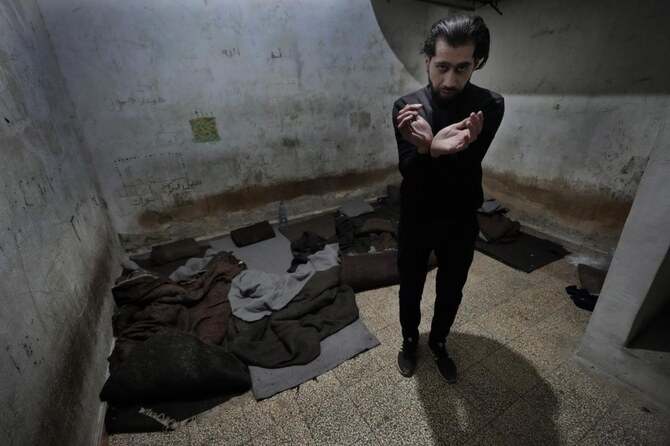
Days after Assad’s fall, Zahra – now 33 — came to visit Branch 215, a detention facility run by military intelligence in Damascus where he was held for two months. In an underground dungeon, he stepped into the windowless, 4-by-4-meter (yard) cell where he says he was held with 100 other inmates.
Each man was allowed a floor tile to squat on, Zahra said. When ventilators weren’t running — either intentionally or because of a power failure — some suffocated. Men went mad; torture wounds festered. When a cellmate died, they stowed his body next to the cell’s toilet until jailers came to collect corpses, Zahra said.
“Death was the least bad thing,” he said. “We reached a place where death was easier than staying here for one minute.”
Assad’s system of repression grew as civil war raged
Zahra was arrested along with his father after security agents killed one of his brothers, a well-known anti-Assad graffiti artist. After they were released, Zahra fled to opposition-held areas. Within a few months, security agents returned and dragged off 13 of his male relatives, including a younger brother and, again, his father.
They were brought to Branch 215. All were tortured and killed. Zahra later recognized their bodies among photos leaked by a defector that showed the corpses of thousands killed while in detention. Their bodies were never recovered, and how and when they died is unknown.
Rights groups estimate at least 150,000 people went missing after anti-government protests began in 2011, most vanishing into Assad’s prison network. Many of them were killed, either in mass executions or from torture and prison conditions. The exact number remains unknown.
Even before the uprising, Assad had ruled with an iron fist. But as peaceful protests turned into a full-fledged civil war that would last 14 years, Assad rapidly expanded his system of repression.
New detention facilities sprung up in security compounds, military airports and under buildings — all run by military, security and intelligence agencies.
Touring the site of his torture and detention, Zahra hoped to find some sign of his lost relatives. But there was nothing. At home, his aunt, Rajaa Zahra, saw the pictures of her killed children for the first time. She had refused to look at the leaked photos before. She lost three of her six sons in Branch 215 and a fourth was killed at a protest. Her brother, she said, had three sons, now he has only one.
“They were hoping to finish off all the young men of the country.”
Syrians were tortured with ‘the tire’ and ‘magic carpet’
The Assad regime’s tortures had names.
One was called the “magic carpet,” where a detainee was strapped to a hinged wooden plank that bends in half, folding his head to his feet, which are then beaten.
Abdul-Karim Hajjeko said he endured this five times. His torturers stomped on his back during interrogations at the Criminal Security branch, and his vertebrae are still broken.
“My screams would go to heaven. Once a doctor came down from the fourth floor (to the ground floor) because of my screams,” he said.
He was also put in “the tire.” His legs were bent inside a car tire as interrogators beat his back and feet with a plastic baton. When they were done, he said, a guard ordered him to kiss the tire and thank it for teaching him “how to behave.” Hajjeko was later taken to the notorious Saydnaya Prison, where he was held for six years.
Many prisoners said the tire was inflicted for rule violations — like making noise, raising one’s head in front of guards, or praying – or for no reason at all.
Mahmoud Abdulbaki, a non-commissioned air force officer who defected from service, was put in the tire during detention at a military police facility. They forced him to count the lashes — up to 200 — and if he made a mistake, the torturer would start over.
“People’s hearts stopped following a beating,” the 37-year-old said.
He was later held at Saydnaya, where he said guards would terrorize inmates by rolling a tire down the corridor lined with cells and beat on the bars with their batons. Wherever it stopped, the entire cell would be subjected to the tire.
Altogether, Abdulbaki spent nearly six years in prison over different periods. He was among those freed on the day Assad fled Syria.
Saleh Turki Yahia said a cellmate died nearly every day during the seven months in 2012 he was held at the Palestine Branch, a detention facility run by the General Intelligence Agency.
He recounted how one man bled in the cell for days after returning from a torture session where interrogators rammed a pipe into him. When the inmates tried to move him, “all his fluids poured out from his backside. The wound opened from the back, and he died,” he said.
Yahya said he was given electric shocks, hanged from his wrists, beaten on his feet. He lost half his body weight and nearly tore his own skin scratching from scabies.
“They broke us,” he said, breaking into tears. “Look at Syria, it is all old men ... A whole generation is destroyed.”
But with Assad gone, he was back visiting the Palestine Branch.
“I came to express myself. I want to tell.”
The mounting evidence will be used in trials
Torture continued up to the end of Assad’s rule.
Rasha Barakat, 34, said she and her sister were detained in March from their homes in Saqba, a town outside Damascus.
Inside a security branch, she was led past her husband, who had been arrested hours earlier and was being interrogated. He was kneeling on the floor, his face green, she said. It was her last brief glimpse of him: He died in custody.
During her own hours-long interrogation, she said, security agents threatened to bring in her sons, 5- and 7-years-old, if she didn’t confess. She was beaten. Female security agents stripped her and poured cold water on her, leaving her shivering naked for two hours. She spent eight days in isolation, hearing beatings nearby.
Eventually she was taken to Adra, Damascus’ central prison, tried and sentenced to five years for supporting rebel groups, charges she said were made up.
There she stayed until insurgents broke into Adra in December and told her she was free. An estimated 30,000 prisoners were released as fighters opened up prisons during their march to Damascus.
Barakat said she is happy to see her kids again. But “I am destroyed psychologically … Something is missing. It is hard to keep going.”
Now comes the monumental task of accounting for the missing and compiling evidence that could one day be used to prosecute Assad’s officials, whether by Syrian or international courts.
Hundreds of thousands of documents remain scattered through the former detention facilities, many labeled classified, in storage rooms commonly underground. Some seen by the AP included transcripts of phone conversations, even between military officers; intelligence files on activists; and a list of hundreds of prisoners killed in detention.
Shadi Haroun, who spent 10 years imprisoned, has been charting Assad’s prison structure and documenting former detainees’ experiences from exile in Turkiye. After Assad’s fall, he rushed back to Syria and toured detention sites.
The documents, he said, show the bureaucracy behind the killings. “They know what they are doing, it is organized.”
Civil defense workers are tracking down mass graves where tens of thousands are believed to be buried. At least 10 have been identified around Damascus, mostly from residents’ reports, and five others elsewhere around the country. Authorities say they are not ready to open them.
A UN body known as the International Impartial and Independent Mechanism has offered to help Syria’s new interim administration in collecting, organizing and analyzing all the material. Since 2011, it has been compiling evidence and supporting investigations in over 200 criminal cases against figures in Assad’s government.
Robert Petit, director of the UN body, said the task is so enormous, no one entity can do it alone. The priority would be to identify the architects of the brutality.
Many want answers now.
Officials cannot just declare that the missing are presumed dead, said Wafaa Mustafa, a Syrian journalist, whose father was detained and killed 12 years ago.
“No one gets to tell the families what happened without evidence, without search, without work.”


![]()

Long silenced by fear, Syrians now speak about rampant torture under Assad
Short Url
https://arab.news/rqa6h
Long silenced by fear, Syrians now speak about rampant torture under Assad
- Activists and rights groups say the brutality was systematic and well-organized, growing to more than 100 detention facilities where torture, sexual violence and mass executions were rampant

Latest updates


© 2026 SAUDI RESEARCH & PUBLISHING COMPANY, All Rights Reserved And subject to Terms of Use Agreement.