

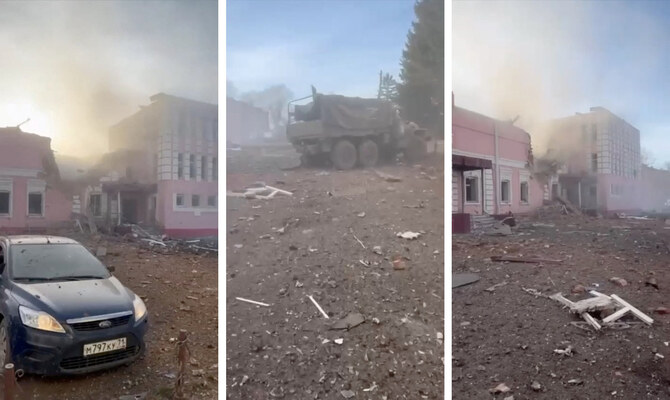

MOSCOW: Russia said Sunday that Ukraine had launched a “counterattack” in the western border region of Kursk, where Kyiv’s forces began a shock ground offensive last August.
It was not immediately clear how much Ukraine had advanced in the region, but pro-Kremlin military bloggers reported earlier that a powerful new offensive was under way.
The assault comes at a critical juncture in the nearly three-year conflict, with both sides seeking to strengthen their negotiating hand ahead of US President-elect Donald Trump’s return to the White House on January 20.
“At about 9 a.m. Moscow time (0600 GMT), in order to halt the advance of Russian troops in the Kursk direction, the enemy launched a counterattack,” the Russian defense ministry said.
The Ukrainian army did not comment on the operation, simply saying in its daily report that fighting was under way in the Kursk region without elaborating.
Ukraine used two tanks, a dozen armored vehicles and a demolition unit in the assault, which was directed toward the village of Berdin — about 15 kilometers (nine miles) northeast of Sudzha, Moscow said.
“The operation to destroy the Ukrainian army formations continues,” it added.
Pro-Kremlin military bloggers acknowledged the Russian army had come under pressure but said Moscow was fighting back.
“The main events of the next attempted offensive by the Ukrainian army are clearly still ahead of us,” influential pro-Russian Telegram channel Rybar said.
Images purportedly showing a column of Ukrainian armored vehicles driving through the snow were shared by pro-Russia military blogger Dva Mayora on Telegram.
Ukrainian officials gave little detail on the new offensive, with a prominent lawmaker urging silence.
“I can’t understand why it is necessary to officially report on the Kursk region. Maybe better to do it afterwards when the operation is over?” Ukrainian MP Oleksiy Goncharenko said.
Other officials expressed their glee at the operation, which comes almost three years since Moscow launched its full-scale military assault on Ukraine.
“Russia is getting what it deserves,” Ukrainian presidential chief of staff Andriy Yermak said.
The head of Ukraine’s Center for Countering Disinformation, Andriy Kovalenko, said on Telegram that defense forces were “working” in the area, without elaborating.
“In the Kursk region, the Russians are very worried because they were attacked from several directions, and it was a surprise for them,” he said.
Kyiv seized dozens of villages in the Kursk region shortly after its incursion started on August 6, 2024, but its advances stalled after Moscow rushed reinforcements to the area, including thousands of troops from its ally North Korea.
A Ukrainian army source told AFP last November that Kyiv still controlled 800 square kilometers (around 300 square miles) of the Russian border region, down from previous claims it controlled almost 1,400 square kilometers.
Ukrainian President Volodymyr Zelensky said last year the Kursk operation has boosted Kyiv’s “exchange fund” — its negotiating position on swapping prisoners of war — and diverted tens of thousands of Russian troops away from the eastern front.
He said Saturday evening that “up to a battalion of North Korean infantry soldiers and Russian airborne troops” had been lost in battles in the Kursk region on that day and the day before.
And in an interview with US podcaster Lex Fridman released Sunday, he underlined the key role Trump would play.
“Trump and I will come to an agreement and... offer strong security guarantees, together with Europe, and then we can talk to the Russians,” Zelensky said, according to the published translation of the interview held in Kyiv over the New Year.
“We and Trump come first, and Europe will support Ukraine’s position,” he added. Trump, he said, “has enough power to pressure him, to pressure Putin.”
But Kyiv has so far been unable to halt Moscow’s advances in Ukraine, which were seven times higher in 2024 than the year prior, according to an AFP analysis of data from the Institute for the Study of War.
Both Russia and Ukraine have exchanged regular attacks since the year began.
Russia said Sunday it had downed dozens of Ukrainian drones overnight in a barrage that damaged homes and triggered air alerts, while Kyiv said Moscow fired 103 drones into its territory.
Four Russian airports briefly suspended traffic early Sunday for “safety” reasons, a spokesperson for Russia’s civil aviation authority Rosaviatsia said.
Elsewhere on the front line, Ukrainian authorities in the eastern Donetsk region reported Sunday that five people had been wounded in Russian shelling.


