
DAMASCUS: The European Union backs a peaceful, inclusive transition in Syria, top French and German diplomats said Friday as they visited Damascus to meet with new leader Ahmed Al-Sharaa.
French Foreign Minister Jean-Noel Barrot and his German counterpart Annalena Baerbock were in the Syrian capital for talks on behalf of the European Union, in the highest-level visit by major Western powers since Islamist-led forces toppled longtime ruler Bashar Assad last month.
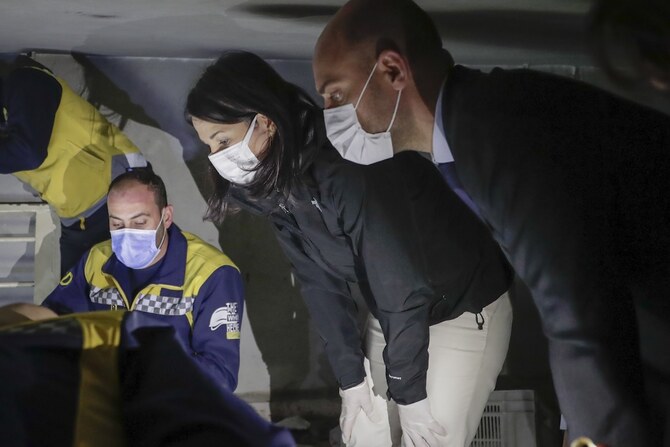
One of their first stops was the notorious Saydnaya prison, not far from the capital, AFP journalists said.

Syria’s new ruler Ahmad Al-Sharaa (R), welcomes France’s Foreign Minister Jean- Noel Barrot, center, and Germany's Foreign Minister Annalena Baerbock in Damascus on Jan. 3, 2025. (AFP)
Accompanied by White Helmet rescuers, Barrot and Baerbock toured the cells and underground dungeons of Saydnaya, the epitome of atrocities committed against Assad’s opponents.
Saydnaya was the site of extrajudicial executions, torture and forced disappearances. An advocacy group said more than 4,000 people were freed from the detention facility when rebel forces took Damascus on Dec. 8.
Sharaa, head of the Islamist group Hayat Tahrir Al-Sham (HTS), led the offensive that toppled Assad.
The HTS-dominated interim authorities now face the daunting task of rebuilding state institutions, with growing calls to ensure an inclusive transition and guarantee minority rights.
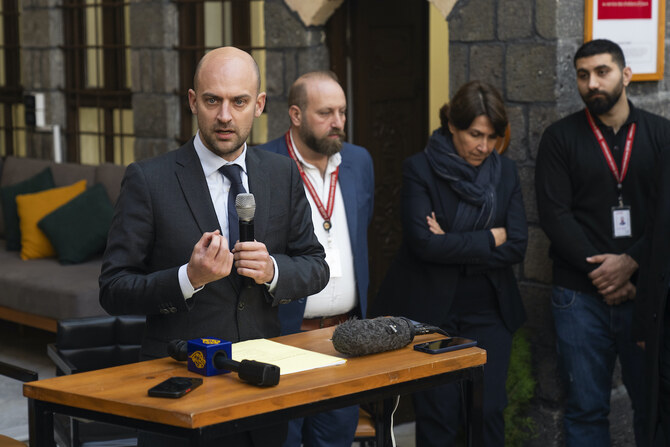
Barrot, in Damascus, expressed hope for a “sovereign, stable and peaceful” Syria.
Opinion
This section contains relevant reference points, placed in (Opinion field)
It was also a “hope that the aspirations of all Syrians can be realized,” he added, “but it is a fragile hope.”
In a statement, Baerbock said Germany wanted to help Syria become a “safe home” for all its people, and a “functioning state, with full control over its territory.”
She said the visit was a “clear signal” to Damascus of the possibility for a new relationship between Syria and Germany, and Europe more broadly.
Earlier, in a post in X, Barrot said: “Together, France and Germany stand alongside the Syrian people, in all their diversity.”
He added that the two European powers wanted to promote a “peaceful transition.”
Despite “skepticism” about HTS — which is rooted in the Syrian branch of Al-Qaeda and is designated a terrorist organization by numerous governments Baerbock said that “we must not miss the opportunity to support the Syrian people at this important crossroads.”
Berlin was ready to support “an inclusive and peaceful transfer of power” as well as social “reconciliation,” Baerbock said.
She also asked the new regime to avoid “acts of vengeance against groups within the population,” to avoid a long delay before elections, and to avert any attempts at the “Islamization” of the judicial and education systems.
Since Assad’s ousting, a bevy of foreign envoys have traveled to Damascus to meet with the country’s new leaders.
France and Germany had both already sent lower-level delegations last month.
At the start of his visit, Barrot met with representatives of Syria’s Christian communities.
Diplomatic sources said Barrot told the Christian leaders that France was committed to a pluralistic Syria with equal rights for all, including minority groups.
Syria’s civil war — which started in 2011, sparked by the Assad government’s brutal repression of democracy protests — saw Germany, France and a host of other countries shutter their diplomatic missions in Damascus.
The conflict killed more than 500,000 people, displaced millions and left Syria fragmented and ravaged.
The new authorities have called for the lifting of sanctions imposed on Syria under Assad to allow for reconstruction.
Paris is due to host an international summit on Syria later this month, following a similar meeting in December in Jordan.