

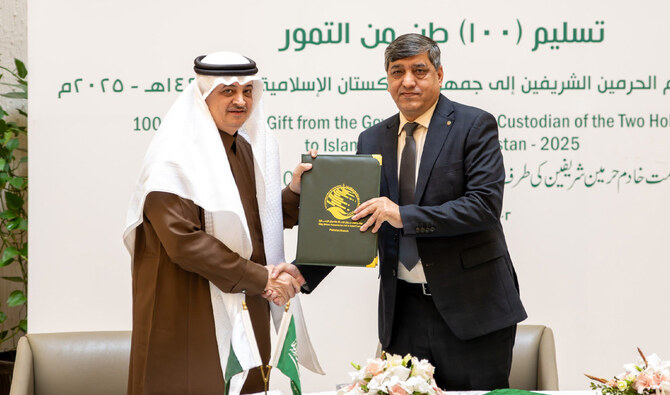
Saudi Arabia gifts Pakistan 100 tons of dates as part of efforts to enhance humanitarian outreach

This handout photograph, released by the Embassy of Saudi Arabia in Pakistan on December 2, 2024, shows Ambassador Nawaf bin Said Al-Malki formally handing over dates to Director General Military Wing, Cabinet Division of Pakistan, Brig. Alamgeer Ayub (right), during a ceremony held in Islamabad. (@ksaembassypk/X)
Short Url
Updated 03 January 2025
Follow

Saudi Arabia gifts Pakistan 100 tons of dates as part of efforts to enhance humanitarian outreach

  • The consignment was presented by Saudi Arabia’s ambassador Nawaf bin Said Al-Malki, KSrelief director Abdullah Al-Baqami
  • ‘The noble act not only strengthens our ties but also reflects profound relationship our nations cherish,’ Pakistani official says

ISLAMABAD: The Kingdom of Saudi Arabia has gifted 100 tons of dates to Pakistan, Pakistani state media reported on Thursday, reinforcing the strong bond between the two nations.
Pakistan and Saudi Arabia enjoy strong trade, defense and brotherly relations. The Kingdom is home to over 2.7 million Pakistani expatriates, serving as the top destination for remittances for the cash-strapped South Asian country.
The annual donation of dates is part of Saudi Arabia’s efforts to enhance its humanitarian outreach and foster bilateral relations with Pakistan, the Associated Press of Pakistan (APP) news agency reported.

The consignment of dates was presented to Director-General Military Wing of Pakistan’s Cabinet Division, Brig. Alamgeer Ayub, by Saudi Ambassador Nawaf bin Said Al-Malki and King Salman Humanitarian Aid & Relief Center (KSrelief) Director Abdullah Al-Baqami in Islamabad.
“The gift exemplifies the enduring bonds of friendship and brotherhood between the two countries, rooted in shared values of generosity and mutual support,” the report read.
It said the Saudi government reaffirmed its commitment to supporting the Pakistani people through this heartfelt gesture.
On the occasion, Brig. Ayub expressed his gratitude to the Kingdom for its “unwavering generosity and consistent support” for Pakistan.
“This noble act of solidarity not only strengthens our ties but also reflects the profound relationship our nations cherish,” he was quoted as saying.
Saudi Arabia’s KSrelief has implemented more than 200 projects, including emergency relief for natural disasters and initiatives to address food security, health care and education, in Pakistan worth millions of dollars to improve the lives of vulnerable communities.


Pakistan-origin fintech holds workforce pay workshop in Saudi Arabia

Updated 6 sec ago
Follow

Pakistan-origin fintech holds workforce pay workshop in Saudi Arabia

  • Riyadh event promotes earned wage access to support employee liquidity
  • Abhi Saudi says flexible pay models can boost retention and productivity

KARACHI: Pakistan-origin fintech Abhi Saudi hosted a workforce-focused workshop in Riyadh, the company said in a statement on Thursday, bringing together senior business leaders to discuss employee financial well-being and flexible pay solutions as Saudi Arabia advances reforms under Vision 2030.

Abhi, a financial technology firm founded in Pakistan and operating in the Gulf through Alraedah Digital Solutions, provides earned wage access (EWA) and small and medium enterprise (SME) financing solutions.

EWA allows employees to withdraw a portion of their already-earned salary before the official payday, helping them manage short-term liquidity needs without relying on traditional credit.

Abhi partners with thousands of firms across the region, offering payroll-linked financial services to employers and their staff.

“The event focused on modern workforce strategies and flexible pay solutions, highlighting how financial well-being initiatives such as Earned Wage Access (EWA) are supporting improved employee engagement, retention, and productivity while aligning with the objectives of Saudi Vision 2030,” the company said.

The “Wages Well-being Workshop” brought together professionals from sectors including telecommunications, banking, consulting and human resources to examine how changing workforce expectations are influencing compensation models and employer responsibilities amid the Kingdom’s broader economic transformation.

According to Abhi, discussions centered on the organizational impact of rigid salary structures, the link between financial stress and workplace performance and how flexible pay models could enhance financial stability without adding operational costs for employers.

Saudi Arabia’s Vision 2030 reform agenda seeks to diversify the economy, strengthen private-sector participation and modernize labor market practices, with financial inclusion and workforce productivity forming key pillars of the strategy.