

Blowback online to Jewish Chronicle article claiming Palestinian solidarity is antisemitic

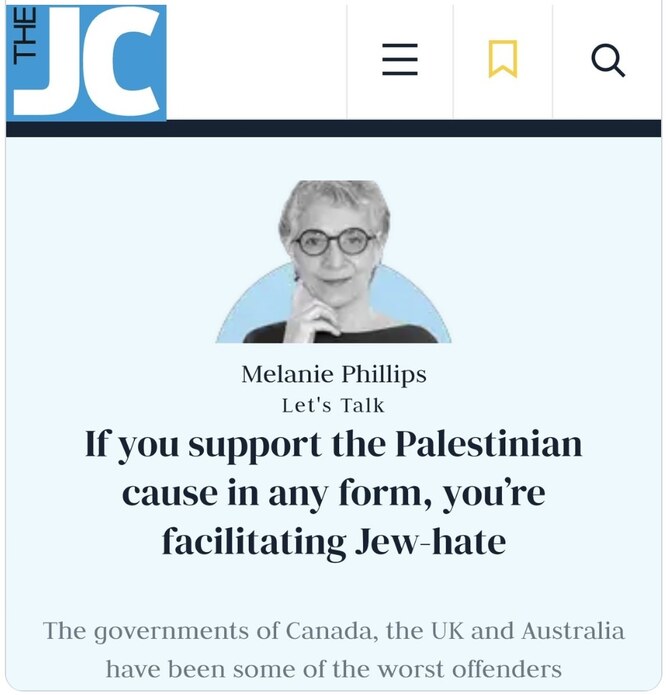
A screenshot of Melanie Phillips’ column in question before the headline was edited. (X: @miqdaad)
Short Url
Updated 02 January 2025
Follow

Blowback online to Jewish Chronicle article claiming Palestinian solidarity is antisemitic

  • Newspaper faces criticism after writer Melanie Phillips suggests advocating for Palestinian rights fosters ‘deranged and murderous Jew-hatred’
  • One social media user wrote: ‘Your exploitation of antisemitism is seriously disturbing. But why would Zionists care that they endanger Jews by merging their identity with Israel?’

LONDON: British newspaper The Jewish Chronicle is facing intense criticism over an article in which the writer equated support for the Palestinian cause with antisemitism.

The piece was written by British commentator Melanie Phillips and published on Tuesday with the headline “If you support the Palestinian cause in any form, you’re facilitating Jew-hate.” It was subsequently edited and the headline changed to “The Truth of the Palestinian cause,” without any editorial note of the changes.

In her article, Phillips suggested that advocating for Palestinian rights fosters “deranged and murderous Jew-hatred.”

She wrote: “Jew-hatred has not only been normalized. It’s been rebranded as social justice because support for Palestinianism, which seeks to write the Jews out of their country, their history and the world, is what now passes for a moral sense among swathes of the public, the entire intelligentsia and even — heaven help us — many Jews.”

Phillips continues: “Let’s not hear any protests that you were once a member of Habonim or have a holiday home in Herzliya … If you support the Palestinian Arab cause today, you are facilitating deranged and murderous Jew-hatred. Own it.”

The article was widely condemned on social media.

The user Torah Jews wrote in a message posted on X: “Your exploitation of antisemitism is seriously disturbing. But why would Zionists care that they endanger Jews by merging their identity with Israel?”

Miqdaad Versi, a spokesperson for the Muslim Council of Britain, wrote that even after the “secret” edits to the article, Phillips’ words “remain disgusting.” He added: “Always good to see the cranks at The Jewish Chronicle show their true colours.”

Some critics accused the newspaper of promoting “Israeli propaganda.” Others warned that such rhetoric undermines efforts to combat true antisemitism by conflating it with solidarity for the Palestinian people.

Political commentator Owen Jones said: “Melanie Phillips is explicitly stating what Israel’s cheerleaders have long been pushing for. They want to redefine antisemitism as ‘any form of solidarity with Palestinians,’ rather than the very dangerous hatred of Jewish people that it is.”

This is not the first time the writer and the newspaper have caused controversy. Phillips has long argued that solidarity with Palestinians should be considered antisemitic, and she has denied the existence of Islamophobia.

In September, The Jewish Chronicle was criticized after it emerged that one of its writers had fabricated details in several high-profile stories. The revelations prompted a mass exodus of staff, with departing employees complaining of poor editorial standards under the present management.


Trending: BBC report suggests sexual abuse and torture in UAE-run Yemeni prisons

Updated 02 February 2026
Follow

Trending: BBC report suggests sexual abuse and torture in UAE-run Yemeni prisons

  • The investigation was produced by British-Yemeni BBC journalist Nawal Al-Maghafi

LONDON: A recent BBC video report diving into what it says was UAE-run prison in Yemen has drawn widespread attention online and raised fresh questions about the role of the emirates in the war-torn country.

The report, published earlier this month and recently subtitled in Arabic and shared on social media, alleged that the prison — located inside a former UAE military base — was used to detain and torture detainees during interrogations, including using sexual abuse as a method.

The investigation was produced by British-Yemeni BBC journalist Nawal Al-Maghafi, who toured the site, looking into cells and what appear to be interrogation rooms.

Al-Maghafi said the Yemeni government invited the BBC team to document the facilities for the first time.

A former detainee, speaking anonymously, described severe abuse by UAE soldiers: “When we were interrogated, it was the worst. They even sexually abused us and say they will bring in the doctor. The ‘so-called’ doctor was an Emirati soldier. He beat us and ordered the soldiers to beat us too. I tried to kill myself multiple times to make it end.”

Yemeni information minister, Moammar al Eryani also appears in the report, clarifying that his government was unable to verify what occurred within sites that were under Emirati control.

“We weren’t able to access locations that were under UAE control until now,” he said, adding that “When we liberated it (Southern Yemen), we discovered these prisons, even though we were told by many victims that these prisons exist, but we didn't believe it was true.”

The BBC says it approached the UAE government for comment, however Abu Dhabi did not respond to its inquiries.

Allegations of secret detention sites in southern Yemen are not new. The BBC report echoes earlier reporting by the Associated Press (AP), which cited hundreds of men detained during counterterrorism operations that disappeared into a network of secret prisons where abuse was routine and torture severe.

In a 2017 investigation, the AP documented at least 18 alleged clandestine detention sites — inside military bases, ports, an airport, private villas and even a nightclub — either run by the UAE or Yemeni forces trained and backed by Abu Dhabi.

The report cited accounts from former detainees, relatives, civil rights lawyers and Yemeni military officials.

Following the investigation, Yemen’s then-interior minister called on the UAE to shut down the facilities or hand them over, and said that detainees were freed in the weeks following the allegations.

The renewed attention comes amid online speculation about strains between Saudi Arabia and the UAE over Yemen.