BAKU: Azerbaijan said on Monday that Moscow had promised to punish those responsible for the downing of an Azerbaijan Airlines plane that Baku says was shot at by Russian air defenses.
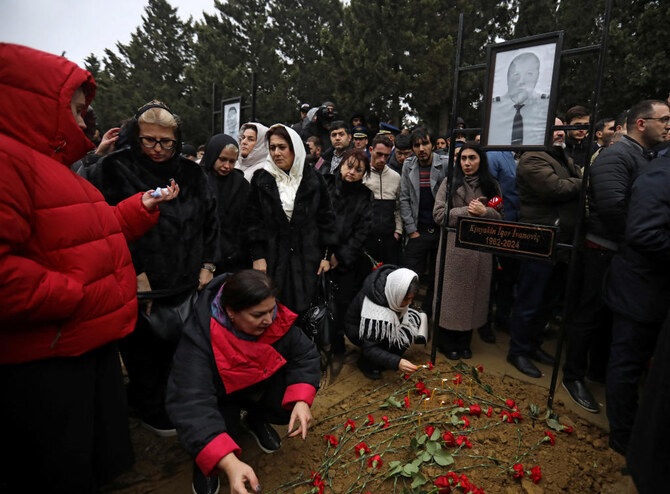
The AZAL Embraer 190 jet crash-landed in Kazakhstan on December 25, killing 38 of the 67 people on board.
Azerbaijani President Ilham Aliyev has demanded that Moscow accept responsibility for mistakenly firing on the plane as it tried to make a scheduled landing at Grozny airport in south Russia.
Russia has not confirmed that one of its air-defense missiles hit the plane, though President Vladimir Putin told Aliyev in a phone call over the weekend that the systems were active at the time and that he was sorry the incident took place in Russian airspace.
Azerbaijan’s prosecutor general reported on Monday that the head of Russia’s Investigative Committee had told Baku: “Intensive measures are being carried out to identify the guilty people and bring them to criminal responsibility.”
Russia has opened a criminal enquiry into the incident.
But it has not said whether it agrees that the plane was hit by one of its air-defense missiles and has not itself said anything about finding or bringing any perpetrators to justice.
Aliyev had issued a rare forthright condemnation of Moscow — a close partner of Baku — on Sunday.
He said the plane was “hit by accident” but was angry that Russia had apparently tried to hide the cause of the crash.
Demanding that Putin admit responsibility, Aliyev also accused Russia of putting forward alternative theories that “clearly showed the Russian side wanted to cover up the issue.”
Russia said Grozny, in the southern Russian region of Chechnya, was being attacked by Ukrainian drones when the AZAL airliner approached to make its landing through thick fog.
Survivors have described hearing explosions outside the plane, which then diverted more than 400 kilometers (250 miles) across the Caspian Sea toward the Kazakh city of Aktau, where it crash-landed.
Kazakhstan said on Monday it had sent the plane’s black boxes to Brazil, where they will be analyzed by the Aeronautical Accidents Investigation and Prevention Center, a unit of the Brazilian air force.

Azerbaijan says Russia pledged to punish those responsible for plane crash
https://arab.news/vgk63
Azerbaijan says Russia pledged to punish those responsible for plane crash
- Aliyev had issued a rare forthright condemnation of Moscow — a close partner of Baku — on Sunday
- He said the plane was “hit by accident” but was angry that Russia had apparently tried to hide the cause of the crash
Only 4% women on ballot as Bangladesh prepares for post-Hasina vote
- Women PMs have ruled Bangladesh for over half of its independent history
- For 2026 vote, only 20 out of 51 political parties nominated female candidates
DHAKA: As Bangladesh prepares for the first election since the ouster of its long-serving ex-prime minister Sheikh Hasina, only 4 percent of the registered candidates are women, as more than half of the political parties did not field female candidates.
The vote on Feb. 12 will bring in new leadership after an 18-month rule of the caretaker administration that took control following the student-led uprising that ended 15 years in power of Hasina’s Awami League party.
Nearly 128 million Bangladeshis will head to the polls, but while more than 62 million of them are women, the percentage of female candidates in the race is incomparably lower, despite last year’s consensus reached by political parties to have at least 5 percent women on their lists.
According to the Election Commission, among 1,981 candidates only 81 are women, in a country that in its 54 years of independence had for 32 years been led by women prime ministers — Hasina and her late rival Khaleda Zia.
According to Dr. Rasheda Rawnak Khan from the Department of Anthropology at Dhaka University, women’s political participation was neither reflected by the rule of Hasina nor Zia.
“Bangladesh has had women rulers, not women’s rule,” Khan told Arab News. “The structure of party politics in Bangladesh is deeply patriarchal.”
Only 20 out of 51 political parties nominated female candidates for the 2026 vote. Percentage-wise, the Bangladesh Socialist Party was leading with nine women, or 34 percent of its candidates.
The election’s main contender, the Bangladesh Nationalist Party, whose former leader Zia in 1991 became the second woman prime minister of a predominantly Muslim nation — after Pakistan’s Benazir Bhutto — was the party that last year put forward the 5 percent quota for women.
For the upcoming vote, however, it ended up nominating only 10 women, or 3.5 percent of its 288 candidates.
The second-largest party, Jamaat-e-Islami, has not nominated a single woman.
The 4 percent participation is lower than in the previous election in 2024, when it was slightly above 5 percent, but there was no decreasing trend. In 2019, the rate was 5.9 percent, and 4 percent in 2014.
“We have not seen any independent women’s political movement or institutional activities earlier, from where women could now participate in the election independently,” Khan said.
“Real political participation is different and difficult as well in this patriarchal society, where we need to establish internal party democracy, protection from political violence, ensure direct election, and cultural shifts around female leadership.”
While the 2024 student-led uprising featured a prominent presence of women activists, Election Commission data shows that this has not translated into their political participation, with very few women contesting the upcoming polls.
“In the student movement, women were recruited because they were useful, presentable for rallies and protests both on campus and in the field of political legitimacy. Women were kept at the forefront for exhibiting some sort of ‘inclusive’ images to the media and the people,” Khan said.
“To become a candidate in the general election, one needs to have a powerful mentor, money, muscle power, control over party people, activists, and locals. Within the male-dominated networks, it’s very difficult for women to get all these things.”


