Rock art in Saudi Arabia’s Harrat is testament to ancient life, cultural exchange
Archaeological surveys conducted by the Heritage Commission have revealed a wealth of rock art and inscriptions dating back to various periods, including Thamudic, Nabataean, Lihyanite, and Islamic
Updated 29 December 2024
Arab News
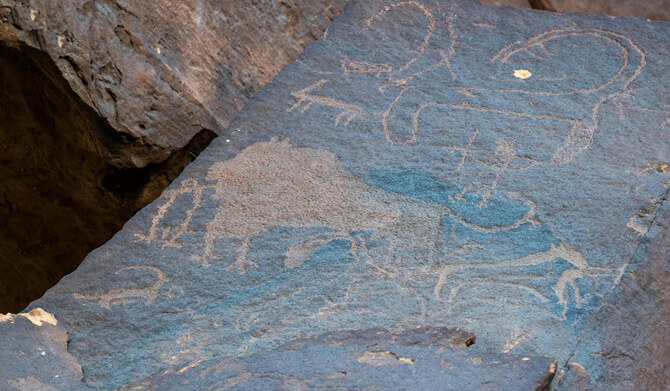
RIYADH: The Harrat region, south of Tabuk, is a treasure trove of ancient history, boasting a remarkable collection of rock art that provides a fascinating glimpse into past civilizations, according to the Saudi Press Agency report.
The rugged volcanic landscape served as a canvas for ancient inhabitants, who expressed their beliefs, experiences, and social interactions through intricate engravings and paintings.
Ancient carvings near Tabuk depict scenes of hunting and daily life, offering a rare glimpse into the lives of the region’s early inhabitants. (SPA)
Depictions of hunting scenes, made using simple tools, offer a window into the daily lives of the early inhabitants of these areas, the SPA report noted.
Rock art also provides a record of the fauna that once lived in the region, including oryx, gazelles, and even tigers.
FASTFACT
Dual-script inscriptions from the 5th century, discovered in Alqan village, highlight the evolution of language and the enduring artistic spirit of the Tabuk area.
Moreover, numerous engravings feature symbolic and abstract motifs, likely carrying religious or cultural significance and reflecting the tribal identities of the area’s ancient societies.
Ancient carvings near Tabuk depict scenes of hunting and daily life, offering a rare glimpse into the lives of the region’s early inhabitants. (SPA)
These rock art sites underscore the historical significance of the Tabuk region as a crossroads for trade and cultural exchange.
Located at the intersection of ancient trade routes, Tabuk served as a vital link between the Arabian Peninsula and neighboring civilizations, including those of ancient Egypt, the Levant, Mesopotamia, the Mediterranean, and Asia.
Archaeological surveys conducted by the Heritage Commission have revealed a wealth of rock art and inscriptions dating back to various periods, including Thamudic, Nabataean, Lihyanite, and Islamic.
A recent discovery in the village of Alqan — “dual-line” inscriptions dating back to the fifth century — has provided valuable new insights.
These inscriptions, featuring both Thamudic and early Arabic scripts, offer compelling evidence of the continuity of writing traditions in the region and the ongoing evolution of language.
Balad Beast brings global beats to historic streets
‘MDLBEAST put us on the international map,’ say Saudi electronic duo Dish Dash
Updated 31 January 2026
Afshan Aziz
JEDDAH: The music festival Balad Beast concluded its fourth edition this weekend, having transformed Jeddah’s UNESCO World Heritage district of Al-Balad into an open-air celebration of music, culture and creativity that attracted thousands of music lovers over two nights.
The festival, organized by Saudi music platform MDLBEAST, featured more than 70 local, regional and international artists across four stages, offering audiences a diverse journey through electronic, hip-hop and global sounds.
French Haitian singer-songwriter Naïka performed on the second night of Balad Beast. (Supplied)
Speaking to Arab News, MDLBEAST chief creative officer Ahmad Al-Ammary, also known as DJ Baloo, described Balad Beast as a “cultural takeover” adding that finding the right spaces for dance floors was a challenge, “but Balad is constantly evolving and we work with that change.”
Addressing the challenges of working in a heritage area, he said: “Balad is sensitive and condensed, so logistics can be complex. In our first year, heavy rain flooded one of the planned squares and we had to relocate the Souq Stage to a much smaller space, but it worked and it has remained there ever since.
HIGHLIGHT
Reggae superstar Shaggy noted that the reality of playing live in Saudi Arabia often surprises those who arrive with preconceptions.
“Yes, the alleys are narrow and the district is old, but they’re full of ideas, patterns, colors and visuals. Everything flows here,” he continued. “As a festival, it’s hard to define Balad, because it gives so much of itself creatively. It’s incredibly generous with its ideas and details, and inspiration comes from everywhere.”
Balad Beast featured more than 70 local, regional and international artists across four stages, offering audiences a diverse journey through electronic, hip-hop and global sounds. (Supplied)
Balad Beast featured performances from international artists including US rapper Playboi Carti, making his first appearance in Saudi Arabia; US rapper Destroy Lonely; Swedish DJ and producer Alesso; and Bosnian-German DJ Solomun on the opening night. The following night saw French-Haitian singer-songwriter Naïka, reggae superstar Shaggy, Dutch DJ Franky Rizardo, British DJ Pawsa, and US rapper Tyga, and more take the stage, while Saudi and regional artists including Cosmicat, TUL8TE, Zeina, Vinyl Mode, Moayed, Dish Dash, Musab, Varoo and HiFi appeared across the festival, offering audiences a mix of global and local talent.
Saudi electronic duo Dish Dash reflected on the festival organizer’s impact for local artists.
As a festival, it’s hard to define Balad, because it gives so much of itself creatively. It’s incredibly generous with its ideas and details, and inspiration comes from everywhere.
Ahmad Al-Ammary, MDLBEAST chief creative officer
“MDLBEAST put us on the international map,” the brothers told Arab News. “It helped us get recognized by festivals, promoters and event organizers abroad. When we travel, people don’t expect this level of talent coming from Saudi Arabia, especially considering we didn’t have this scene before.”
Shaggy, who performed a hit-filled set during the festival, told Arab News: “I’ve been blessed with some incredible songs, and I see music as a gift and a tool for service. When I go on stage, I’m there to entertain people, to make them smile and feel good, but that service also supports many livelihoods from the people working at this festival to those who work with me. These songs have become part of people’s lives, and I don’t take that lightly.”
Balad Beast featured more than 70 local, regional and international artists across four stages, offering audiences a diverse journey through electronic, hip-hop and global sounds. (Supplied)
Shaggy also noted that the reality of playing live in Saudi Arabia often surprises those who arrive with preconceptions.
“I’ve performed in Saudi Arabia more than once, and while there are certain rules that are different, it’s not an issue for me. My focus is always on delivering the hits and giving the audience a great time,” he said.
“There’s a big misconception. People have more freedom than (outsiders) think. Everyone has been extremely nice.”
Asked what advice he would offer to aspiring artists, Shaggy said: “Understand that what you’re given is a gift and a form of service. Stay humble, do the work, and remember why you’re doing it.”
As Al-Ammary noted, there are many such aspiring artists now making a name for themselves in the Kingdom.
“Talent is emerging everywhere, at different levels,” he said. “The scene is still in a mysterious and surprising phase. There’s a rawness to it.”