

Pakistan province says warring tribes in violence-hit Kurram district have reached consensus

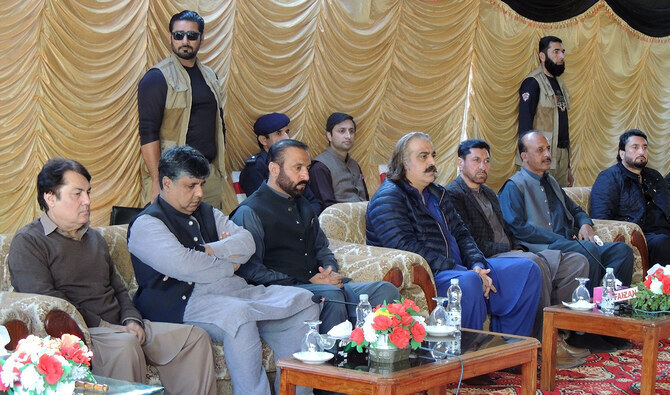
Khyber Pakhtunkhwa Chief Minister Ali Amin Gandapur (center, seated) attends a grand jirga in Kohat, Pakistan, on November 30, 2024, to discuss the security situation in Kurram district. (Photo courtesy: Chief Minister’s Office/File)
Short Url
Updated 29 December 2024
Follow

Pakistan province says warring tribes in violence-hit Kurram district have reached consensus

  • Rival factions in Kurram district expected to formally sign agreement on Tuesday, says KP official
  • At least 136 have been killed in sectarian and tribal clashes in Kurram district since November

PESHAWAR: The warring tribes in violence-hit northwestern Kurram district have reached a consensus on all contentious points but a formal agreement between them will be signed in the next two days, an official of Pakistan’s Khyber Pakhtunkhwa (KP) province confirmed on Sunday. 

Kurram, a northwestern district of around 600,000 people in KP, has long been a hotspot for tribal and sectarian violence, with authorities struggling to maintain control.

The area’s situation has necessitated travel in convoys escorted by security personnel, yet it failed to prevent an attack on Nov. 21, when gunmen ambushed a convoy, killing 52 people. The attack sparked further violence and road closures, restricting access to medicine, food and fuel in the region as casualties surged to 136.

A grand jirga, or council of political and tribal elders formed by the provincial government, has been attempting to mediate between the rival Sunni and Shia factions this month as protests in Parachinar, the main city in Kurram, have also spread to the southern port city of Karachi. 

“Efforts to settle the century-old Kurram dispute are going ahead as members of the jirga have reached a consensus,” Muhammad Ali Saif, the KP government’s spokesperson, said in a statement.

“The Ahle Sunnat side has requested a two-day break to hold their internal discussions,” he said, adding that the jirga will reconvene on Tuesday. 

Saif said both warring factions were showing progress in heading toward lasting peace and reaching a settlement to their dispute. 

Last week, Saif said authorities had decided to dismantle private bunkers, observation posts used in the fighting by both sides, and given a deadline of Feb. 1 for tribesmen in Kurram to hand over heavy weapons. 

Local tribesmen have so far reportedly refused to surrender their weapons, citing concerns about their safety.

Munir Bangash, a Sunni tribal elder and a member of the jirga, confirmed to Arab News that his faction had sought two days to hold consultations before signing the agreement. 

“There are no hurdles left in signing the peace agreement but we sought to days’ time to consult all and sundry of our tribe,” Bangash said. “I’m sure there is no hurdle. Everything will be okay after two days.”

Professor Jamil Kazmi, a member of the jirga representing the Shia faction, however, did not seem optimistic about the jirga brokering a permanent solution to the Kurram dispute. 

He said certain elements had their “personal vested interests,” without elaborating what those interests were or identifying those elements. 

“Yes, an agreement has been reached which will be signed by both parties but I fear the issue can’t be settled on a permanent basis because some elements always sabotage peace efforts,” Kazmi told Arab News. 

While the talks continue, the KP government has launched a helicopter service to evacuate people and transport aid and medicines to Kurran as a major highway connecting the district’s main city of Parachinar to the provincial capital of Peshawar has been blocked since last month, triggering a humanitarian crisis with reports of starvation, lack of medicine and oxygen shortages.

In a meeting on Monday, the KP cabinet decided to establish a special police force to secure the Peshawar-Parachinar road, for which 399 people would be recruited.

Shia Muslims dominate parts of Kurram, although they are a minority in the rest of the country. Militant groups like the Pakistani Taliban and Daesh have previously targeted the minority group in the district.


Pakistan vaccinates over 43 million children as last polio drive of 2025 enters 6th day

Updated 8 sec ago
Follow

Pakistan vaccinates over 43 million children as last polio drive of 2025 enters 6th day

  • Campaign running simultaneously in Pakistan and Afghanistan, last two polio-endemic countries
  • Health authorities urge parents and communities to fully cooperate with anti-polio vaccinators

ISLAMABAD: Pakistan has vaccinated more than 43.8 million children in five days of its last nationwide polio campaign of 2025, health authorities said on Saturday, as the drive entered its sixth day amid renewed efforts to curb the virus.

The campaign, running from Dec. 15 to 21, targets children under the age of five and is being conducted simultaneously in Pakistan and Afghanistan, according to Pakistan’s National Emergency Operations Center (NEOC) which oversees eradication efforts.

Pakistan and neighboring Afghanistan are the only two countries where wild poliovirus transmission has never been interrupted, keeping global eradication efforts at risk. The virus, which can cause irreversible paralysis, has no cure and can only be prevented through repeated oral vaccination.

“The last nationwide polio campaign of 2025 continues in full swing on the sixth day,” the NEOC said in a statement. “Over 43.8 million children have been vaccinated in five days so far.”

Provincial data released by the National EOC showed that around 22.7 million children had been vaccinated in Punjab province, more than 10.2 million in Sindh, approximately 6.9 million in Khyber Pakhtunkhwa and about 2.5 million in Balochistan. In Islamabad, over 450,000 children received polio drops, while more than 274,000 were vaccinated in Gilgit-Baltistan and over 714,000 in Azad Jammu and Kashmir.

“The polio campaign is being conducted simultaneously in Pakistan and Afghanistan,” the NEOC said. “More than 400,000 polio workers are going door to door across the country to administer vaccines.”

Pakistan has logged 30 polio cases so far in 2025, underscoring the fragility of progress against the virus. The country recorded 74 cases in 2024, a sharp rise from six cases in 2023, reflecting setbacks caused by vaccine hesitancy, misinformation and access challenges in high-risk areas.

Health officials say insecurity remains a major obstacle. Polio workers and their security escorts have repeatedly been targeted in militant attacks, particularly in parts of northwestern Khyber Pakhtunkhwa and southwestern Balochistan, complicating efforts to reach every child. Natural disasters, including flooding, have further disrupted vaccination campaigns in recent years.

“Parents and communities are urged to fully cooperate with polio workers,” the NEOC said, stressing that every child under the age of five must be given polio drops.

Pakistan has dramatically reduced polio prevalence since the 1990s, when annual cases exceeded 20,000. Health authorities, however, warn that without sustained access to children in underserved and conflict-affected areas, eradication will remain out of reach.