ISLAMABAD: Short-term inflation, measured by the Sensitive Price Index (SPI), has risen to 5.08 percent in Pakistan on a year-on-year basis, the country’s statistics bureau said this week, with an increase observed in prices of edible items.
The SPI, which comprises 51 essential items collected from 50 markets in 17 cities, is computed on a weekly basis to assess the price movement of essential commodities at shorter interval of time so as to review the price situation in the country.
The SPI for the week ending on Dec. 26 increased by 0.80 percent as compared to the previous week, according to the Pakistan Bureau of Statistics (PBS). This is the third time short-term has increased in the South Asian country. Weekly inflation last decreased by 0.34 percent in Pakistan in the week ending on Dec. 5.
“During the week, out of 51 items, prices of 17 (33.33 percent) items increased, 10 (19.61 percent) items decreased and 24 (47.06 percent) items remained stable,” it said in a report.
Major increase was observed in prices of chicken (22.47 percent), tomatoes (20.75 percent), sugar (2.19 percent), vegetable ghee 1 kilogram (1.17 percent), firewood (0.95 percent), cooking oil 5 liter (0.74 percent), cooked beef and mustard oil (0.69 percent) each, liquefied petroleum gas (0.18 percent) and washing soap (0.09 percent).
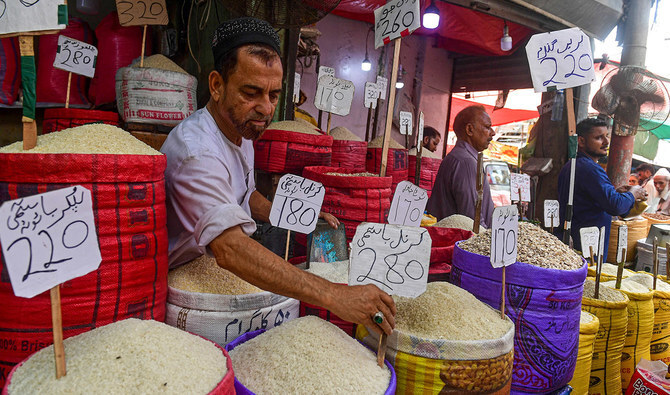
The items that recorded a decrease in prices included onions (8.13 percent), potatoes (2.38 percent), bananas (0.68 percent), rice (0.50 percent) and eggs (0.30 percent).
Pakistan’s annual consumer inflation slowed to 4.9 percent in November, lower than the government’s forecast, according to the PBS. The finance ministry had projected inflation would slow to 5.8 percent-6.8 percent in November and ease to 5.6 percent-6.5 percent in December.
Consumer inflation cooled from 7.2 percent in October, a sharp drop from a multi-decade high of nearly 40 percent in May 2023.

Pakistan weekly inflation increases for third week in a row
https://arab.news/nrpuc
Pakistan weekly inflation increases for third week in a row
- Pakistan’s annual consumer inflation slowed to 4.9 percent in November, lower than the government’s forecast
- Major increase observed in prices of chicken, tomatoes, sugar, vegetable ghee, liquefied petroleum gas and soap
Pakistan says CPEC has helped bridge cultural and language barriers with China
- Ataullah Tarar suggests Pakistan-China digital platform to counter ‘disinformation’ around CPEC
- People-to-people ties have remained limited between the two states despite strong official relations
ISLAMABAD: Federal Minister for Information and Broadcasting Ataullah Tarar said on Wednesday the China-Pakistan Economic Corridor (CPEC) has brought about a “cultural change,” helping break barriers of language and bringing the two countries closer together.
Pakistan and China have longstanding strategic relations, though much of their interactions have traditionally occurred at the government-to-government level through diplomatic, strategic and economic engagements. People-to-people ties between them have mostly remained limited, though the Pakistani minister said there was a gradual shift in the trend in the wake of the multibillion-dollar economic, infrastructure development and regional connectivity initiative.
Launched in 2015, CPEC includes investments in energy, transport, and industrial zones, and has since become a cornerstone of bilateral ties and Pakistan’s long-term development strategy.
“CPEC in Pakistan has broken a lot of barriers. It has broken the barrier of language, and it has broken the barriers of division. It has brought harmony,” Tarar said while addressing a ceremony organized by the Pakistan-China Institute, a local think tank.
“This corridor brought about a cultural change where we had investments coming in, where we had infrastructure being built, where we had industry being built, where we had airports and seaports being developed.”
He said it was “heartening” to see cultural change in Pakistan, such as a Chinese citizen speaking fluent Urdu or a Pakistani citizen speaking Mandarin.
Tarar said the cultural shift had become part of Pakistan’s ethos as the two countries move forward, describing Chinese President Xi Jinping’s 2015 visit as a turning point in reviving the economy.
He also maintained CPEC was targeted by a disinformation campaign, suggesting a digital media platform between Pakistan and China to counter the problem.
“I would suggest that maybe the Pakistan-China Institute can come up with a digital media platform to call out fake news and to label fake news circulating around CPEC,” he said, adding the government would fully support the endeavor.
“I think that will go a long way in not only strengthening the media cooperation but also in getting rid of misinformation and stating the correct facts in a very timely manner,” he added.
Tarar said the initiative will help promote a positive narrative around CPEC 2.0, referring to the next phase of the initiative that aims to focus on industrial development in Pakistan.


