China says Pakistani astronaut to participate in short-term space missions

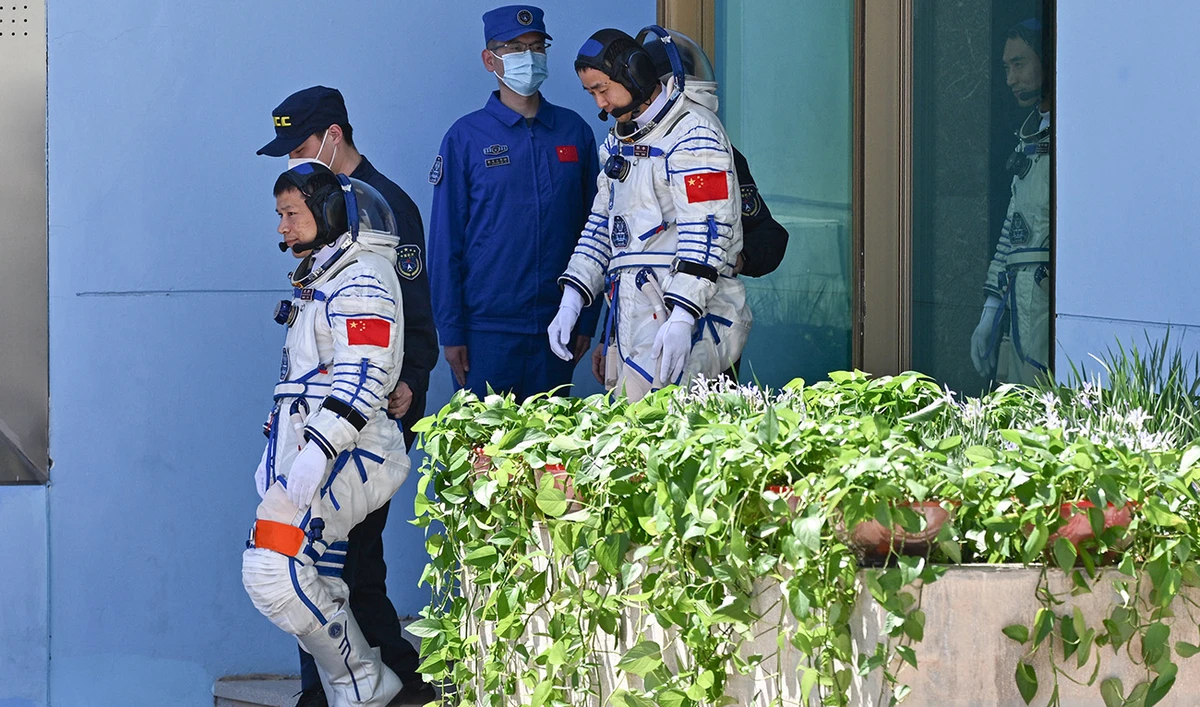
Astronauts for China's Shenzhou-20 space mission Wang Jie, Chen Dong, and Chen Zhongrui arrive to a departure ceremony before boarding a bus to take them to the Shenzhou-20 spaceship at the Jiuquan Satellite Launch Centre in the Gobi desert in northwest China on April 24, 2025. (AFP)
Short Url
Updated 30 October 2025
Follow

China says Pakistani astronaut to participate in short-term space missions

  • Astronaut will participate in crew’s routine work and conduct experiments on Pakistan’s behalf, says Chinese space agency 
  • Beijing, Islamabad have deepened space cooperation in recent years, with joint satellite development and a planned lunar mission

ISLAMABAD: A Pakistani astronaut will train at the Chinese space station and will be part of upcoming short-duration spaceflight missions as a payload specialist, the Chinese Manned Space Agency announced on Thursday. 

Pakistan’s national space agency signed a cooperation agreement with China in February this year, paving the way for the country’s first astronaut to embark on a mission to the Chinese space station, Tiangong. China said earlier this year it had begun the selection process for the Pakistani astronaut. 

“Two Pakistani astronauts will undergo training alongside Chinese astronauts, and one of them will be selected to participate in a short-duration spaceflight mission as a payload specialist,” China Manned Space Agency spokesperson Zhang Jingbo said at a press conference. 

Chinese publication Global Times reported the same. 

“China is currently selecting astronauts from Pakistan, with one expected to take part in a short-duration space mission at an appropriate time,” Global Times reported. 

Jingbo said the preliminary stage for the Pakistani astronaut’s selection is being carried out in Pakistan, while the secondary and final stages will be conducted in China. 

“During the mission, the [Pakistani] astronaut will not only participate in the crew’s routine work, but also conduct scientific experiments on behalf of Pakistan,” Jingbo added. 

Pakistan and China have deepened their space partnership in recent years, marked by joint satellite development and a planned lunar mission. In January, the two countries signed a memorandum of understanding for Pakistan’s first lunar rover to be included in China’s Chang’e 8 mission in 2028.

The rover, developed by SUPARCO, will land at the lunar south pole, carrying scientific instruments designed by Pakistani, Chinese and European scientists. Pakistani scientists will operate the rover from Earth, conducting surface mapping, soil analysis and radiation studies.

Pakistan previously participated in lunar exploration in 2024, when its first lunar satellite, ICUBE-Q, developed by students at the Institute of Space Technology (IST) in collaboration with Shanghai Jiao Tong University, was deployed aboard China’s Chang’e 6 mission to capture lunar images and collect magnetic field data.
Pakistan stresses increasing trade, economic engagement with Europe amid EU-India deal 

Updated 09 February 2026
Follow

Pakistan stresses increasing trade, economic engagement with Europe amid EU-India deal 

  • Deputy PM Ishaq Dar chairs meeting to review measures to strengthen Pakistan-EU economic and trade cooperation
  • Free trade agreement grants Indian exporters sweeping tariff-free access to EU, Pakistan’s second-largest export market

ISLAMABAD: Pakistan’s Deputy Prime Minister and Foreign Minister Ishaq Dar on Monday stressed the importance of deepening trade and economic engagement with the European Union (EU) amid the bloc’s recent free trade agreement with India. 

India and EU last month announced they had successfully concluded negotiations for a free trade agreement with the EU, which Indian Prime Minister Narendra Modi described as the “mother of all trade deals.” The agreement grants Indian exporters sweeping tariff-free access to the EU, Pakistan’s second-largest export market. European Commission President Ursula von der Leyen said the deal created a free trade zone of two billion people.

The main concern for Pakistan is that the India-EU deal may significantly reduce Islamabad’s tariff advantage under the EU’s Generalized Scheme of Preferences Plus, which allows duty-free access for many Pakistani exports in return for commitments on labor rights, human rights and governance. Pakistan’s foreign office, however, has said it continues to view its trade relationship with the EU, particularly under the GSP Plus framework, as mutually beneficial.

Dar chaired a high-level inter-ministerial meeting to review measures aimed at strengthening Pakistan’s economic and trade cooperation with EU on Monday, the foreign ministry said. 

“DPM/FM underscored the importance of deepening and expanding trade and economic engagement with the EU, noting that the EU remains a key economic partner for Pakistan, particularly under the GSP Plus framework,” the statement said. 

He highlighted that Pakistan has successfully completed four biennial GSP Plus reviews, reaffirming Islamabad’s commitment to fully meeting its obligations under the scheme to expand mutually beneficial trade opportunities.

The meeting was attended by the federal minister of law and senior officials as well as Pakistan’s ambassador to the EU. 

The development takes place as Pakistan’s exports dwindle. After rising 5 percent to $32.1 billion last fiscal year, the Pakistan Bureau of Statistics reported that exports fell 9 percent to $15.2 billion in the first half of the current year through December. 

Pakistani industrialists and financial analysts have urged the government to reduce domestic production costs, particularly high power tariffs. EU accounts for a substantial share of Pakistan’s exports, particularly textiles and garments. 

“The EU-India FTA will have a definite impact on Pakistan’s textile exports to the EU,” said Shankar Talreja, the head of research at Karachi-based Topline Securities Ltd, told Arab News last month. 

“Pakistani companies’ competitive advantage to compete against a giant like India needs to be restored in the form of regionally aligned energy tariffs and policy certainty.”