

Pakistan’s deputy PM praises late Manmohan Singh for fostering regional peace

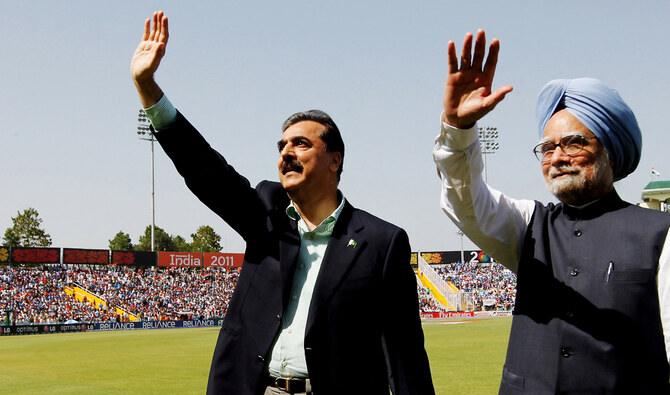
This file photo, taken on March 30, 2011, shows Pakistan's the then Prime Minister Yusuf Raza Gilani (left) with his Indian counterpart, Manmohan Singh, waving before the World Cup cricket second semi-final between India and Pakistan in Mohali, India. (REUTERS/File)
Short Url
Updated 28 December 2024
Follow

Pakistan’s deputy PM praises late Manmohan Singh for fostering regional peace

  • Ishaq Dar says former Indian premier relied on dialogue and believed in collective progress
  • Deputy PM’s statement comes at a time of strained diplomatic ties between India and Pakistan

ISLAMABAD: Pakistan’s Deputy Prime Minister Ishaq Dar on Friday expressed grief over the death of former Indian Prime Minister Manmohan Singh, praising his leadership for prioritizing dialogue and mutual understanding to address regional issues, which improved ties between the two nuclear-armed rivals.
Singh, an economist and the first Sikh to serve as India’s premier, passed away on Thursday at the age of 92. Born in Gah, a village in what is now Pakistan’s Chakwal district, Singh’s family migrated to India following the partition in 1947.
He studied at Oxford and Cambridge, earning recognition as a scholar before spearheading economic reforms that lifted India out of a financial crisis in the early 1990s.
“His approach to regional issues reflected his belief that mutual understanding, dialogue, and cooperation were essential for collective progress,” Dar said in a social media post on X, formerly Twitter. “He played a notable role in improving Pakistan-India bilateral relations during his tenure as Prime Minister.”

He added “the people and the Government of Pakistan extend their heartfelt condolences to Dr. Manmohan Singh’s family, and to the people and the Government of India.”
The deputy prime minister’s statement comes at a time of strained diplomatic ties between India and Pakistan, with both countries having downgraded their bilateral relations in 2019 following India’s revocation of Jammu and Kashmir’s special constitutional status.
Regular border skirmishes and accusations of cross-border militancy have further exacerbated tensions.
Singh is widely regarded as a key architect of India’s economic liberalization, credited with steering the country through a severe balance-of-payments crisis in 1991 as finance minister.
His tenure as prime minister was characterized by steady economic growth and efforts to improve relations with neighbors, though his critics cite challenges in domestic and foreign policy toward the end of his term.


Pakistan, Malaysia discuss halal food, energy and tourism to boost cooperation

Updated 47 min 44 sec ago
Follow

Pakistan, Malaysia discuss halal food, energy and tourism to boost cooperation

  • Bilateral trade between both countries stands at about $1.4 billion a year
  • In Oct., both countries announced a new $200 million halal meat trade quota

ISLAMABAD: Pakistan and Malaysian officials have held talks on halal food, green energy and tourism sectors as part of renewed efforts to expand ties between the two Muslim-majority nations, the Pakistani High Commission in Malaysia on Monday.

The discussions took place during a meeting between Pakistan’s High Commissioner to Malaysia, Syed Ahsan Raza Shah and Tun Pehin Sri Dr. Wan Junaidi Tuanku Jaafar, governor of Malaysia’s Sarawak state.

Bilateral trade between the two countries stands at about $1.4 billion a year, according to official data from both governments. In Oct., both countries announced a new $200 million halal meat trade quota.

“Constructive talks on Pakistan-Malaysia ties in halal [food], palm oil, green energy, rice, labor, tourism, culture & sustainable development,” the Pakistani High Commission in Malaysia said on X.

Malaysia’s exports to Pakistan are led by palm oil and other vegetable fats, followed by machinery, rubber products and organic chemicals. Pakistan’s main exports to Malaysia include rice, textiles, seafood and minerals.

The two countries have also traded under the Malaysia-Pakistan Closer Economic Partnership Agreement since 2008, which provides preferential market access for goods and services.

Pakistan has been rapidly growing its green energy, halal food, and tourism sectors. Its halal food industry is attracting global buyers with Shariah-compliant products, while tourism is leveraging the country’s natural beauty, heritage sites and cultural attractions to draw international visitors.