Iran FM warns against ‘destructive interference’ in Syria’s future

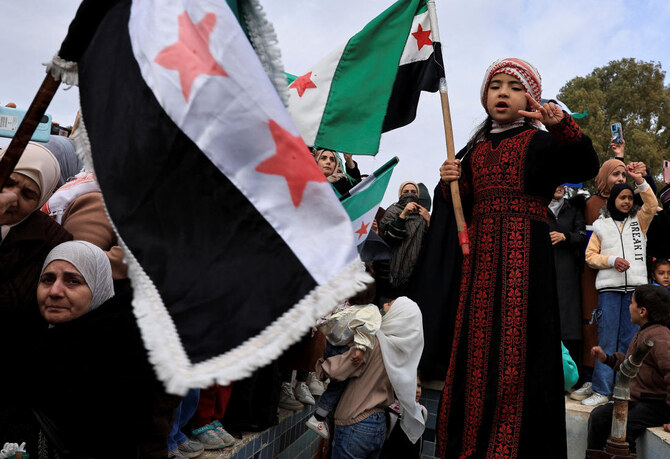
Iran’s supreme leader Ayatollah Ali Khamenei said Syria’s young men would ‘stand with strength and determination against those who have designed this insecurity.’ (Reuters)
Short Url
Updated 27 December 2024
Follow

Iran FM warns against ‘destructive interference’ in Syria’s future

  • Abbas Araghchi: Iran ‘considers the decision-making about the future of Syria to be the sole responsibility of the people... without destructive interference or foreign imposition’

BEIJING: Iran’s top diplomat warned Friday against “destructive interference” in Syria’s future and said decisions should lie solely with the country’s people, writing in Chinese state media as he visited Beijing.
Abbas Araghchi touched down in the Chinese capital on Friday afternoon, Iranian state media reported, to begin his first official visit to the country since being appointed foreign minister.
China and Iran were both supporters of ousted Syrian president Bashar Assad.
Assad fled Syria this month after an Islamist-led offensive wrested city after city from his control, with the capital Damascus falling on December 8.
Iran “considers the decision-making about the future of Syria to be the sole responsibility of the people... without destructive interference or foreign imposition,” Araghchi wrote in a Chinese-language article in People’s Daily published on Friday.
He also emphasized Iran’s respect for Syria’s “unity, national sovereignty and territorial integrity.”
Iran’s supreme leader – a key backer of Assad’s administration – predicted on Sunday “the emergence of a strong, honorable group” that would stand against “insecurity” in Syria.
Ayatollah Ali Khamenei said Syria’s young men would “stand with strength and determination against those who have designed this insecurity and those who have implemented it, and God willing, he will overcome them.”
In People’s Daily, Araghchi said supporting the Syrian people was a “definite principle (that) should be taken into consideration by all the actors.”
Beijing had also built strong ties with Assad – he met President Xi Jinping in China last year, where the two leaders announced a “strategic partnership.”
China has affirmed its support for the Syrian people and has said it opposes terrorist forces taking advantage of the situation to create chaos.
Araghchi’s two-day visit will include talks with his Chinese counterpart Wang Yi, according to Iran’s foreign ministry.
China is Iran’s largest trade partner, and a top buyer of its sanctioned oil.
Xi pledged in October to increase ties with Iran during talks with his counterpart Masoud Pezeshkian in Russia on the sidelines of a BRICS summit.
Araghchi told reporters in a video published by Iranian state media as he arrived in Beijing that the visit was taking place “at a very suitable time.”
“Now it is natural that there are sensitive situations, both the region has various tensions, and there are various issues at the international level, also our nuclear issue in the new year will face a situation that needs more consultations,” he said.
“The invitation of our Chinese friends was for this reason, that at the beginning of the new year... we should think together, consult and be ready for the challenges that will come.”
He wrote in his editorial that Iran and China shared the “common view” that calling for an immediate ceasefire in Gaza was the biggest priority in the Middle East.


Jordan, Germany committed to two-state solution

King Abdullah of Jordan receives German Chancellor Friedrich Merz in Aqaba. (Petra)
Updated 4 sec ago
Follow

Jordan, Germany committed to two-state solution

  • Chancellor Merz calls for more humanitarian aid to flow into the war-torn Gaza Strip

AMMAN: Jordan’s King Abdullah has warned of “the danger of continued Israeli escalations in the West Bank,” which Israel has occupied since 1967.

King Abdullah received German Chancellor Friedrich Merz during his brief stopover in Jordan on Saturday.

Their discussions in Aqaba focused mainly on the peace process in Israel and the Palestinian territories, AFP reported.

Merz called for more humanitarian aid to flow into the Gaza Strip and for Hamas fighters to lay down their weapons, adding that both Jordan and Germany are committed to a negotiated two-state solution.

“There can be no place for terrorism and antisemitism in this shared future,” Merz said.

Jordan’s royal palace said in a statement that King Abdullah had underlined “the need to commit to implementing all stages of the agreement to end the war and deliver humanitarian aid to all areas of the strip.”

The meeting discussed ways to strengthen the partnership between Jordan and Germany, focusing on the deep-rooted ties between the two countries, Jordanian news agency Petra reported.

King Abdullah emphasized the importance of expanding cooperation in various domains, including the economic and defense sectors, and continuing to coordinate in support of efforts to achieve stability in the region, according to Petra.

The leaders highlighted the need to pursue a “political horizon to achieve a just and comprehensive peace in the region.”

Chancellor Merz expressed Germany’s readiness to strengthen cooperation with Jordan in various sectors.

The Syrian Arab Republic’s Sana news agency reported that the two leaders discussed ways to support Syria and Lebanon in maintaining their security, stability, and sovereignty.

They stressed the importance of respecting the sovereignty of regional countries and reviewed key developments in the Middle East.

Deputy Prime Minister and Foreign Minister Ayman Safadi had previously affirmed that Jordan continues to support Syria after years of war and destruction, expressing hope for a stable and secure future that ensures Syria’s territorial unity, Sana added.

King Abdullah separately met with Kaja Kallas, EU high representative for foreign affairs and security policy and European Commission vice president on Sunday to discuss ways to strengthen cooperation within the framework of the strategic and comprehensive partnership between Jordan and the EU.

The meeting at Basman Palace covered the importance of building on available economic opportunities, particularly through the Jordan-EU Summit, scheduled to be held in Amman in January 2026, as well as the joint economic forum scheduled for next year, with participation from investors on both sides.

The meeting also touched on regional developments and the need to achieve comprehensive calm and preserve the sovereignty of states.

The two sides emphasized that the two-state solution is the only way to achieve just and comprehensive peace.

The king reiterated the need to adhere to the terms of the agreement to end the war in Gaza and ensure the flow of relief aid, as well as to stop unilateral measures against Palestinians in the West Bank.

For her part, Kallas emphasized the importance of the EU’s partnership with Jordan and the shared commitment to deepen cooperation in various fields, noting Jordan’s pivotal role in the region.