India readies for 400 million pilgrims at mammoth Kumbh Mela festival

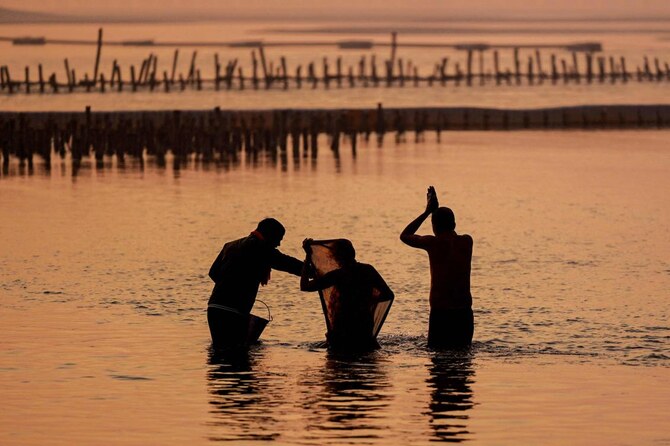
Hindu pilgrims take a dip along the banks of Sangam, the confluence of Ganges, Yamuna and mythical Saraswati rivers, ahead of the Maha Kumbh Mela festival in Prayagraj on Dec. 22, 2024. (AFP)
Short Url
Updated 26 December 2024
Follow

India readies for 400 million pilgrims at mammoth Kumbh Mela festival

  • The millennia-old sacred show of religious piety and ritual bathing is held once every 12 years at the site where the holy Ganges, Yamuna and the mythical Saraswati rivers meet

PRAYAGRAJ, India: Beside India’s holy rivers, a makeshift city is being built for a Hindu religious festival expected to be so vast it will be seen from space, the largest gathering in history.
Line after line of pontoon bridges span the rivers at Prayagraj, as Indian authorities prepare for 400 million pilgrims – more than the combined population of the United States and Canada – during the six-week-long Kumbh Mela.
The millennia-old sacred show of religious piety and ritual bathing is held once every 12 years at the site where the holy Ganges, Yamuna and the mythical Saraswati rivers meet.
But this edition from January 13 to February 26 is expected to be a mega draw, as it is set to coincide with a special alignment of the planets.
Beads of sweat glisten on laborer Babu Chand’s forehead as he digs a trench for seemingly endless electrical cables, one of an army of workers toiling day and night at a venue sprawling over 4,000 hectares (15 square miles).
“So many devotees are going to come,” 48-year-old Chand said, who says he is working for a noble cause for the mela, or fair.
“I feel I am contributing my bit – what I am doing seems like a pious act.”
A humongous tent city, two-thirds the area of Manhattan, is being built on the floodplains of Prayagraj, formerly called Allahabad, in the northern state of Uttar Pradesh.
“Some 350 to 400 million devotees are going to visit the mela, so you can imagine the scale of preparations,” said Vivek Chaturvedi, the spokesman for the festival.
Preparing for the Kumbh is like setting up a new country, requiring roads, lighting, housing and sewerage.
“What makes this event unique is its magnitude and the fact that no invitations are sent to anybody... Everyone comes on their own, driven by pure faith,” Chaturvedi said.
“Nowhere in the world will you see a gathering of this size, not even one-tenth of it.”
Around 1.8 million Muslims take part in the annual Hajj pilgrimage to Makkah in Saudi Arabia.
The Kumbh numbers, according to Chaturvedi, are mind-boggling.
Some 150,000 toilets have been built, 68,000 LED lighting poles have been erected, and community kitchens can feed up to 50,000 people at the same time.
Alongside religious preparations, Prayagraj has undergone a major infrastructure overhaul, and huge posters of Prime Minister Narendra Modi and state Chief Minister Yogi Adityanath dot the city.
Both are from the ruling Hindu-nationalist Bharatiya Janata Party (BJP), with politics and religion deeply intertwined.
The Kumbh Mela is an ancient celebration, with its origins rooted in Hindu mythology.
Hindus believe that taking a dip in Sangam, the confluence of the rivers, will cleanse them of their sins and help them attain “moksha,” setting them free from the cycle of birth and death.
According to legends, deities and demons fought over a pitcher – or “kumbh” – containing the nectar of immortality.
During the battle, four drops fell to Earth.
One drop landed in Prayagraj.
The others fell at Haridwar, Nashik and Ujjain – the three other cities where the rotating Kumbh Mela is held on other years.
But the one in Prayagraj – held every 12 years – is the largest.
Organizing authorities are calling it the great, or “Maha” Kumbh Mela.
The last Kumbh Mela at Prayagraj in 2019 saw 240 million devotees, according to authorities – but that was the smaller “Ardh” or half festival, spaced in between the main event.
“When you talk about the Kumbh, you have to talk about astronomy,” said historian Heramb Chaturvedi, 69.
“Jupiter transits one zodiac sign in a single year,” he added. “Therefore, when it completes 12 zodiac signs, then it is Kumbh.”
Core to celebrations is giving alms to the “wise and learned, the poor and the needy,” he said.
Some pilgrims have already arrived, including naked naga sadhus – wandering monks who have walked for weeks from the remote mountains and forests where they are usually devoted to meditation.
They will lead the dawn charge into the chilly river waters on the six most auspicious bathing dates, starting with the first on January 13.
“I have come here to give my blessings to the public,” 90-year-old naga sadhu Digambar Ramesh Giri, naked with dread-locked hair in a bun, said.
“Whatever you long for in your heart you get at Kumbh.”


Federal agents must limit tear gas for now at protests outside Portland ICE building, judge says

Updated 04 February 2026
Follow

Federal agents must limit tear gas for now at protests outside Portland ICE building, judge says

  • The ruling came in response to a lawsuit filed by the ACLU of Oregon on behalf of protesters and freelance journalists covering demonstrations at the flashpoint US Immigration and Customs Enforcement building

PORTLAND, Oregon: A judge in Oregon on Tuesday temporarily restricted federal officers from using tear gas at protests at the US Immigration and Customs Enforcement building in Portland, just days after agents launched gas at a crowd of demonstrators including young children that local officials described as peaceful.
US District Judge Michael Simon ordered federal officers not to use chemical or projectile munitions on people who pose no imminent threat of physical harm, or who are merely trespassing or refusing to disperse. Simon also limited federal officers from firing munitions at the head, neck or torso “unless the officer is legally justified in using deadly force against that person.”
Simon, whose temporary restraining order is in effect for 14 days, wrote that the nation “is now at a crossroads.”
“In a well-functioning constitutional democratic republic, free speech, courageous newsgathering, and nonviolent protest are all permitted, respected, and even celebrated,” he wrote. “In helping our nation find its constitutional compass, an impartial and independent judiciary operating under the rule of law has a responsibility that it may not shirk.”
Ruling follows a lawsuit filed by the ACLU of Oregon
The ruling came in response to a lawsuit filed by the ACLU of Oregon on behalf of protesters and freelance journalists covering demonstrations at the flashpoint US Immigration and Customs Enforcement building.
The suit names as defendants the Department of Homeland Security and its head Kristi Noem, as well as President Donald Trump. It argues that federal officers’ use of chemical munitions and excessive force is a retaliation against protesters that chills their First Amendment rights.
The Department of Homeland Security said federal officers have “followed their training and used the minimum amount of force necessary to protect themselves, the public, and federal property.”
“DHS is taking appropriate and constitutional measures to uphold the rule of law and protect our officers and the public from dangerous rioters,” spokesperson Tricia McLaughlin said.
Courts consider question of tear gas use
Cities across the country have seen demonstrations against the administration’s immigration enforcement surge.
Last month, a federal appeals court suspended a decision that prohibited federal officers from using tear gas or pepper spray against peaceful protesters in Minnesota who aren’t obstructing law enforcement. An appeals court also halted a ruling from a federal judge in Chicago that restricted federal agents from using certain riot control weapons, such as tear gas and pepper balls, unless necessary to prevent an immediate threat. A similar lawsuit brought by the state is now before the same judge.
The Oregon complaint describes instances in which the plaintiffs — including a protester known for wearing a chicken costume, a married couple in their 80s and two freelance journalists — had chemical or “less-lethal” munitions used against them.
In October, 83-year-old Vietnam War veteran Richard Eckman and his 84-year-old wife Laurie Eckman joined a peaceful march to the ICE building. Federal officers then launched chemical munitions at the crowd, hitting Laurie Eckman in the head with a pepper ball and causing her to bleed, according to the complaint. With bloody clothes and hair, she sought treatment at a hospital, which gave her instructions for caring for a concussion. A munition also hit her husband’s walker, the complaint says.
Jack Dickinson, who frequently attends protests at the ICE building in a chicken suit, has had munitions aimed at him while posing no threat, according to the complaint. Federal officers have shot munitions at his face respirator and at his back, and launched a tear-gas canister that sparked next to his leg and burned a hole in his costume, the complaint says.
Freelance journalists Hugo Rios and Mason Lake have similarly been hit with pepper balls and tear gassed while marked as press, the complaint says.
“Defendants must be enjoined from gassing, shooting, hitting and arresting peaceful Portlanders and journalists willing to document federal abuses as if they are enemy combatants,” the complaint states.
The owner and residents of the affordable housing complex across the street from the ICE building has filed a separate lawsuit, similarly seeking to restrict federal officers’ use of tear gas because its residents have been repeatedly exposed over the past year.
Local officials have also spoken out against use of chemical munitions. Portland Mayor Keith Wilson demanded ICE leave the city after federal officers used such munitions Saturday at what he described as a “peaceful daytime protest where the vast majority of those present violated no laws, made no threat, and posed no danger to federal forces.”
“To those who continue to work for ICE: Resign. To those who control this facility: Leave,” Wilson wrote in a statement Saturday night.
The protest was one of many similar demonstrations nationwide against the immigration crackdown in cities like Minneapolis, where in recent weeks federal agents killed two people, Alex Pretti and Renee Good.