Pakistan air strikes kill 46 in Afghanistan — Taliban spokesman

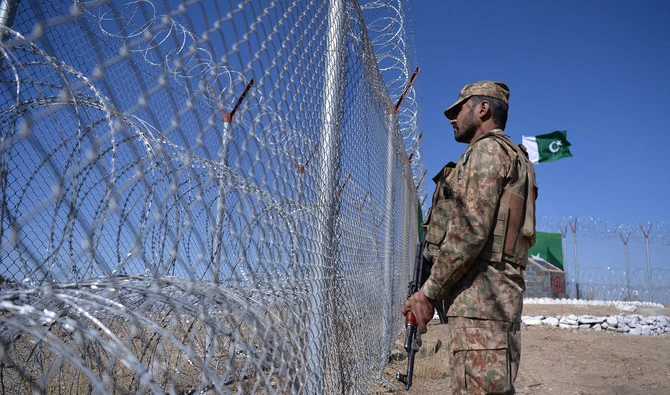
A Pakistani soldier keeps vigil next to a fenced border along with Afghan's Paktika province border in Angoor Adda in South Waziristan, Pakistan, on October 18, 2017. (AFP/File)
Short Url
Updated 25 December 2024
Follow

Pakistan air strikes kill 46 in Afghanistan — Taliban spokesman

  • Zabihullah Mujahid says most of the dead were women and children, six wounded, mostly children
  • There has been no official comment from Pakistani authorities on the latest strike in Afghan territory

KABUL: Pakistan air strikes in an eastern border province of Afghanistan had killed 46 people, the Taliban government spokesman told AFP on Wednesday.
There has been no official comment from Pakistani authorities on the latest strike in Afghan territory.
“Last night [Tuesday], Pakistan bombarded four points in the Barmal district of Paktika province. The total number of dead is 46, most of whom were children and women,” spokesman Zabihullah Mujahid said.
He added that six more people were wounded, mostly children.
An Afghan defense ministry statement late Tuesday condemned the latest strikes by Pakistan on Afghan territory, calling them “barbaric” and a “clear aggression.”
“The Islamic Emirate will not leave this cowardly act unanswered, but rather considers the defense of its territory and sovereignty to be its inalienable right,” the statement said, using the Taliban authorities’ name for the government.
Deadly air strikes by Pakistan’s military in the border regions of Afghanistan in March that the Taliban authorities said killed eight civilians prompted skirmishes on the frontier.
A Barmal resident, Maleel, told AFP Tuesday’s strikes killed 18 members of one family.
“The bombardment hit two or three houses, in one house, 18 people were killed, the whole family lost their lives,” he said.
He said a strike killed three people in another house and wounded several others, who were taken to hospital.
Border tensions between the two countries have escalated since the Taliban government seized power in 2021, with Pakistan battling a resurgence of militant violence in its western border regions.
Islamabad has accused Kabul’s Taliban authorities of harboring militant fighters, allowing them to strike on Pakistani soil with impunity.
Kabul has denied the allegations.
The strike comes after the Pakistani Taliban, who are known as Tehreek-e-Taliban Pakistan (TTP) and share a common ideology with their Afghan counterparts, last week claimed a raid on an army outpost near the border with Afghanistan, which Pakistani intelligence officials said killed 16 soldiers.
Earlier Tuesday, high-level Taliban officials were meeting with Pakistan’s special envoy for Afghanistan who was on a visit to Kabul.
IMF Executive Board to review $1.2 billion loan disbursement for Pakistan today

Updated 4 sec ago
Follow

IMF Executive Board to review $1.2 billion loan disbursement for Pakistan today

  • Pakistan, IMF reached a Staff-Level Agreement in October for second review of $7 billion Extended Fund, climate fund program
  • Economists view IMF bailout packages as essential for cash-strapped Pakistan grappling with a prolonged macroeconomic crisis

ISLAMABAD: The Executive Board of the International Monetary Fund (IMF) is set to meet in Washington today to review a $1.2 billion loan disbursement for Pakistan, state media reported on Monday.

Pakistan and the IMF reached a Staff-Level Agreement (SLA) in October for the second review of a $7 billion Extended Fund Facility (EFF) and the first review of its $1.4 billion Resilience and Sustainability Facility (RSF). 

The agreement between the two sides took place after an IMF mission, led by the international lender’s representative Iva Petrova, held discussions with Pakistani authorities during a Sept. 24–Oct. 8 visit to Karachi, Islamabad and Washington D.C.

“The International Monetary Fund’s (IMF) Executive Board is set to meet in Washington today to review and approve $1.2 billion in loan for Pakistan,” state broadcaster Pakistan TV reported. 

Pakistan has been grappling with a prolonged macroeconomic crisis that has drained its financial resources and triggered a balance of payments crisis for the past couple of years. Islamabad, however, has reported some financial gains since 2022, which include recording a surplus in its current account and bringing inflation down considerably.

Economists view the IMF’s bailout packages as crucial for cash-strapped Pakistan, which has relied heavily on financing from bilateral partners such as Saudi Arabia, China and the United Arab Emirates, as well as multilateral lenders including the IMF, World Bank, Asian Development Bank and Islamic Development Bank. 

Speaking to Arab News last month, Pakistan’s former finance adviser Khaqan Najeeb said the $1.2 billion disbursement will further stabilize Pakistan’s near-term external position and unlock additional official inflows.

“Continued engagement also reinforces macro stability, as reflected in recent improvements in inflation, the current account, and reserve buffers,” Najeeb said.

Pakistan came close to sovereign default in mid-2023, when foreign exchange reserves fell below three weeks of import cover, inflation surged to a record 38% in May, and the country struggled to secure external financing after delays in its IMF program. Fuel shortages, import restrictions, and a rapidly depreciating rupee added to the pressure, while ratings agencies downgraded Pakistan’s debt and warned of heightened default risk.

The crisis eased only after Pakistan reached a last-minute Stand-By Arrangement with the IMF in June 2023, unlocking emergency support and preventing an immediate default.