



DUBAI: For Father Iyad Ghanem, a Catholic priest at the Syriac Archdiocese of Homs and Hama, two of Syria’s four largest cities, this Christmas represents both new beginnings and the end of a dark chapter in Syria’s history.
In the wake of the dramatic developments that led to the ousting of Syria’s long-time President Bashar Assad on Dec. 8, Christians in the country are celebrating Christmas under the transitional government of Hayat Tahrir Al-Sham (HTS) for the first time.
HTS, a rebel group led by Ahmad Al-Sharaa, Syria’s de facto leader, has sought to reassure minority communities, including Kurds, Alawites and Shiites, as it distances itself from its hardline Islamist roots. For many Christians, the end of the Assad era has come as a veritable Christmas gift.
“Our churches are at peace, and we, as clergymen, are free to conduct our masses. Yet, it is too early for the parish to pass judgment on HTS. The atmosphere remains uncertain, and much is left to unfold,” Father Iyad told Arab News.
“Our country and community have endured so much over the past 13 years. With this new era upon us, we must free ourselves from fear, find the voices that were silenced for so long, and eliminate radicalism in all its forms. This is all unfamiliar territory, and we are still adjusting.”
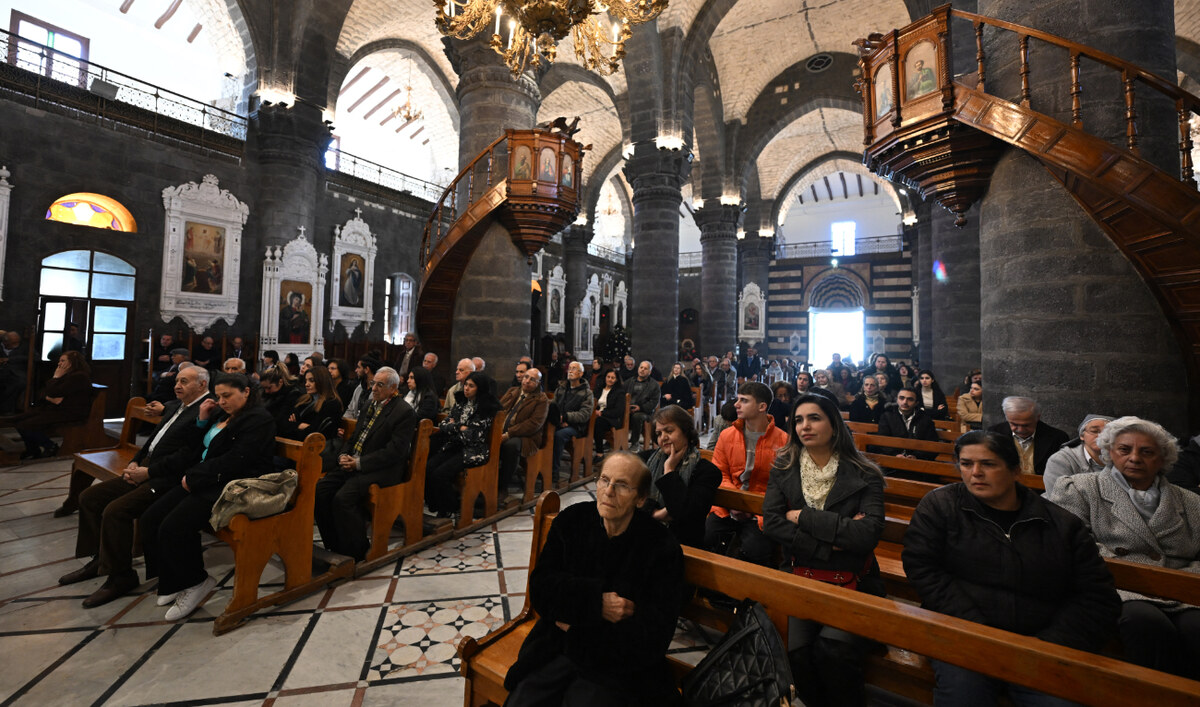
Worshippers attend Sunday Mass at the Cathedral of Our Lady of the Dormition, known also as the Olive Church, in Syria's capital Damascus on December 15, 2024. (AFP)
Syria is part of a region often referred to as the “cradle of Christianity,” making it one of the earliest places in the world to host a Christian community. In the town of Maaloula, a handful of villages still speak Aramaic, the ancient dialect of Christ, to this day.
Once numbering over a million, Syria’s Christian population has dwindled to just 3 percent owing to the prolonged war that began in 2011 and the rise of Daesh in 2014. The violence and persecution left them vulnerable, forcing a large-scale exodus to Western countries.
Rassem Sairafi, a Christian from Homs, said he is optimistic about Syria’s future and hopes for a democratic and free nation.
“Many educated Syrians are returning from abroad. If they are included in the new government, I believe we will be in safe hands,” he told Arab News.
“Historically, Syria’s Sunni majority has been moderate. It was only during the war that began in 2011 that sectarianism took root. Hopefully, we can leave that behind and ensure we do not replace one dictatorship with another.”
FAST FACTS
- Christianity in Syria dates back to the 1st century AD.
- Before the Syrian civil war, they made up roughly 10% of the population.
The Assad regime left Syria in ruins. Its legacy is starkly evident in decimated infrastructure, a deeply entrenched corrupt political system, and a bankrupt economy that has pushed 90 percent of the population below the poverty line.
In a report for the US public broadcaster PBS on Dec. 12, correspondent Simona Foltyn said: “Streets are getting busier by the day and shops and government institutions are slowly returning to work.
“The opposition has taken over government institutions in the capital, Damascus, and has begun the task of governing the country, using its experience in Idlib as a blueprint. But administrating a whole country, as opposed to a province, is quite a different matter, and it remains to be seen how easily it can be scaled.”
She added: “Apart from the joy and relief, the mundane but vital work of making a country function is job number one for many.”
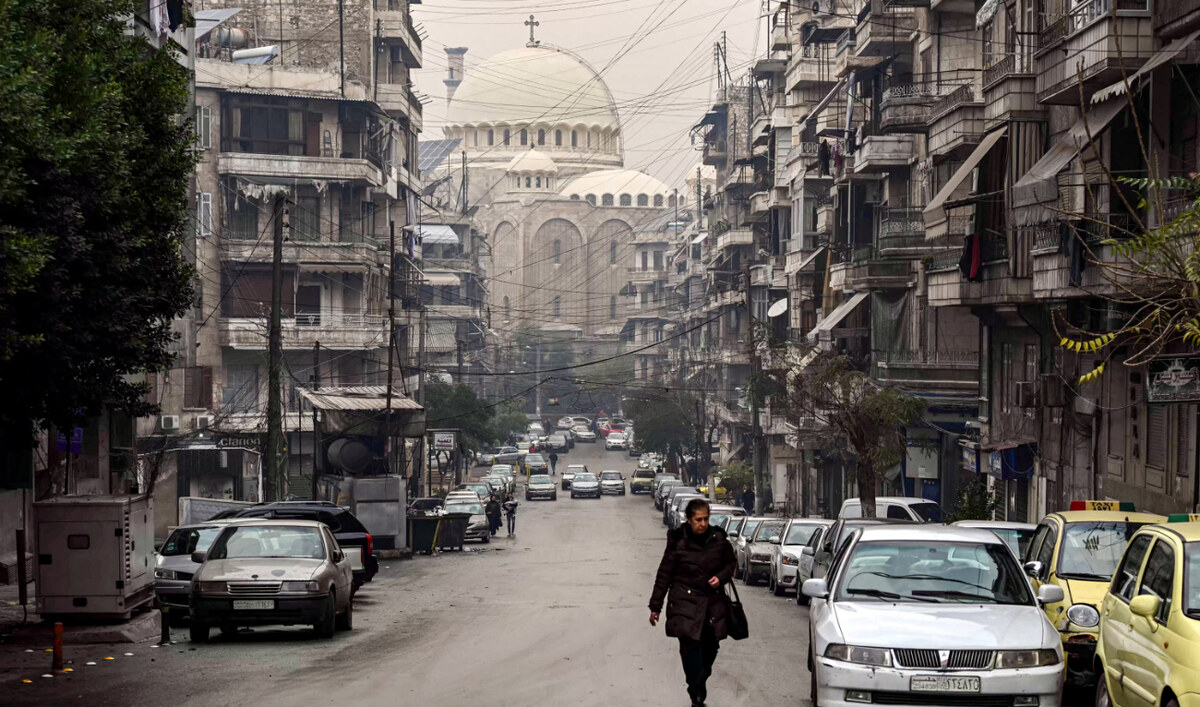
A woman walks along a street near the Greek Catholic Church of St George in Syria's northern city of Aleppo on December 12, 2024. (AFP)
With Assad’s fall, Christians face additional uncertainty as a religious minority about their fate under the country’s new rulers. They feel that their future hangs in the delicate balance of a new era and constitution.
The Christian community, like all Syrians, endured severe hardships under Assad’s regime and so regards the new government with a mix of caution and optimism.
“We are nervous because we are unsure. We do not know what the future holds,” said Rawaa, a Christian from Damascus. “But we are aware of HTS’s history. While their recent legislative decisions are comforting, we remain eager to see if they will uphold these commitments over time.”
Despite being hailed as Syria’s “liberators” and Al-Sharaa’s recent efforts to rebrand himself — shedding his military persona as Abu Mohamad Al-Jolani to adopt the image of a statesman — the country’s stability and economic recovery remain precarious.
HTS is still designated as a terrorist group by the UN, US, EU, and UK, among many others, as it started as a splinter group of Al-Qaeda, which it broke away from in 2016.
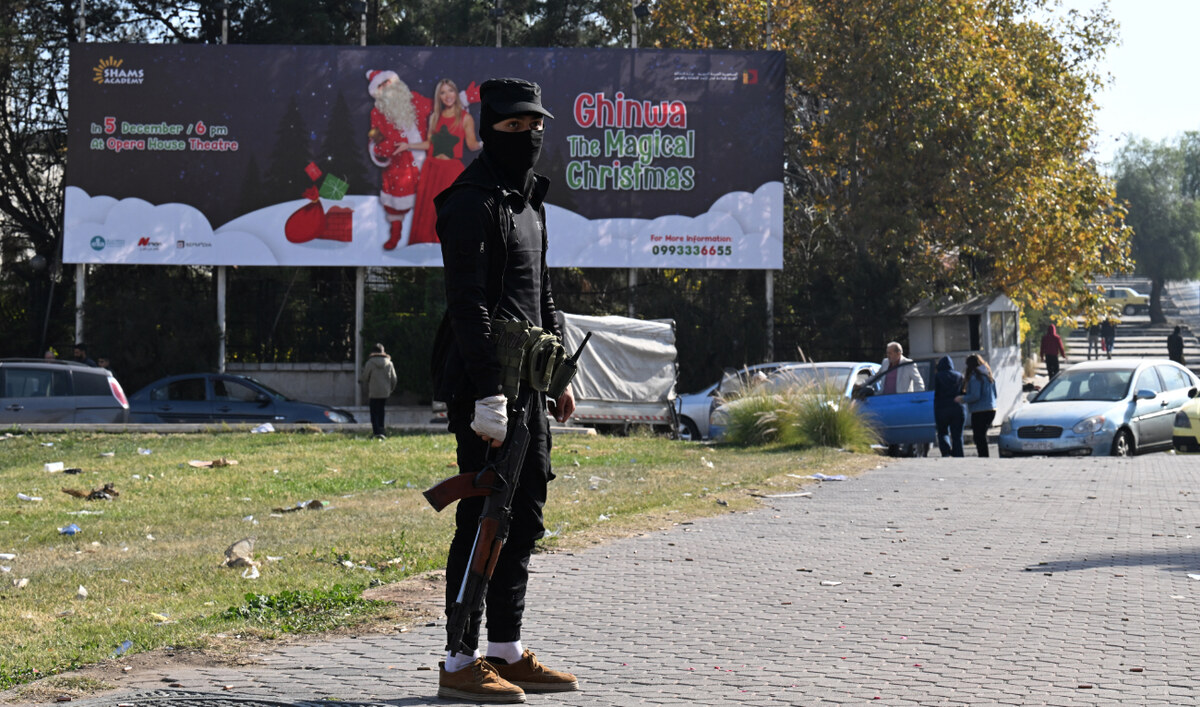
A rebel fighter stands next to a giant Christmas advertisement in central Damascus on December 9, 2024. (AFP)
Once confined to the overcrowded and impoverished northwestern region of Idlib but now acting as the self-imposed caretaker government in Damascus, HTS faces the daunting challenge of rebuilding a nation devastated by years of corruption and mismanagement under Assad.
In an effort to stave off chaos, Al-Sharaa has taken steps to restore basic services in some areas, called for the preservation of state institutions, and promoted the vision of an inclusive society and a peaceful transition to new governance.
Senior leaders of the transitional government continue to meet with representatives of various religious communities, emphasizing their commitment to protecting minority rights as part of broader efforts to reassure both Syrians and the international community.
Both Father Iyad and Rawaa voiced their aversion to the use of the term “minority” when describing their community, insisting they are an integral part of Syria’s fabric and one of the essential components that define the country.
This year, across various parts of the country, only churches have adorned their doors and squares with Christmas decorations — a gesture that Rawaa interprets as a sign of hope for the future. However, celebrations remain subdued. Many, including Rawaa’s family and friends, are opting for private gatherings.
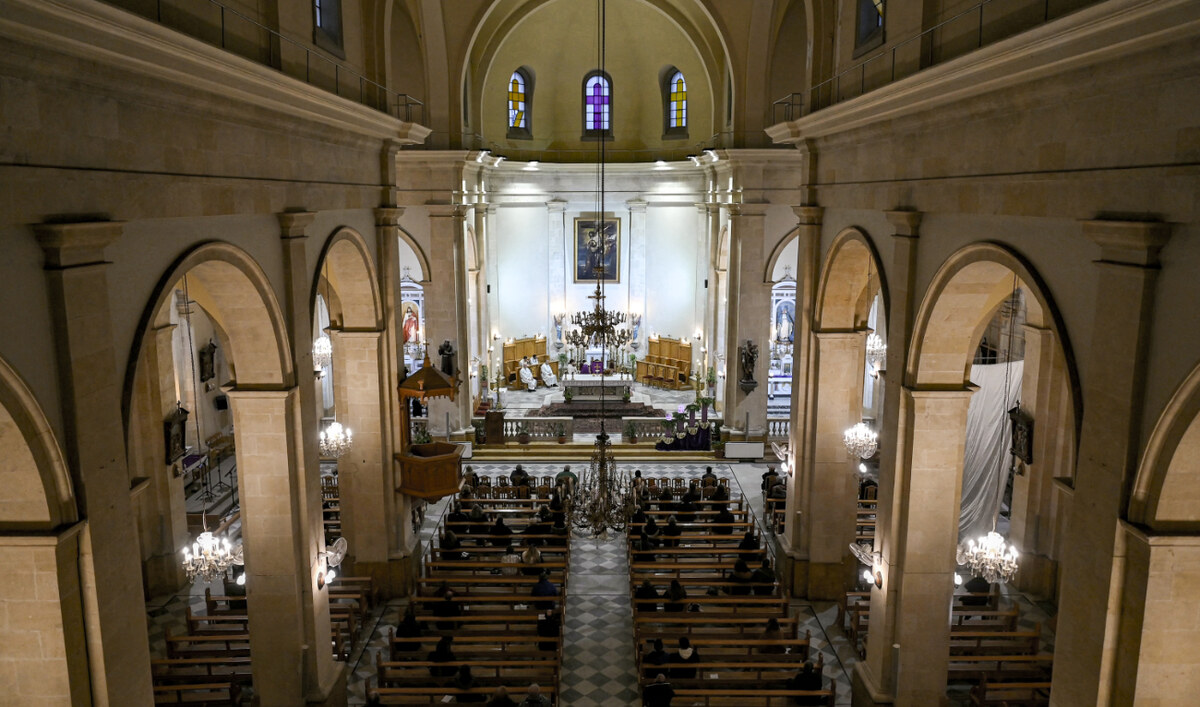
Christian worshippers attend mass at the Roman Catholic Church of Saint Francis of Assisi (also known as the Latin Cathedral) in Syria's northern city of Aleppo on December 12, 2024. (AFP)
“My neighborhood hasn’t put up Christmas decorations since the war began 13 years ago, and this year is no different,” Rawaa told Arab News.
“But it’s not out of fear of HTS. It’s because of the shortages we face and the hardships we endure. We lack electricity, fuel, and financial resources. The population is struggling, and the festive spirit is hard to find in such conditions.”
“Our celebrations will be within our homes, with close family and friends,” Rawaa said. “This is a new experience for us. While there has been no persecution from HTS, we are proceeding cautiously. The transitional government has promised to launch awareness campaigns to combat radicalism if necessary. Time will tell if they fulfill that promise.”
Mary Bitar, a Christian from Damascus, saw reason for optimism amid the adversities in the lead-up to Christmas.
“People are out and about. No one is being harassed. We may lack Christmas lights because of the electricity shortages, but our hearts are full, and we remain hopeful,” she said.
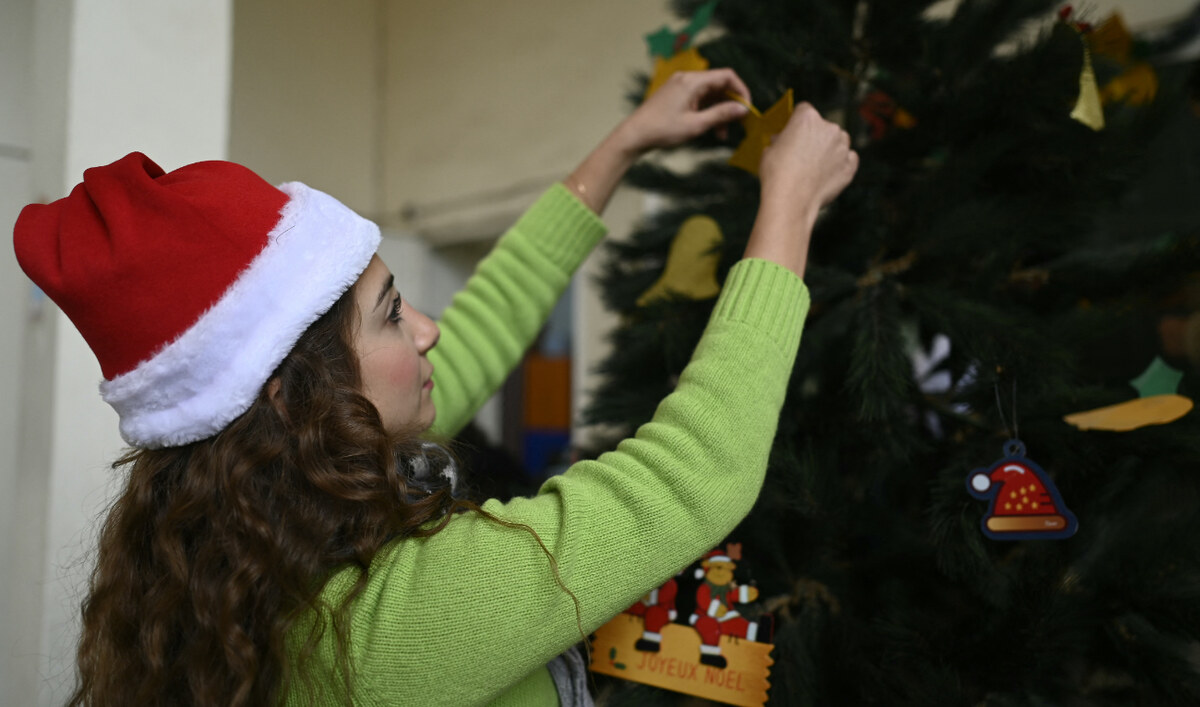
A Syrian Christian decorates a Christmas tree at the Marist Brothers charitable association quarters in Aleppo on December 12, 2024. (AFP)
In his comments, Father Iyad emphasized that isolated acts of terrorism must be addressed before they escalate, citing a recent incident in Hama where armed men desecrated a Christian graveyard and set crosses in town squares ablaze.
“Small factions that align themselves with HTS must be controlled,” he told Arab News. “Those seeking to sow chaos must be stopped. We will not tolerate any radicalized behavior.”
Despite these challenges, Father Iyad remains steadfast in his message of hope. “My wish is for unity — a just legislation that provides equal rights to all Syrians. A peaceful, beautiful Syria for everyone.”


