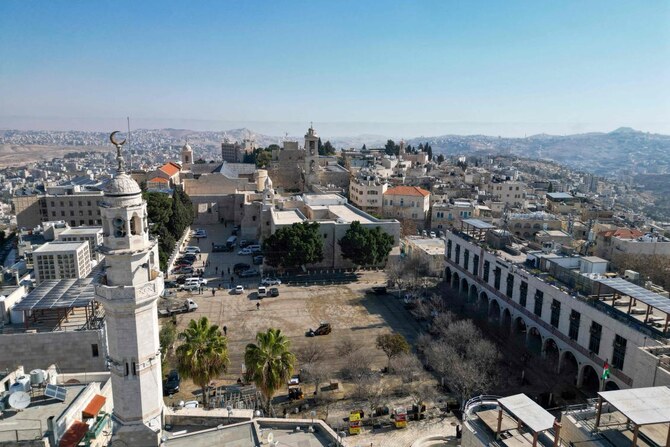
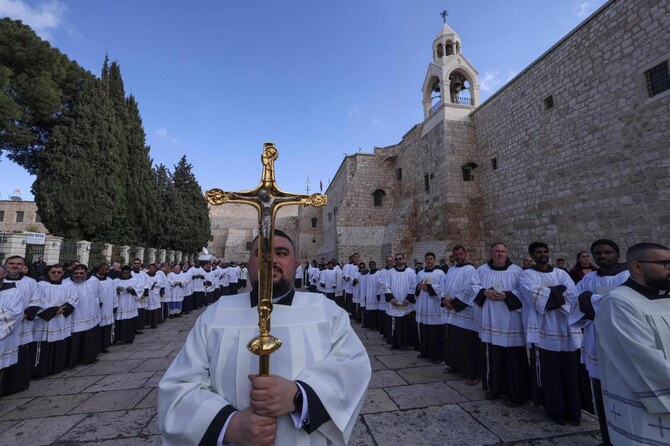
BETHLEHEM: Palestinian security forces deployed around the Church of the Nativity in the West Bank holy city of Bethlehem on Tuesday, as the faithful prepared for another solemn Christmas overshadowed by the war in Gaza.
An unusual calm enveloped Manger Square, the heart of the Palestinian city dominated by the revered church that marks the site where Christians believe Jesus Christ was born.
The white-walled compound and its surrounding plaza were empty, save for a few vendors selling coffee and corn and a significant contingent of journalists, an AFP reporter saw.
Missing for a second consecutive year were the decorations, bustling tourists and crowds of pilgrims that were staples of Christmases past, reflecting the somber mood as the war between Israel and Palestinian militants in the Gaza Strip drags on.
The fighting in Gaza — which is separated from the occupied West Bank by a swath of Israeli territory — erupted after Hamas’s deadly attack on Israel on October 7 last year.
Traditionally, a grand Christmas tree would light up Manger Square, but local authorities opted against elaborate celebrations for a second year.
“This year we limited our joy,” Bethlehem mayor Anton Salman told AFP.
“We want to focus on the Palestinian reality and show the world that Palestine is still suffering from the Israeli occupation, still suffering from the injustice.”
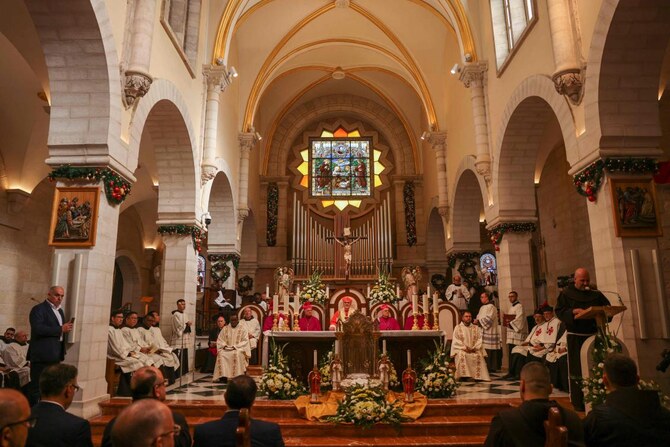
Prayers, including the church’s famed midnight mass, will still be held in the presence of the Catholic Church’s Latin Patriarch, but the festivities will be of a more strictly religious nature than the festive celebrations the city once held.
Despite the gloomy mood, some Christians in the Holy Land — who number about 185,000 in Israel and 47,000 in the Palestinian territories — are finding refuge in prayer.
“Christmas is a feast of faith... We’re going to pray and ask God to end our suffering,” Salman said.
Vendors in front of the local municipality building, the Bethlehem Peace Center, waited for customers in vain behind pots full of steaming coffee.
Mohammad Awad, 57, has been selling coffee for more than 25 years at the foot of the Mosque of Omar, whose elegant minaret stands directly opposite the Church of the Nativity.
“Business was good before the war, but now there’s no one,” the vendor lamented. “I hope the war in Gaza will end soon and that tourists will return.”
While most streets were quiet, a handful of visitors could still be seen in the area.
“On one hand, it’s sad that there are so few people,” said Christiana von der Tann, a German who came with her husband to spend the holidays with her daughter, a journalist in Tel Aviv.
“But then you can access the Church of the Nativity as you can freely go inside... That’s the advantage.
“But it’s very sad for the people here, it’s very sad they can’t sell their goods. They’ve got a really hard time.”
Violence across the Israeli-occupied West Bank has surged since the war in Gaza broke out, but Bethlehem has remained largely quiet, even though the fighting has taken a toll on the now predominantly Muslim city.
Foreign tourists, on whom Bethlehem’s economy almost entirely relies, stopped coming due to the war. And an increase in restrictions on movement in the form of Israeli checkpoints is also preventing many Palestinians from visiting.
“Last night, there was a rocket attack in Tel Aviv and it was a little scary,” said Tann.
“We had to go to a shelter room. That was a special experience. You don’t forget that you are in a country at war.”


![]()
![]()
![]()

Security deployed as wartime Bethlehem readies for another somber Christmas
Short Url
https://arab.news/gj76a
Security deployed as wartime Bethlehem readies for another somber Christmas
- Missing for a second consecutive year were the decorations, bustling tourists and crowds of pilgrims that were staples of Christmases past


Latest updates





© 2026 SAUDI RESEARCH & PUBLISHING COMPANY, All Rights Reserved And subject to Terms of Use Agreement.