Noche Buena: How Filipinos celebrate Christmas Eve with a traditional family feast

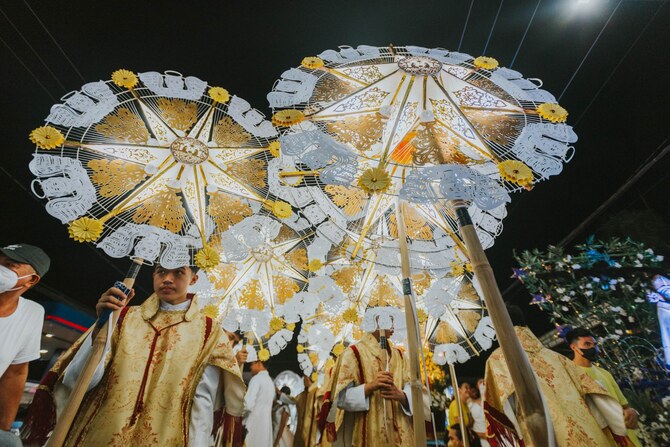
This file photo shows a folk procession called the Lubenas in Philippines' Pampanga province. (Gerald Gloton)
Short Url
Updated 24 December 2024
Follow

Noche Buena: How Filipinos celebrate Christmas Eve with a traditional family feast

  • Noche Buena is the dinner that follows the last evening mass of the Christmas season
  • In Philippines’ Pampanga province, some Christmas celebrations take place from Dec. 24 to Jan. 2

MANILA: For many Filipinos, the time-honored traditions of Noche Buena, or Christmas Eve, is the most awaited part of this holiday season, when dinner tables across the country are filled with a hearty selection of traditional dishes.

Noche Buena, which is Spanish for “the good night,” is the dinner that follows the last evening mass of the season, known as misa de gallo or simbang gabi.

The multi-generational feast features staples like queso de bola, a ball-shaped Edam cheese wrapped in red wax coating, or lechon, the popular roasted pig dish that often gets the spotlight in most Filipino festivities.

But it is the classic hot chocolate that Noelle Lejano looks forward to the most, as her grandmother makes it extra special and only at this time of the year.

“Hot chocolate holds a deeper sentimental value because my lola (grandmother) makes it only once a year, every Noche Buena. It’s the best hot chocolate I’ve ever had, and it makes the celebration feel extra special and nostalgic,” the 24-year-old writer and brand strategist from Manila told Arab News.

Her family mixes it up between classic and more modern fare for the occasion, from the tried-and-tested favorite Christmas ham to a charcuterie board that she makes with her mother.

“These dishes aren’t just food — they’re traditions that bring us together and make the holiday feel like home,” Lejano said.

“Noche Buena is a highlight, especially with everyone gathering together and making the rounds to greet and hug each other as the clock strikes midnight. To pass the time before midnight, we play games, which keep the energy alive and the laughter flowing.”

Noche Buena is also celebrated in Latin America, reflecting a unique mix of Catholic traditions, indigenous folk practices, and more recent American influences, the late food historian Doreen Fernandez wrote in her 1994 book “Tikim: Essays on Filipino Food and Culture.”

For people in Pampanga province, about 80 km north of Manila, the deep-seated Catholic and Spanish influences are reflected in their culinary fare.

In Gerald Gloton’s household, Noche Buena is a time to indulge in their provincial roots, which includes serving sopas, or Filipino chicken soup, from the morning of the 24th all the way into Christmas morning.

They also serve an array of other beloved dishes, such as the ube halaya, a rich purple jam made from boiled and mashed ube and thickened with milk, rice cakes, and menudo, a stewed pork and tomato dish.

“We gather for sumptuous meals, exchange gifts, and attend Mass to celebrate the birth of Christ, reinforcing our shared faith and family values,” Gloton said.

The celebration of Noche Buena, which comes after Midnight Mass, has been “customary and required” for food anthropologist and writer Ruston Banal, who was raised in a devout Catholic household and is also from Pampanga.

“It’s significant because, in my situation, it marks the moment when the entire family gets together. Some of my siblings are already employed elsewhere, but they still make an effort to honor this custom by coming home,” he said.

In his hometown of Guagua, Christmas is an extended celebration that begins from Dec. 24 all the way to Jan. 2, where celebrations are centered on food.

“It’s all about the food; some of my relatives even spend a lot of money to prepare a lavish feast for other relatives who visit us,” he said.

Every year, the occasion turns into “a quiet competition among family members,” as they try to make the greatest dishes, ranging from bringhe, a local version of the Spanish paella made with sticky rice, chicken, sausage, vegetables and coconut milk, to kaldereta, a hearty tomato and liver stew made with leghorn chicken with carrots, potatoes, and bell peppers.

“Food is an extension of themselves,” Banal said. “(They cook like) a person in love, giving it their all.”


Bangladesh halts controversial relocation of Rohingya refugees to remote island

Updated 29 December 2025
Follow

Bangladesh halts controversial relocation of Rohingya refugees to remote island

  • Administration of ousted PM Sheikh Hasina spent about $350m on the project
  • Rohingya refuse to move to island and 10,000 have fled, top refugee official says

DHAKA: When Bangladesh launched a multi-million-dollar project to relocate Rohingya refugees to a remote island, it promised a better life. Five years on, the controversial plan has stalled, as authorities find it is unsustainable and refugees flee back to overcrowded mainland camps.

The Bhasan Char island emerged naturally from river sediments some 20 years ago. It lies in the Bay of Bengal, over 60 km from Bangladesh’s mainland.

Never inhabited, the 40 sq. km area was developed to accommodate 100,000 Rohingya refugees from the cramped camps of the coastal Cox’s Bazar district.

Relocation to the island started in early December 2020, despite protests from the UN and humanitarian organizations, which warned that it was vulnerable to cyclones and flooding, and that its isolation restricted access to emergency services.

Over 1,600 people were then moved to Bhasan Char by the Bangladesh Navy, followed by another 1,800 the same month. During 25 such transfers, more than 38,000 refugees were resettled on the island by October 2024.

The relocation project was spearheaded by the government of former Prime Minister Sheikh Hasina, who was ousted last year. The new administration has since suspended it indefinitely.

“The Bangladesh government will not conduct any further relocation of the Rohingya to Bhasan Char island. The main reason is that the country’s present government considers the project not viable,” Mizanur Rahman, refugee relief and repatriation commissioner in Cox’s Bazar, told Arab News on Sunday.

The government’s decision was prompted by data from UN agencies, which showed that operations on Bhasan Char involved 30 percent higher costs compared with the mainland camps in Cox’s Bazar, Rahman said.

“On the other hand, the Rohingya are not voluntarily coming forward for relocation to the island. Many of those previously relocated have fled ... Around 29,000 are currently living on the island, while about 10,000 have returned to Cox’s Bazar on their own.”

A mostly Muslim ethnic minority, the Rohingya have lived for centuries in Myanmar’s western Rakhine state but were stripped of their citizenship in the 1980s and have faced systemic persecution ever since.

In 2017 alone, some 750,000 of them crossed to neighboring Bangladesh, fleeing a deadly crackdown by Myanmar’s military. Today, about 1.3 million of them shelter in 33 camps in the coastal Cox’s Bazar district, making it the world’s largest refugee settlement.

Bhasan Char, where the Bangladeshi government spent an estimated $350 million to construct concrete residential buildings, cyclone shelters, roads, freshwater systems, and other infrastructure, offered better living conditions than the squalid camps.

But there was no regular transport service to the island, its inhabitants were not allowed to travel freely, and livelihood opportunities were few and dependent on aid coming from the mainland.

Rahman said: “Considering all aspects, we can say that Rohingya relocation to Bhasan Char is currently halted. Following the fall of Sheikh Hasina’s regime, only one batch of Rohingya was relocated to the island.

“The relocation was conducted with government funding, but the government is no longer allowing any funds for this purpose.”

“The Bangladeshi government has spent around $350 million on it from its own funds ... It seems the project has not turned out to be successful.”