BETHLEHEM: The Nativity Store in Manger Square has sold handmade olive wood carvings and religious items to people visiting the traditional birthplace of Jesus since 1927. But as Bethlehem prepares to mark its second Christmas under the shadow of the war in Gaza, there are almost no tourists, leaving the Nativity Store and other businesses unsure of how much longer they can hold on.
For the second straight year, Bethlehem’s Christmas celebrations will be somber and muted, in deference to ongoing war in Gaza. There will be no giant Christmas tree in Manger Square, no raucous scout marching bands, no public lights twinkling and very few public decorations or displays.
“Last year before Christmas, we had more hope, but now again we are close to Christmas and we don’t have anything,” said Rony Tabash, the third-generation owner of Nativity Store.
Israel’s war against Hamas has been raging for nearly 15 months, and there still is no end in sight. Repeated ceasefire efforts have stalled.
Since the war began, tourism to Israel and the Israeli-occupied West Bank has plummeted. And after Israel barred entry to most of the 150,000 Palestinians in the West Bank who had jobs in Israel, the Palestinian economy contracted by 25 percent in the past year.
The yearly Christmas celebrations in Bethlehem — shared among Armenian, Catholic and Orthodox denominations — are usually major boons for the city, where tourism accounts for 70 percent of its yearly income. But the streets are empty this season.
Tabash said he continues to open the store every day, but often an entire week will go by without a sale. Tabash works with more than 25 local families who create hand-carved religious items out of the region’s storied olive wood. But with no buyers, work has dried up for these families.
Lots of room at the inn
The number of visitors to the city plunged from a pre-COVID high of around 2 million visitors per year in 2019 to fewer than 100,000 visitors in 2024, said Jiries Qumsiyeh, the spokesperson for the Palestinian tourism ministry.
According to the Christmas story, Mary was forced to give birth to Jesus in a stable because there was no room at the inn. Today, nearly all of Bethlehem’s 5,500 hotel rooms are empty.
The city’s hotel occupancy rate plunged from around 80 percent in early 2023 to around 3 percent today, said Elias Al Arja, the head of Bethlehem Hoteliers Association. At his own hotel, the Bethlehem Hotel, he said he has laid off a staff of more than 120 people and retains just five employees.
The city hosts more than 100 stores and 450 workshops dealing with traditional Palestinian handicraft, Qumsiyeh said. But just a week before Christmas, when the city should be bursting with visitors, Manger Square was mostly empty save for a few locals selling coffee and tea. Only two of the eight stores in the main drag of the square were open for business.
Qumsiyeh worries that when the war ends and tourism eventually rebounds, many of the families that have handed down traditional skills for generations will no longer be making the items that reflect Palestinian heritage and culture.
Many are leaving the region entirely. “We have witnessed a very high rate of emigration since the beginning of the aggression, especially among those working in the tourism sector,” said Qumsiyeh.
A Christmas without joy
Almost 500 families have left Bethlehem in the past year, said Mayor Anton Salman. And those are just the families who moved abroad with official residency visas. Many others have moved abroad on temporary tourist visas and are working illegally, and it’s unclear if they will return, Salman said.
Around half of the population in the Bethlehem area, including nearby villages, works in either tourism or in jobs in Israel.
The unemployment rate in Bethlehem is roughly 50 percent, said Salman. Unemployment across the West Bank is around 30 percent, according to the Palestinian Economy Ministry.
Canceling Christmas festivities is one way to draw attention to the difficult situation in Bethlehem and across the Palestinian territories, said Salman. “This year we want to show the world that the Palestinian people are still suffering and they haven’t the joy that everybody else in the world having,” said Salman.
It is another blow to the Holy Land’s dwindling population over the decade due to emigration and a low birthrate.
Christians are a small percentage of the population. There are about 182,000 in Israel, 50,000 in the West Bank and Jerusalem and 1,300 in Gaza, according to the US State Department.
Finding the light in the night
Father Issa Thaljieh, the parish priest of the Greek Orthodox Church in the Church of the Nativity, said many families are struggling financially, leaving them unable to pay rent or school fees, much less buy Christmas presents or celebrate the holiday in other ways. The church’s social services have tried to help, but the needs are great, he said.
Thaljieh said his Christmas message this year focused on encouraging Palestinians in Bethlehem to stay despite the challenges.
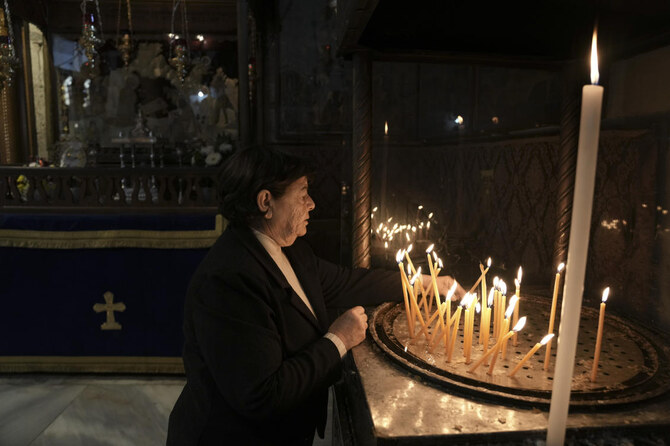
“A church without Christians is not a church,” he said, as workers hand-polished the ornate brass candelabras in the cavernous, empty church a week before the holiday.
“The light that was born when Jesus Christ was born here is the light that moves beyond darkness, so we have to wait, we have to be patient, we have to pray a lot, and we have to stay with our roots because our roots are in Bethlehem,” he said.
Some families are finding ways to bring back pockets of joy.
Bethlehem resident Nihal Bandak, 39, gave into her three children’s requests to have a Christmas tree this year, after not having one last year. Decorating the tree is the favorite part of Christmas of her youngest daughter, 8-year-old Stephanie.
Mathew Bandak, 11 was thrilled his family brought back some of their traditions, but also torn.
“I was happy because we get to decorate and celebrate, but people are in Gaza who don’t have anything to celebrate,” he said.
Rony Tabash, the third-generation owner of Nativity Store, said he will continue to open the store, because it’s part of his family’s history.
“We are not feeling Christmas, but in the end, Christmas is in our hearts,” he said, adding that the entire city was praying for a ceasefire and peace. “We have a big faith that always, when we see Christmas, it will give us the light in the night.”

Bethlehem plans another somber Christmas under the shadow of war in Gaza
Short Url
https://arab.news/mww4a
Bethlehem plans another somber Christmas under the shadow of war in Gaza
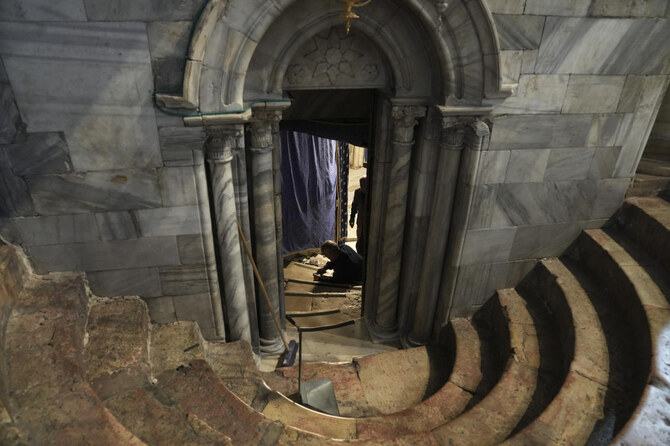
- Manger Square is empty of tourists and many businesses aren’t sure how much longer they can hold on
- The city’s hotel occupancy rate plunged from around 80 percent in early 2023 to around 3 percent today
Israeli strikes kill 3 people in Gaza, hospital says
DEIR AL-BALAH: Israeli military strikes on Monday killed three people west of Gaza City, according to the hospital where the casualties arrived.
Shifa Hospital reported the deaths amid the months-old ceasefire that has seen continued fighting. The Israeli army said Monday it is striking targets in response to Israeli troops coming under fire in the southern city of Rafah, which it says was a violation of the ceasefire. The army said it is striking targets “in a precise manner.”
The four-month-old U.S-backed ceasefire followed stalled negotiations and included Israel and Hamas accepting a 20-point plan proposed by US President Donald Trump aimed at ending the war unleashed by Hamas’ Oct. 7, 2023, attack into Israel. At the time, Trump said it would lead to a “Strong, Durable, and Everlasting Peace.”
Hamas freed all the living hostages it still held at the outset of the deal in exchange for thousands of Palestinian prisoners held by Israel and the remains of others.
But the larger issues the agreement sought to address, including the future governance of the strip, were met with reservations, and the US offered no firm timeline.
Top UN official concerned over Israel’s West Bank decision
The United Nations top official on Monday expressed concern about the Israeli security cabinet’s decision to deepen the country’s control over the occupied West Bank.
Secretary-General Antonio Guterres is “gravely concerned” and warned that the Israeli decision could erode the prospect of a two-state solution, spokesperson Stéphane Dujarric said in a statement.
“Such actions, including Israel’s continued presence in the Occupied Palestinian Territory are not only destabilizing but – as recalled by the International Court of Justice – unlawful,” he said.
Israel ‘s security cabinet on Sunday approved measures that aim to deepen Israeli control over the occupied West Bank and weaken the already limited powers of the Palestinian Authority.
Israel’s far-right Finance Minister Bezalel Smotrich said the measures would make it easier for Jewish settlers to force Palestinians to give up land, adding that “we will continue to bury the idea of a Palestinian state.”
Israel captured the West Bank, as well as Gaza and east Jerusalem, in the 1967 Mideast war. The Palestinians want all three territories for a future state.
Rafah crossing improving, official says
The Palestinian official set to oversee day-to-day affairs in Gaza said on Monday that passage through the Rafah crossing with Egypt is starting to improve after a chaotic first week of reopening marked by confusion, delays and a limited number of crossings.
Ali Shaath, head of the National Committee for the Administration of Gaza, told Egypt’s Al-Qahera News that operations at the crossing were improving on Sunday. He said 88 Palestinians were scheduled to travel through Rafah on Monday, more than have crossed in the initial days since reopening. Israel did not immediately confirm the figures.
The European Union border mission at the crossing said in a statement Sunday that 284 Palestinians had crossed since reopening. Travelers included people returning after having fled the war and medical evacuees and their escorts. In total, 53 medical evacuees departed during the first five days of operations.
That remains well below the agreed target of 50 medical evacuees exiting and 50 returnees entering daily, negotiated by Israeli, Egyptian, Palestinian and international officials.
Shaath and other members of the committee remain in Egypt, without Israeli authorization to enter the war-battered enclave.
The Rafah crossing opened last week for the first time since mid-2024, one of the main requirements for the ceasefire between Israel and Hamas. It was closed Friday and Saturday because of confusion around operations.
Palestinian officials say nearly 20,000 people are seeking to leave Gaza for medical care unavailable in its largely destroyed health system.
Palestinians who returned to Gaza in the first days after the crossing reopened described hourslong delays and invasive searches by Israeli authorities and an Israeli-backed Palestinian armed group, Abu Shabab. Israel denied mistreatment.
Gaza’s Health Ministry said on Monday that five people were killed over the previous 24 hours, bringing the death toll to 581 since the October ceasefire. The truce led to the return of the remaining hostages — both living captives and bodies — from the 251 abducted during the Oct. 7, 2023, attack that triggered the war.
Hamas-led militants killed around 1,200 people, mostly civilians, in the attack. Israel’s military offensive has since killed over 72,000 Palestinians, according to the ministry, which operates under the Hamas-run government and is staffed by medical professionals. The UN and independent experts consider it the most reliable source on war casualties.
Shifa Hospital reported the deaths amid the months-old ceasefire that has seen continued fighting. The Israeli army said Monday it is striking targets in response to Israeli troops coming under fire in the southern city of Rafah, which it says was a violation of the ceasefire. The army said it is striking targets “in a precise manner.”
The four-month-old U.S-backed ceasefire followed stalled negotiations and included Israel and Hamas accepting a 20-point plan proposed by US President Donald Trump aimed at ending the war unleashed by Hamas’ Oct. 7, 2023, attack into Israel. At the time, Trump said it would lead to a “Strong, Durable, and Everlasting Peace.”
Hamas freed all the living hostages it still held at the outset of the deal in exchange for thousands of Palestinian prisoners held by Israel and the remains of others.
But the larger issues the agreement sought to address, including the future governance of the strip, were met with reservations, and the US offered no firm timeline.
Top UN official concerned over Israel’s West Bank decision
The United Nations top official on Monday expressed concern about the Israeli security cabinet’s decision to deepen the country’s control over the occupied West Bank.
Secretary-General Antonio Guterres is “gravely concerned” and warned that the Israeli decision could erode the prospect of a two-state solution, spokesperson Stéphane Dujarric said in a statement.
“Such actions, including Israel’s continued presence in the Occupied Palestinian Territory are not only destabilizing but – as recalled by the International Court of Justice – unlawful,” he said.
Israel ‘s security cabinet on Sunday approved measures that aim to deepen Israeli control over the occupied West Bank and weaken the already limited powers of the Palestinian Authority.
Israel’s far-right Finance Minister Bezalel Smotrich said the measures would make it easier for Jewish settlers to force Palestinians to give up land, adding that “we will continue to bury the idea of a Palestinian state.”
Israel captured the West Bank, as well as Gaza and east Jerusalem, in the 1967 Mideast war. The Palestinians want all three territories for a future state.
Rafah crossing improving, official says
The Palestinian official set to oversee day-to-day affairs in Gaza said on Monday that passage through the Rafah crossing with Egypt is starting to improve after a chaotic first week of reopening marked by confusion, delays and a limited number of crossings.
Ali Shaath, head of the National Committee for the Administration of Gaza, told Egypt’s Al-Qahera News that operations at the crossing were improving on Sunday. He said 88 Palestinians were scheduled to travel through Rafah on Monday, more than have crossed in the initial days since reopening. Israel did not immediately confirm the figures.
The European Union border mission at the crossing said in a statement Sunday that 284 Palestinians had crossed since reopening. Travelers included people returning after having fled the war and medical evacuees and their escorts. In total, 53 medical evacuees departed during the first five days of operations.
That remains well below the agreed target of 50 medical evacuees exiting and 50 returnees entering daily, negotiated by Israeli, Egyptian, Palestinian and international officials.
Shaath and other members of the committee remain in Egypt, without Israeli authorization to enter the war-battered enclave.
The Rafah crossing opened last week for the first time since mid-2024, one of the main requirements for the ceasefire between Israel and Hamas. It was closed Friday and Saturday because of confusion around operations.
Palestinian officials say nearly 20,000 people are seeking to leave Gaza for medical care unavailable in its largely destroyed health system.
Palestinians who returned to Gaza in the first days after the crossing reopened described hourslong delays and invasive searches by Israeli authorities and an Israeli-backed Palestinian armed group, Abu Shabab. Israel denied mistreatment.
Gaza’s Health Ministry said on Monday that five people were killed over the previous 24 hours, bringing the death toll to 581 since the October ceasefire. The truce led to the return of the remaining hostages — both living captives and bodies — from the 251 abducted during the Oct. 7, 2023, attack that triggered the war.
Hamas-led militants killed around 1,200 people, mostly civilians, in the attack. Israel’s military offensive has since killed over 72,000 Palestinians, according to the ministry, which operates under the Hamas-run government and is staffed by medical professionals. The UN and independent experts consider it the most reliable source on war casualties.
© 2026 SAUDI RESEARCH & PUBLISHING COMPANY, All Rights Reserved And subject to Terms of Use Agreement.


