YAKUTAT, Alaska: Forget the open-air sleigh overloaded with gifts and powered by flying reindeer.
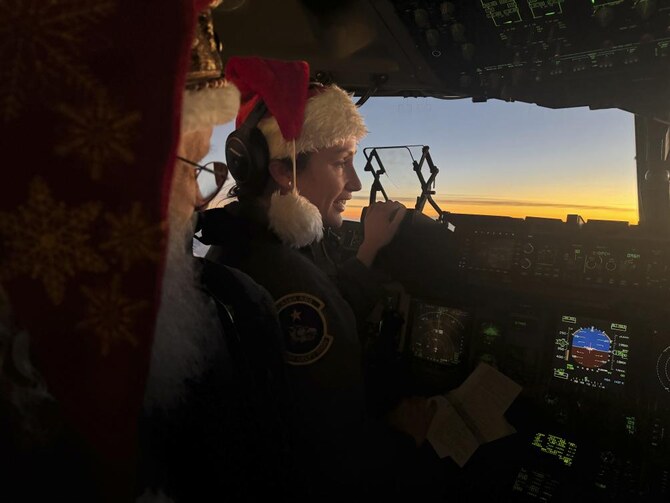
Santa and Mrs. Claus this week took supersized rides to southeast Alaska in a C-17 military cargo plane and a camouflaged Humvee, as they delivered toys to the Tlingit village of Yakutat, northwest of Juneau.
The visit was part of this year’s Operation Santa Claus, an outreach program of the Alaska National Guard to largely Indigenous communities in the nation’s largest state. Each year, the Guard picks a village that has suffered recent hardship — in Yakutat’s case, a massive snowfall that threatened to buckle buildings in 2022.
“This is one of the funnest things we get to do, and this is a proud moment for the National Guard,” Maj. Gen. Torrence Saxe, adjutant general of the Alaska National Guard, said Wednesday.
Saxe wore a Guard uniform and a Santa hat that stretched his unit’s dress regulations.
The Humvee caused a stir when it entered the school parking lot, and a buzz of “It’s Santa! It’s Santa!” pierced the cold air as dozens of elementary school children gathered outside.
In the school, Mrs. Claus read a Christmas story about the reindeer Dasher. The couple in red then sat for photos with nearly all of the 75 or so students and handed out new backpacks filled with gifts, books, snacks and school supplies donated by the Salvation Army. The school provided lunch, and a local restaurant provided the ice cream and toppings for a sundae bar.
Student Thomas Henry, 10, said while the contents of the backpack were “pretty good,” his favorite item was a plastic dinosaur.
Another, 9-year-old Mackenzie Ross, held her new plush seal toy as she walked around the school gym.
“I think it’s special that I have this opportunity to be here today because I’ve never experienced this before,” she said.
Yakutat, a Tlingit village of about 600 residents, is in the lowlands of the Gulf of Alaska, at the top of Alaska’s panhandle. Nearby is the Hubbard Glacier, a frequent stop for cruise ships.
Some of the National Guard members who visited Yakutat on Wednesday were also there in January 2022, when storms dumped about 6 feet (1.8 meters) of snow in a matter of days, damaging buildings.
Operation Santa started in 1956 when flooding severely curtailed subsistence hunting for residents of St. Mary’s, in western Alaska. Having to spend their money on food, they had little left for Christmas presents, so the military stepped in.
This year, visits were planned to two other communities hit by flooding. Santa’s visit to Circle, in northeastern Alaska, went off without a hitch. Severe weather prevented a visit to Crooked Creek, in the southwestern part of the state, but Christmas was saved when the gifts were delivered there Nov. 16.
“We tend to visit rural communities where it is very isolated,” said Jenni Ragland, service extension director with the Salvation Army Alaska Division. “A lot of kids haven’t traveled to big cities where we typically have Santa and big stores with Christmas gifts and Christmas trees, so we kind of bring the Christmas program on the road.”
After the C-17 Globemaster III landed in Yakutat, it quickly returned to Joint Base Elmendorf-Richardson in Anchorage, an hour away, because there was nowhere to park it at the village’s tiny airport. Later it returned to pick up the Christmas crew.
Santa and Mrs. Claus, along with their tuckered elves, were seen nodding off on the flight back.


![]()
![]()

Santa and Mrs. Claus use military transports to bring Christmas to an Alaska Native village

Short Url
https://arab.news/m4bej
Santa and Mrs. Claus use military transports to bring Christmas to an Alaska Native village
- Operation Santa started in 1956 when flooding severely curtailed subsistence hunting for residents of St. Mary’s, in western Alaska


Latest updates



© 2026 SAUDI RESEARCH & PUBLISHING COMPANY, All Rights Reserved And subject to Terms of Use Agreement.