

India’s legendary filmmaker Shyam Benegal dies at age 90

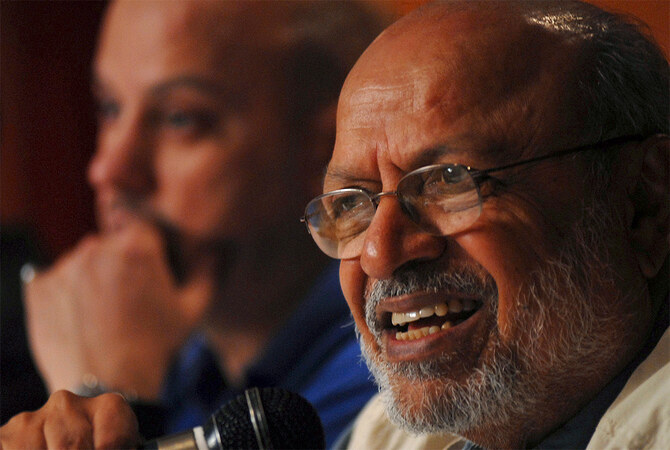
Indian film directors Shyam Benegal, right, is seen during a discussion on Indian Cinema in Hyderabad, India, on February 18, 2008. (AP/File)
Short Url
Updated 24 December 2024
Follow

India’s legendary filmmaker Shyam Benegal dies at age 90

  • Benegal, a mentor to several veteran Bollywood actors, died due to chronic kidney disease 
  • Benegal came into limelight in 1970s, with a series of films that challenged mainstream Bollywood

NEW DELHI: Shyam Benegal, a renowned Indian filmmaker known for pioneering a new wave cinema movement that tackled social issues in the 1970s, has died after suffering from chronic kidney disease. He was 90.

His contribution to cinema was recognized as a director, editor and screenwriter. He was also credited with a new genre of filmmaking.

Benegal passed away on Monday at Mumbai’s Wockhardt Hospital, and his cremation will take place on Tuesday, the Press Trust of India news agency reported, citing his daughter Piya.

“Benegal had been suffering from chronic kidney disease for several years but it had gotten very bad. That’s the reason for his death,” Piya said.

Many paid tribute to the legendary filmmaker on social media platform X.

Filmmaker Mahesh Bhatt wrote that Benegal told stories without pretense. “They were raw and real, about the struggles of ordinary people. His films had craft and conviction.”

“Deeply saddened by the passing of Shyam Benegal, whose storytelling had a profound impact on Indian cinema. His works will continue to be admired by people from different walks of life,” India’s Prime Minister Narendra Modi tweeted.

He was a mentor to top Indian actors, including Shabana Azmi, Smita Patil, Naseeruddin Shah, and Om Puri who made their mark in Bollywood’s popular cinema as well.

“I have lost my foster father, a man to whom I owe more than I can say,” posted Naseeruddin Shah.

“Shyam Benegal was not just a legend; he was a visionary who redefined storytelling and inspired generations,” said actor Manoj Bajpayee.

Benegal came into the limelight in the 1970s, with a series of films that challenged mainstream Bollywood. His films Ankur (1974), Nishant (1975), Manthan (1976), and Bhumika (1977) represented a parallel cinema dealing with the social realities of a poor nation.

“Ankur” explored the feudal divide in India, while ”Manthan” was based on the story of the country’s cooperative dairy milk movement.

Benegal was widely known for his series “Bharat Ek Khoj,” a landmark 53-episode television series based on the book Discovery of India, written by India’s first prime minister, Jawahar Lal Nehru, and chronicled the country’s troubled passages, from ancient times to modernity.

He also directed a 2023 biopic on Sheikh Mujibur Rahman, who led Bangladesh’s freedom struggle against Pakistan in the 1970s. Former Bangladesh Prime Minister Sheikh Hasina, who fled to India in August following a student movement, is the daughter of Sheikh Mujibur Rahman

Benegal was born in December 1934, in Hyderabad in southern India, and had an early launch in the world of cinema. He earned an Economics degree from Hyderabad’s Osmania University and established the Hyderabad Film Society. He also ventured into advertising, where he directed over 900 sponsored documentaries and advertising films.

Benegal is survived by his wife Nira Benegal and daughter Piya.


Row erupts in UK over support for British-Egyptian activist Alaa Abd El-Fattah

Updated 54 min 52 sec ago
Follow

Row erupts in UK over support for British-Egyptian activist Alaa Abd El-Fattah

  • Arab Spring campaigner’s ‘abhorrent’ social media posts resurface after he arrived in Britain following release from Egyptian prison
  • PM Starmer criticized for glowing welcome to activist who had previously been supported by both Tory and Labour governments

LONDON: The UK prime minister is facing criticism after he celebrated the return to Britain of a human rights activist who was recently released from an Egyptian prison but whose past social media posts apparently contained violent and antisemitic language.
Successive British governments have campaigned for the release of Alaa Abd El-Fattah, a dual national who had been imprisoned in Egypt for most of the past 14 years. He returned to the UK on Friday after Egyptian authorities lifted a travel ban that had forced him to remain in the country since he was freed in September.
But a senior member of the opposition Conservative Party on Saturday criticized Prime Minister Keir Starmer for giving a “personal, public endorsement” to Abd El-Fattah when Starmer said he was “delighted” the activist had been reunited with his family in Britain.
Robert Jenrick, the Conservative spokesman on justice issues, demanded to know whether Starmer knew about historical social media posts in which Abd El-Fattah allegedly endorsed killing “Zionists’’ and police. Jenrick also called on Starmer to condemn Abd El-Fattah’s statements and withdraw his “unalloyed endorsement” of the activist.
“Nobody should be imprisoned arbitrarily nor for peaceful dissent,’’ Jenrick wrote. “But neither should the prime minister place the authority of his office behind someone whose own words cross into the language of racism and bloodshed.”
The Foreign, Commonwealth and Development Office said in a statement that it had been “a long-standing priority” of governments under both major parties to work for Abd El-Fattah’s release. But that does not imply an endorsement of his social media posts, the spokesman said.
“The government condemns Mr. El-Fattah’s historic tweets and considers them to be abhorrent,” the statement said, using a slightly different style for his last name.
Abd El-Fattah’s family in the UK had vigorously campaigned for his release, arguing that he had spent most of the past 14 years behind bars because of his opposition to the government of President Abdel-Fattah El-Sisi.
His mother, Laila Soueif, 69, staged a 10-month hunger strike to pressure British authorities to do more to secure her son’s release.
Starmer on Friday paid tribute to Abd El-Fattah’s family and all the others who campaigned for his freedom.
“I’m delighted that Alaa Abd El-Fattah is back in the UK and has been reunited with his loved ones, who must be feeling profound relief,” Starmer said.
But soon after Abd El-Fattah arrived at London’s Heathrow Airport, critics began circulating historical social media posts in which he appeared to endorse the killing of Zionists and police.
The Times of London reported that Abd El-Fattah has previously said the comments were taken out of context and were part of a “private conversation” that took place during an Israeli offensive in the Gaza Strip.
Abd El-Fattah’s press team didn’t immediately response to a request for comment, and it was not immediately clear whether the posts were authentic.