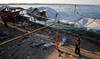
NAIROBI: The situation on South Sudan’s border was “completely overwhelming” as thousands flee war-torn Sudan each day, Doctors Without Borders (MSF) warned Monday.
The medical charity said up to 5,000 people were crossing the border every day. The United Nations recently put it even higher at 7-10,000 daily.
Sudan is suffering one of the world’s worst humanitarian emergencies since conflict broke out in April 2023 between the army and the paramilitary Rapid Support Forces, with tens of thousands killed and millions displaced.
An MSF emergency coordinator in Renk town, near a transit center holding some 17,000 people according to the UN, said they were working with the International Committee of the Red Cross to provide care.
“But the situation is completely overwhelming and it’s not enough,” said Emanuele Montobbio.
Facilities had been expanded to accommodate the arrival of war wounded, he said, but they were unable to treat everyone.
“Over 100 wounded patients, many with serious injuries, still await surgery,” Montobbio said.
Bashir Ismail, from Mosmon in Blue Nile state, was recovering in hospital in Renk after an air raid.
“Something hit me in the chest — it was the most painful experience of my life,” he said.
“I was so disoriented that it felt like I had lost my memory.”
MSF South Sudan’s deputy medical coordinator Roselyn Morales said thousands who had crossed faced “critical shortages of food and shelter, clean water, shelter and health care.”
South Sudan is ill-equipped to handle the arrival of thousands seeking shelter from war, with the young country itself battling violence, endemic poverty and natural disasters.
Alhida Hammed fled to Renk after his village was attacked and he was shot in Sudan’s Blue Nile state.
“The houses were blazing, and everyone was running in different directions,” he said.
He now has no shelter and is living under a tree, but does not want to return to Sudan.
“Home is no longer a home — it is filled with bad memories.”

South Sudan overwhelmed by refugee influx: MSF
https://arab.news/76maa
South Sudan overwhelmed by refugee influx: MSF
- Sudan is suffering one of the world’s worst humanitarian emergencies since conflict broke out in April 2023
Ambassadors, military attaches visit border villages, are briefed on weapons centralization south of Litani River
- Aoun: Contacts ongoing at home and abroad to consolidate security in southern Lebanon
BEIRUT: A delegation of Arab and foreign ambassadors and military attaches toured areas south of the Litani River on Monday, accompanied by Lebanese Army Chief Gen. Rodolphe Haykal, for a briefing on the progress in implementing the plan to confine weapons to the state.
According to a military source, the visit aimed to “review the tasks being carried out by the Lebanese Army to implement the Homeland Shield Plan mandated by the Council of Ministers.”
The first phase of the plan is scheduled to conclude by the end of this month, after which the army will move to the next stage: centralizing all weapons north of the Litani line.
Diplomats are expected to convey their field observations to their respective governments on the eve of a US–Saudi–French meeting with the army commander on Dec. 17 and 18 in Paris, where they will also discuss supporting the Lebanese Army, the weapons centralization plan, and the progress achieved.
The commander of the southern Litani sector, Brig. Gen. Nicolas Thabet, briefed the diplomatic delegation on the operations being carried out by the army during a meeting held at the Benoit Barakat Barracks in Tyre, which was joined by the army commander and senior officers. The delegation then moved on to inspect the western sector.
Haykal stressed “the importance of supporting the army and the commitment of all parties to the ceasefire agreement and respect for Lebanese territorial sovereignty.”
While Thabet presented an operational overview to the ambassadors, diplomats focused on evaluating the first phase of the weapons centralization plan, the mechanisms for transitioning to the second phase, and the obstacles facing the army.
The diplomats inspected several army positions deployed along the forward edge, including the town of Aita Al-Shaab and the Wadi Zibqin area, where a Hezbollah facility had previously been located.
A week earlier, Thabet had disclosed that “during the execution of its mission south of the Litani, the army has dealt with 177 tunnels since the launch of the Homeland Shield Plan, closed 11 crossings along the Litani River, and seized 566 rocket launchers.”
Monday’s tour coincided with a meeting on the other side of the border between US Envoy Thomas Barrack and Israeli Prime Minister Benjamin Netanyahu in Tel Aviv, focused on de-escalating tensions with Lebanon and Syria.
On Monday, Israel continued through its media to promote the prospect of an imminent Israeli military escalation against Hezbollah unless it is disarmed by the end of the year.
According to the Lebanese Army, “the recent Israeli strikes targeted civilian homes. The army inspected them after they were hit and found no evidence that they contained any weapons.”
Army command further clarified that “after the Israeli enemy threatened two days ago to bomb homes, the Lebanese Army conveyed a message to the relevant mechanism expressing its readiness to inspect the houses before any strike to determine whether they contained weapons or ammunition.”
However, Israeli forces allegedly rejected the proposal and went ahead with air raids on the homes, destroying them.
For his part, President Joseph Aoun said on Monday before visitors that “contacts are ongoing domestically and internationally to consolidate security and stability in the south through negotiations via the mechanism committee, which will hold a meeting next Friday.”
He added that the mechanism’s work “enjoys Lebanese, Arab, and international support, particularly following the appointment of former Ambassador Simon Karam as head of the Lebanese delegation.”
Aoun noted that “the choice of negotiation is the alternative to war, which would yield no results but would cause further harm and destruction to Lebanon and the Lebanese without exception.”