

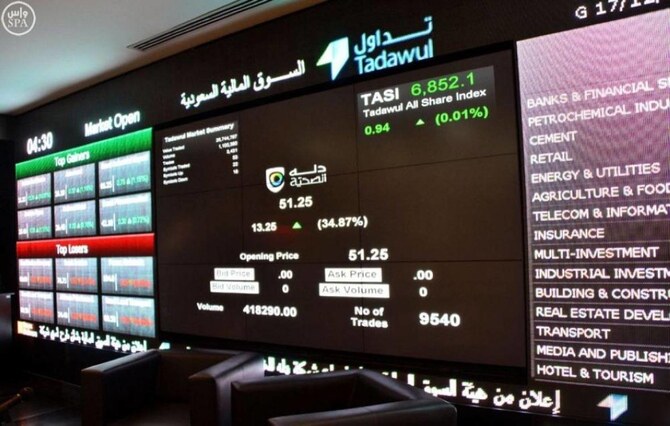
Closing Bell: Saudi main index slips to close at 11,849

The total trading turnover of the benchmark index was SR4.14 billion ($1.1 million), as 84 of the stocks advanced and 137 retreated. File/SPA
Short Url
Updated 22 December 2024
Follow

Closing Bell: Saudi main index slips to close at 11,849

  • Parallel market Nomu lost 205.92 points, or 0.65%, to close at 31,238.29
  • MSCI Tadawul Index shed 4.86 points, or 0.33%, to close at 1,484.56

RIYADH: Saudi Arabia’s Tadawul All Share Index slipped on Sunday, losing 43.07 points, or 0.36 percent, to close at 11,849.37.

The total trading turnover of the benchmark index was SR4.14 billion ($1.1 million), as 84 of the stocks advanced and 137 retreated. 

The Kingdom’s parallel market Nomu lost 205.92 points, or 0.65 percent, to close at 31,238.29. This comes as 37 of the listed stocks advanced while 49 retreated. 

The MSCI Tadawul Index also lost 4.86 points, or 0.33 percent, to close at 1,484.56. 

The best-performing stock of the day was Saudi Vitrified Clay Pipes Co., whose share price surged 9.89 percent to SR38.90. 

Other top performers included SHL Finance Co., whose share price rose 6.43 percent to SR18.20, as well as Taiba Investments Co., whose share price surged 4.97 percent to SR39.05.

Riyadh Cables Group Co. recorded the biggest drop, falling 6.30 percent to SR136.80.

Al Hassan Ghazi Ibrahim Shaker Co. saw its stock prices fall 5.15 percent to SR26.70.

Dr. Sulaiman Al Habib Medical Services Group also saw its stock prices decline 4.02 percent to SR286.60.

Meanwhile, Al-Baha Investment and Development Co. has announced moving its headquarters to Riyadh.

The company’s shares will be suspended for two business days starting Dec. 22, following the board of directors’ recommendation to reduce capital by 26.5 percent from SR 297 million to SR 218.3 million during an extraordinary general meeting held on Dec. 19.

The National Agricultural Development Co. has announced the release of its Sustainability and Environmental, Social, and Governance report.

According to a Tadawul statement, it outlines the company’s approach to embedding sustainability criteria within its strategic direction and operations as well. It reflects the firm’s commitment to its ESG responsibilities along with its devotion to sustainable development objectives in line with the Global Reporting Initiative standards. 

NADEC’s strategy complements the requirements for economic growth, keeps pace with developments in the Kingdom, and aligns with Vision 2030, which emphasizes environmental sustainability and renewable energy as fundamental components of development.

The analysis further provides a comprehensive insight into NADEC’s sustainability initiatives and commitments for the year 2023. The statement also disclosed that NADEC will periodically issue reports to keep stakeholders informed of ongoing developments going forward.

NADEC ended the session at SR25.50, up 0.98 percent.

Alhasoob Co. has announced the termination of the non-binding memorandum of understanding to acquire all shares of Alkhorayef Printing Solutions Co. by issuing shares to its owner Alkhorayef Group Co. 

A bourse filing revealed that this comes without reaching an agreement between the two parties and without any obligation on either party.

Alhasoob Co. ended the session at SR64.20, down 3.07 percent.

Saudi Basic Industries Corporation has announced the board decision to distribute SR5.1 billion in interim cash dividends to shareholders for the second half of the year. 

According to a Tadawul statement, the total number of shares eligible for dividends amounted to 3 billion shares, with the dividend per share standing at SR1.70. The statement also revealed that the percentage of dividend to the share par value stood at 17 percent.

SABIC ended the session at SR67.00, up 0.30 percent.


Jordan’s industry fuels 39% of Q2 GDP growth

Updated 31 December 2025
Follow

Jordan’s industry fuels 39% of Q2 GDP growth

JEDDAH: Jordan’s industrial sector emerged as a major contributor to economic performance in 2025, accounting for 39 percent of gross domestic product growth in the second quarter and 92 percent of national exports.

Manufactured exports increased 8.9 percent year on year during the first nine months of 2025, reaching 6.4 billion Jordanian dinars ($9 billion), driven by stronger external demand. The expansion aligns with the country’s Economic Modernization Vision, which aims to position the country as a regional hub for high-value industrial exports, the Jordan News Agency, known as Petra, quoted the Jordan Chamber of Industry President Fathi Jaghbir as saying.

Export growth was broad-based, with eight of 10 industrial subsectors posting gains. Food manufacturing, construction materials, packaging, and engineering industries led performance, supported by expanded market access across Europe, Arab countries, and Africa.

In 2025, Jordanian industrial products reached more than 144 export destinations, including emerging Asian and African markets such as Ethiopia, Djibouti, Thailand, the Philippines, and Pakistan. Arab countries accounted for 42 percent of industrial exports, with Saudi Arabia remaining the largest market at 955 million dinars.

Exports to Syria rose sharply to nearly 174 million dinars, while shipments to Iraq and Lebanon totaled approximately 745 million dinars. Demand from advanced markets also strengthened, with exports to India reaching 859 million dinars and Italy about 141 million dinars.

Industrial output also showed steady improvement. The industrial production index rose 1.47 percent during the first nine months of 2025, led by construction industries at 2.7 percent, packaging at 2.3 percent, and food and livestock-related industries at 1.7 percent.

Employment gains accompanied the sector’s expansion, with more than 6,000 net new manufacturing jobs created during the period, lifting total industrial employment to approximately 270,000 workers. Nearly half of the new jobs were generated in food manufacturing, reflecting export-driven growth.

Jaghbir said industrial exports remain among the economy’s highest value-added activities, noting that every dinar invested generates an estimated 2.17 dinars through employment, logistics, finance, and supply-chain linkages. The sector also plays a critical role in narrowing the trade deficit and supporting macroeconomic stability.

Investment activity accelerated across several subsectors in 2025, including food processing, chemicals, pharmaceuticals, mining, textiles, and leather, as manufacturers expanded capacity and upgraded production lines to meet rising demand.

Jaghbir attributed part of the sector’s momentum to government measures aimed at strengthening competitiveness and improving the business environment. Key steps included freezing reductions in customs duties for selected industries, maintaining exemptions for production inputs, reinstating tariffs on goods with local alternatives, and imposing a 16 percent customs duty on postal parcels to support domestic producers.

Additional incentives in industrial cities and broader structural reforms were also cited as improving the investment climate, reducing operational burdens, and balancing consumer needs with protection of local industries.