

Druze leader Jumblatt paves way for Lebanese-Syrian relationship without Assad

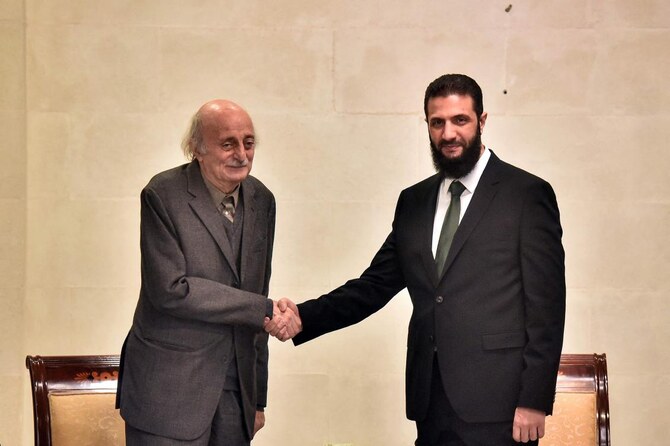
Lebanese Druze leader Walid Jumblatt, left, shakes hands with Syrian leader Ahmed Al-Sharaa during a visit to Damascus on Dec. 22, 2024. (AFP)
Short Url
Updated 22 December 2024
Follow

Druze leader Jumblatt paves way for Lebanese-Syrian relationship without Assad

  • Ahmed Al-Sharaa: ‘Syria’s interference in Lebanese affairs was negative’ in the past
  • Walid Jumblatt said Assad’s ouster should usher in new constructive relations between Lebanon and Syria

BEIRUT: Syria’s new leader, Ahmed Al-Sharaa, vowed in a meeting in Damascus on Sunday not to negatively interfere in neighboring Lebanon.

A major political and religious delegation headed by prominent Lebanese Druze leader Walid Jumblatt met with Hayat Tahrir Al-Sham leader Al-Sharaa at the People’s Palace.

This marks the first visit of a Lebanese political figure to Syria following the fall of Bashar Assad’s regime.

Al-Sharaa made a series of unprecedented statements about Lebanese-Syrian ties following decades of strained and sometimes bloody relations with the former Syrian regime.

Al-Sharaa said, “Syria was a source of concern and disturbance for Lebanon, and its interference in Lebanese affairs was negative,” adding that “the former Syrian regime killed Kamal Jumblatt, Bashir Gemayel, and Rafik Hariri.”

He emphasized that Syria, in its new era, would “stay at equal distance from everyone in Lebanon” and no longer engage in “negative interference in Lebanon.”

Al-Sharaa said that “Lebanon needs a strong economy and political stability that Syria will support” and called on the Lebanese to "erase from their memory the legacy of the old Syria in Lebanon.”

The international community was unable to solve the Syrian problem over 14 years, Al-Sharaa said.

“We took a different path because we believe that people can claim their rights by taking matters into their own hands only,” he added.

Commenting on Hezbollah’s years-long involvement in Syrian affairs in support of Assad’s regime, he said: “This is a new chapter with all components of the Lebanese people, regardless of previous stances.”

Jumblatt saluted the Syrian people for their “great victories and for getting rid of oppression and tyranny.”

He said: “We have a long way to go, and we are suffering from Israeli expansion, so I will present a memorandum on Lebanese-Syrian relations on behalf of the Democratic Gathering.”

Jumblatt believes that “the crimes committed against the Syrian people are similar to those committed in Gaza and Bosnia-Herzegovina and constitute crimes against humanity,” adding that “it is worth referring the matter” to international inquiries.

The delegation headed by Jumblatt included Sheikh Akl of the Unitarian Druze Community, leader of the Progressive Socialist Party Dr. Sami Abi Al-Muna, Taymour Jumblatt, Druze MPs and religious figures.

Jumblatt said: “We hope that Lebanese-Syrian relations will return through the embassies and that all of those who committed crimes against the Lebanese will be held accountable.

“We also hope that fair trials will be held for all those who committed crimes against the Syrian people.”

Also on Sunday, the Lebanese Public Prosecution said that it received a telegram from the American judiciary regarding the arrest of Maj. Gen. Jamil Al-Hassan, director of administration for the Air Force Intelligence under the collapsed Assad regime.

Unconfirmed reports suggest that several officers from the Assad regime fled to Lebanon in the early hours following the collapse of the regime, utilizing illegal crossings managed by Hezbollah.

Those who entered Lebanese territory illegally included members of the Fourth Division, previously led by Maher Al-Assad, including officers of various ranks.

Security reports indicated that “several of them were apprehended while in possession of hundreds of thousands of dollars and quantities of gold, and the detainees were subsequently handed over to the Lebanese General Security.”

Interior Minister Bassam Mawlawi confirmed last week that “some Syrian figures crossed overland into Lebanon, and some of them traveled via Beirut airport.”

He also said that photos of wanted Syrian officers had been disseminated to Lebanese air, sea, and land ports for their capture.

In a telegram circulated through Interpol, the US judiciary accuses Gen. Hassan of “war crimes, including genocide committed against the Syrian people by dropping explosive barrels.”

The international warrant has been disseminated to security services, which, as stated by a security source, are currently engaged in efforts to “ascertain whether Hassan is present in Beirut, in anticipation of his arrest and subsequent transfer to the judiciary.”

In a related incident on Sunday, unknown gunmen kidnapped Col. Ahmed Khair Beyk of the Syrian army on the Beirut Airport Road.

A security source linked the kidnapping to “drug and Captagon trafficking,” stating that “the perpetrators are a gang involved in the drug trade.”

Beyk had previously served as an aide to Brig. Gen. Ghassan Bilal in the Syrian army’s Fourth Division.

In other developments, the issue of detainees and opponents of the Syrian regime, held in Lebanese prisons for years, has resurfaced following the fall of the Assad regime in Syria.

Their families held a sit-in in downtown Beirut on Sunday to demand general amnesty.

The protesters called for “speeding up trials and releasing their sons, notably the religious leaders among them.”

The number of detainees stands at 350, including 180 Lebanese and 170 Syrians, many of whom were arrested for supporting the Syrian opposition and labeled as terrorists.

On the other side of the border, the Lebanese Red Cross received seven Lebanese citizens at the Naqoura crossing.

They had been kidnapped by Israeli forces that infiltrated Lebanese territory and subjected them to interrogation.

The Israeli army claimed through its spokesperson Avichay Adraee that the forces of the 188th Brigade uncovered a large Hezbollah combat complex that contained eight weapons depots above and below ground, connected through a network of underground tunnels.

Communication and electrical devices, anti-tank missiles aimed at northern Israeli towns, explosives, computers, and other items were found, said the spokesperson.

The complex was destroyed, and the weapons were seized.


A language course is reviving Moroccan Jewish culture and bridging Middle East divide

Updated 7 sec ago
Follow

A language course is reviving Moroccan Jewish culture and bridging Middle East divide

  • “In my family there were (many) different languages — Moroccan Arabic, French, Hebrew at the synagogue, and my dad also speaks Amazigh, Berber,” said Elfassi.
  • His passions for music and language took Elfassi on a journey to Bordeaux, France, and Be’er Sheva, Israel, writing a dissertation on Jewish identity among Moroccan Jews

RABAT: Growing up in Fez, Morocco, Yona Elfassi was always aware of the history of the city, which has been a center of culture, learning and spirituality since the ninth century.
Home to great minds such as the 12th-century philosopher and jurist Ibn Rushd and his contemporary, the physician and codifier of Jewish law Maimonides, the city was shaped by Jewish, Arab, Amazigh, Spanish and French cultures.
These influences left a deep imprint on Elfassi, 37.
“In my family there were (many) different languages — Moroccan Arabic, French, Hebrew at the synagogue, and my dad also speaks Amazigh, Berber,” said Elfassi.
Music, too, was a constant presence — from Andalusian to Flamenco, to Moroccan classic, to Moroccan chaabi popular, to Berber music,” he said. “We weren’t a family of professional musicians, but we were a family that lived with music.”
As a Jewish resident of Morocco, Elfassi belongs to a tiny demographic, as 99 percent of Jews of Moroccan heritage today live elsewhere. After major emigrations in the 20th century, only around 2,500 Jews remain in a country where they once made up 5 percent of the population. Today an estimated 50,000 live in France, 25,000 in Canada and 25,000 in the United States; and some 1 million Moroccan Jews make up one of Israel’s largest ethnic groups.
His passions for music and language took Elfassi on a journey to Bordeaux, France, and Be’er Sheva, Israel, writing a dissertation on Jewish identity among Moroccan Jews. (He has two doctorates, one in sociology and political science from Sciences Po Bordeaux and one in anthropology and history from Ben-Gurion University of the Negev.)
His research into Morocco’s history eventually grew into a vocation to teach Darija, the Moroccan Arabic dialect, to allow diaspora Moroccan Jews to connect with their ancestors through language, culture and stories.
“As a sociologist, I was fueled by the conviction that academic research ought to forge connections and deepen understanding” beyond the academy, Elfassi said. “These stories and human histories are at the core of why I decided to teach, and my identity has inspired me to work with Jews of Moroccan background to reconcile with their ancestral language.”
As the COVID-19 pandemic ended, he launched Limud Darija, an educational movement and multimedia language platform. The hybrid courses mix Zoom classes with in-person gatherings, which take place in Israel. Elfassi also holds music workshops, drawing from Sephardic piyyutim— Jewish liturgical poems with Judeo-Arabic pronunciation and melodies — and the music of 20th-century Moroccan pop icons such as Hajja El Hamdaouia, Sliman Elmaghribi, Zohra El Fassiya and Abdelhadi Belkhayat.
Limud Darija’s impact has grown rapidly. “Today our community includes over 500 active members with the mission of connecting people across generations, helping participants reclaim lost voices and fostering resilience and a sense of belonging through cultural practices,” Elfassi said.
Through his Instagram feed and TikTok presence, many Moroccan Muslims have found Elfassi’s work and are inspired to see Moroccan Jews preserving the language of their shared home. Muslims, Elfassi said, in turn have expressed interest in learning Hebrew. “I opened an active WhatsApp group where we’re teaching Hebrew to Muslim speakers of Darija,” he said.
“Through this shared connection, divisions begin to fade,” Elfassi said. “The Israelis the Muslim Moroccans meet are seen as Moroccans like themselves, as family. They are talking a common language, talking about what unites them, people are begun to be seen as individuals.” The Muslims and Jews, he said, get the chance “to bond over music and heritage and language, not political or war-related topics, and they do not further the false ‘pro-Palestine’ vs ‘pro-Israel’ dichotomy, and instead humanize everyone as individuals, as human beings.”
Limud Darija students describe how the program has connected them more deeply with people in their own lives as well. “My parents talked between them in Moroccan language, but by the time I was an adult, I forgot,” said Yehudit Levy, a retired schoolteacher in Ganei Tikvah, Israel, who has studied with Elfassi for three years. “Since I started to learn with Yona, everything comes up — songs, music, food, poetry, all the traditional things come up. I smell Morocco when I am in the class.”
Noam Sibony, a Limud Darija alumnus, is a neuroscience researcher and musician living in Toronto. The 28-year-old spent nine months volunteering in Lod, an Israeli city whose population is Arab and Jewish, at a community center, working with local children and youth. Limud Darija, he said, showed him how learning the language of another culture can help build relationships that transcend regional politics and conflicts.
Habiba Boumlik, a professor of French, literature and women’s and gender studies at LaGuardia University in Queens, New York, and co-founder of the New York Forum of Amazigh Film, an annual film festival celebrating the Indigenous Berber people of North Africa, sees parallels between Elfassi’s work and her efforts to preserve the Tamazight language.
“I give credit to people who invest in learning language, and it is great with the new technology and variety of sources on the Internet. Even if people aren’t fluent, they can do so much with the language, and they will go to Morocco and connect more deeply,” Boumlik said.
Darija is closely related to the Judeo-Arabic dialect, Boumlik explained, and so has the potential to contribute to the Moroccan vernacular, just as Judeo-Arabic slang and idioms have shaped Modern Hebrew.
“The exchange among the Moroccans and Israelis will only enrich Darija as they also enrich their families and themselves,” Boumlik said. “And it is so important that they can connect with Moroccans on the Internet and have a dialogue. It is not just the culture and language of their grandparents — it is the living language and culture of the new generation.”
Bringing people together on this level, Elfassi said, is peacebuilding on a human scale, prioritizing personal stories, shared culture and mutual respect. “For me, peace will start with people, not with the decision-makers,” he said. “Peace is just two people talking to each other, having respect for each other and having a conversation where they can disagree, but where they always show respect for the humanity of the other.”