

Lebanese army reclaims Palestinian sites in Bekaa that served Syrian regime and Hezbollah

1 / 2
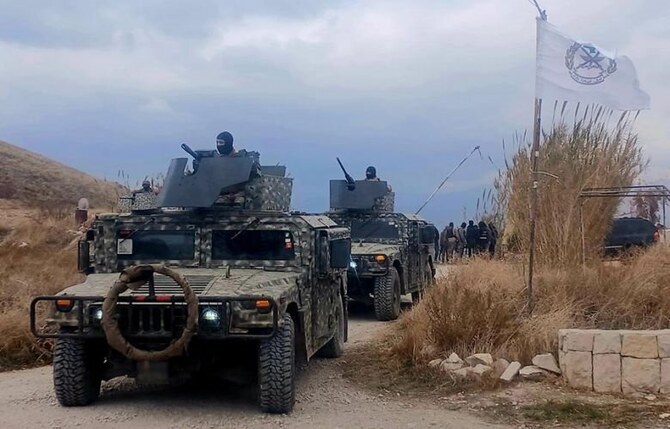
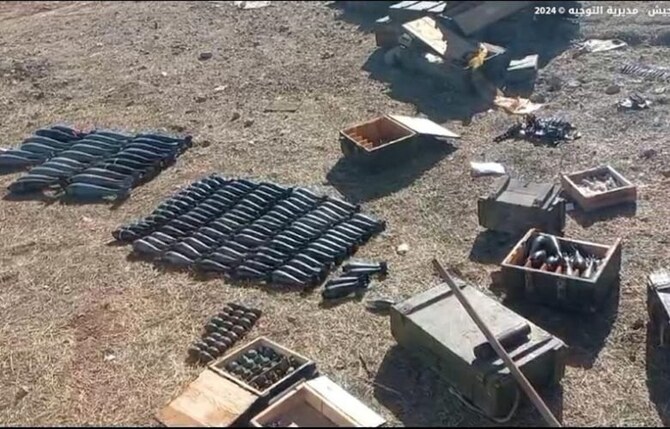
On Saturday, the Lebanese army took control of several strategic sites previously held by Palestinian factions. (Supplied)
2 / 2
On Saturday, the Lebanese army took control of several strategic sites previously held by Palestinian factions. (Supplied)
Short Url
Updated 21 December 2024
Follow

Lebanese army reclaims Palestinian sites in Bekaa that served Syrian regime and Hezbollah

  • Israeli forces continue violations of ceasefire agreement, carrying out demolition operations in Naqoura

BEIRUT: On Saturday, the Lebanese army took control of several strategic sites previously held by Palestinian factions.

The factions had been affiliated with Syrian president Bashar Assad’s regime, which fell 13 days ago, and subsequently with Hezbollah, and had posed a threat to Lebanon’s eastern sector.

The army took over the Sultan Yaacoub site in western Bekaa from the Popular Front for the Liberation of Palestine, the General Command and the Halwa camp from Fatah Al-Intifada, and the Hechmech site, located between Qousaya and Deir El Ghazal in central Bekaa, from both factions.

Army command said the forces took over the sites in addition to “seizing quantities of weapons and ammunition and military gear.”

It added that the army “continues to take control of positions previously occupied by Palestinian groups within Lebanon as part of efforts to maintain security and stability and enforce state authority in various areas.”

The camps had remained outside of the Lebanese state’s control for around 40 years, refusing to surrender their weapons under the 1989 Taif Agreement, which stated that all weapons should be surrendered to the Lebanese State, except for firearms in Palestinian camps in Lebanon, which were considered Syrian-protected areas.

Hisham Debsi, director of the independent Palestinian center Tatweer for Strategic Studies and Human Development, told Arab News: “The Syrian regime had launched 13 Palestinian organizations, forming its own system that subsequently served its own policies and those of Hezbollah. With the collapse of Hezbollah, these organizations, which are located in Bekaa, became unprotected, and with the collapse of the Assad regime, the last shield for these organizations — who can be called mercenaries — has fallen.

“They were a disgrace to the Palestinian cause because they would speak in its name when, in fact, they were tools used by the Syrian regime and Hezbollah,” he continued. 
These Palestinian factions aimed to “marginalize Fatah and abolish independent Palestinian decision-making,” said Debsi, adding that the Lebanese army taking control of these sites restored “normalcy.”

Regarding the fate of Palestinian militants affiliated with these factions, he said: “As individuals, if they have families in the Lebanese camps, they can join them. However, most of them are Palestinian refugees from Syria, and they can go wherever they wish in Syria.”

Debsi claimed that most Palestinian refugees who fled from Syria to Lebanon during the 2011 protests had since left for Europe, with only a small number remaining in Lebanon’s camps.

In the recent conflict in Lebanon, Israel did not directly target sites associated with Palestinian factions, which were bombarded in the 2006 war. For years, reports have alleged that these sites housed weaponry, but there has never been concrete evidence to support such claims.

In line with security measures enforcing UN Resolution 1701, the Lebanese army reported on Saturday that its intelligence unit had arrested six individuals and seized weapons during raids on three Palestinian refugee camps in the Bekaa Valley.

In southern Lebanon, invading Israeli forces continued their violations of the ceasefire agreement, carrying out further demolition operations in the town of Naqoura. They also set up a permanent military checkpoint in place of a Lebanese army post near the town’s fishing harbor and razed citrus groves near the UNIFIL headquarters.

An Israeli drone flew at low altitude over the border, an area that residents of the south are prohibited from approaching or traversing.

In the southern suburb of Beirut, the General Directorate of Civil Defense released a statement saying that search and rescue teams had successfully recovered the bodies of four victims from the rubble of the Ayoub building in the Haret Hreik area, which was hit by Israeli airstrikes targeting the residence of Hezbollah Secretary-General Hassan Nasrallah on Sept. 27.

The bodies will undergo DNA testing to confirm their identities, along with three other bodies discovered on Friday in the same area, the statement added.


US military launches strikes in Syria against Daesh fighters after American deaths

Updated 20 December 2025
Follow

US military launches strikes in Syria against Daesh fighters after American deaths

  • “This is not the beginning of a war — it is a declaration of vengeance,” Defense Secretary Pete Hegseth says
  • President Trump earlier pledged “very serious retaliation” but stressed that Syria was fighting alongside US troops

WASHINGTON: The Trump administration launched military strikes Friday in Syria to “eliminate” Daesh group fighters and weapons sites in retaliation for an ambush attack that killed two US troops and an American interpreter almost a week ago.
A US official described it as “a large-scale” strike that hit 70 targets in areas across central Syria that had Daesh (also known as Islamic State or IS) infrastructure and weapons. Another US official, who also spoke on condition of anonymity to discuss sensitive operations, said more strikes should be expected.
The attack was conducted using F-15 Eagle jets, A-10 Thunderbolt ground attack aircraft and AH-64 Apache helicopters, the officials said. F-16 fighter jets from Jordan and HIMARS rocket artillery also were used, one official said.
“This is not the beginning of a war — it is a declaration of vengeance. The United States of America, under President Trump’s leadership, will never hesitate and never relent to defend our people,” Defense Secretary Pete Hegseth said on social media.


President Donald Trump had pledged “very serious retaliation” after the shooting in the Syrian desert, for which he blamed Daesh. The troops were among hundreds of US troops deployed in eastern Syria as part of a coalition fighting the terrorist group.
Trump in a social media post said the strikes were targeting Daesh “strongholds.” He reiterated his support for Syrian President Ahmad Al-Sharaa, who he said was “fully in support” of the US effort to target the militant group.
Trump also offered an all-caps threat, warning the group against attacking US personnel again.
“All terrorists who are evil enough to attack Americans are hereby warned — YOU WILL BE HIT HARDER THAN YOU HAVE EVER BEEN HIT BEFORE IF YOU, IN ANY WAY, ATTACK OR THREATEN THE USA.,” the president added.
The attack was a major test for the warming ties between the United States and Syria since the ouster of autocratic leader Bashar Assad a year ago. Trump has stressed that Syria was fighting alongside US troops and said Al-Sharaa was “extremely angry and disturbed by this attack,” which came as the US military is expanding its cooperation with Syrian security forces.
Syria’s foreign ministry in a statement on X following the launch of US strikes said that last week’s attack “underscores the urgent necessity of strengthening international cooperation to combat terrorism in all its forms” and that Syria is committed “to fighting Daesh and ensuring that it has no safe havens on Syrian territory and will continue to intensify military operations against it wherever it poses a threat.”


Daesh has not claimed responsibility for the attack on the US service members, but the group has claimed responsibility for two attacks on Syrian security forces since, one of which killed four Syrian soldiers in Idlib province. The group in its statements described Al-Sharaa’s government and army as “apostates.” While Al-Sharaa once led a group affiliated with Al-Qaeda, he has had a long-running enmity with Daesh.
Syrian state television reported that the US strikes hit targets in rural areas of Deir ez-Zor and Raqqa provinces and in the Jabal Al-Amour area near Palmyra. It said they targeted “weapons storage sites and headquarters used by Daesh as launching points for its operations in the region.”

Trump this week met privately with the families of the slain Americans at Dover Air Force Base in Delaware before he joined top military officials and other dignitaries on the tarmac for the dignified transfer, a solemn and largely silent ritual honoring US service members killed in action.

President Donald Trump, from left, Defense Secretary Pete Hegseth and Chairman of the Joint Chiefs Air Force Gen. Dan Caine attend a casualty return ceremony at Dover Air Force Base, Delaware, on Dec. 17, 2025,of soldiers who were killed in an attack in Syria last week. (AP)

The guardsmen killed in Syria last Saturday were Sgt. Edgar Brian Torres-Tovar, 25, of Des Moines, and Sgt. William Nathaniel Howard, 29, of Marshalltown, according to the US Army. Ayad Mansoor Sakat, of Macomb, Michigan, a US civilian working as an interpreter, was also killed.
The shooting nearly a week ago near the historic city of Palmyra also wounded three other US troops as well as members of Syria’s security forces, and the gunman was killed. The assailant had joined Syria’s internal security forces as a base security guard two months ago and recently was reassigned because of suspicions that he might be affiliated with Daesh, Interior Ministry spokesperson Nour Al-Din Al-Baba has said.
The man stormed a meeting between US and Syrian security officials who were having lunch together and opened fire after clashing with Syrian guards.
When asked for further information, the Pentagon referred AP to Hegseth’s social media post.