Israel army says troops shot Syrian protester in leg

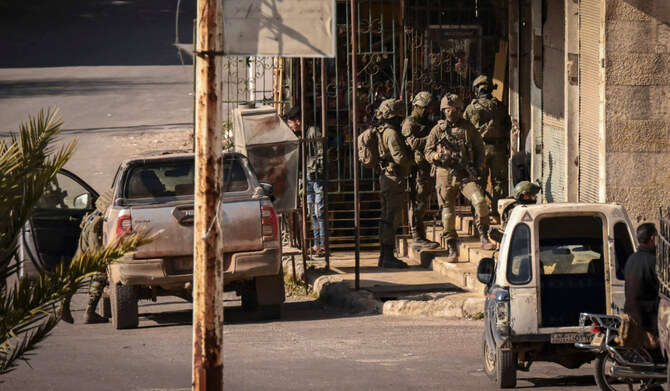
Israeli soldiers patrol in the Syrian town of Jubata al-Khashab, in the UN-patrolled buffer zone in the Israeli-annexed Golan Heights, on December 20, 2024. (AFP)
Short Url
Updated 21 December 2024
Follow

Israel army says troops shot Syrian protester in leg

  • Israeli forces have been operating in areas beyond the buffer zone in Syrian-controlled territory, the military has confirmed

JERUSALEM: The Israeli military said its forces shot a protester during a demonstration against the army’s activities in a village in southern Syria on Friday, injuring him in the leg.
Since Islamist-led rebels toppled Syrian president Bashar Assad on December 8 Israel has carried out hundreds of air strikes on Syrian military facilities in what it says is a bid to prevent them from falling into hostile hands.
In a move widely condemned internationally, Israel also sent troops into a United Nations-patrolled buffer zone in the Golan Heights, and beyond, calling it a defensive and temporary measure.
“During a protest against IDF’s activities in the area of Maariya in southern Syria, IDF (Israeli military) called on protesters to distance themselves from the troops,” the military told AFP.
The village is just outside the southern point of the UN-patrolled zone.
“After the troops identified a threat, they operated in accordance with standard operating procedures against the threat... The protester was shot in the leg,” the military said.
The London-based Syrian Observatory for Human Rights war monitor said the Israeli troops were stationed at a barracks in the village.
“During a protest condemning the Israeli incursion, a young man was injured by Israeli forces’ gunfire in the village of Maariya, in the Daraa region,” the Observatory said.
Israeli forced from Al-Jazeera barracks “opened fire directly at the demonstrators,” wounding the man in the leg, it said.

A villager from Maariya told AFP that Israeli soldiers had been entering his village and other nearby villages in recent days.
“When the Israelis entered ... they sowed fear and horror among the people, the children, the women,” Ali Al-Khalaf, 52, told AFP.
“So much so that some people fled to other nearby villages. They (Israeli troops) entered the villages of Maariya, Aabdyn and Jamlah,” he added.
On Tuesday, Israeli Prime Minister Benjamin Netanyahu held a security briefing atop a strategic Syrian mountain inside the UN-patrolled zone.
During the visit Netanyahu reviewed the army’s deployment in the area, his office said.
Hours after Assad was overthrown, Netanyahu had ordered Israeli troops to seize the buffer zone.
Israel has framed the move as temporary and defensive, with Netanyahu saying it was in response to a “vacuum on Israel’s border and in the buffer zone.”
Israeli forces have also been operating in areas beyond the buffer zone in Syrian-controlled territory, the military has confirmed.
Netanyahu said his country has “no interest in confronting Syria. Israel’s policy toward Syria will be determined by the evolving reality on the ground.”
Syria’s new leader Ahmed Al-Sharaa accused Israel of “a new unjustified escalation in the region” by entering the buffer zone but said “the general exhaustion in Syria after years of war” prevents it from entering new conflicts.
Israel conquered around two-thirds of the Golan during the 1967 Arab-Israeli war and later annexed it. The United States, during Donald Trump’s first term as president, is the only country that has recognized Israel’s sovereignty over the occupied Golan.


Iran president confirms talks with US

Updated 7 sec ago
Follow

Iran president confirms talks with US

  • No official confirmation from Tehran on where the talks would be held

Iran’s president confirmed on Tuesday that he had ordered the start of talks with the US following requests “from friendly governments.”

There has been no official confirmation from Iran on where the talks would be held, but an Arab official, speaking on condition of anonymity, told AFP a meeting was likely to take place in Turkiye on Friday, following diplomatic interventions by Ankara, as well as Egypt, Oman and Qatar.
US President Donald Trump  has spoken of potential military action and sent an aircraft carrier group to the Middle East following anti-government protests in Iran that were met with a deadly crackdown last month.

FASTFACT

On Tuesday, Qatar’s Foreign Ministry said diplomacy with Iran was ‘continuing very intensively,’ in ‘tandem with all our neighbors.’

Trump has maintained he is hopeful that Washington will “work something out” with Tehran, but also warned that “bad things would happen” if a deal was not agreed.
Tehran has insisted it wants diplomacy, while promising a decisive response to any aggression.
“I have instructed my Minister of Foreign Affairs, provided that a suitable environment exists — one free from threats and unreasonable expectations — to pursue fair and equitable negotiations,” President Masoud Pezeshkian wrote in a post on X.
He added that the talks followed requests “from friendly governments.”
On Tuesday, Qatar’s Foreign Ministry said diplomacy with Iran was “continuing very intensively,” in “tandem with all our neighbors.”
Earlier, a senior official from the UAE said Iran needed to reach a deal and “rebuild their relationship with the  US.”

I have instructed my Minister of Foreign Affairs, provided that a suitable environment exists to pursue fair and equitable negotiations.

President, Masoud Pezeshkian

“I would like to see direct Iranian-American negotiations leading to understandings so that we don’t have these issues every other day,” said presidential adviser Anwar Gargash.
Iran has repeatedly stressed that any talks should remain focused solely on the nuclear issue, rejecting the possibility of negotiations over its missile program or defense capabilities.
In an interview with CNN broadcast on Monday, Iranian Foreign Minister Abbas Araghchi said Tehran had lost trust in Washington as a negotiating partner but a deal on the nuclear issue remained achievable.
“So I see the possibility of another talk if the US negotiation team follows what President Trump said: to come to a fair and equitable deal to ensure that there is no nuclear weapons,” he said.
Since his return to office in January last year, Trump has reinstated his “maximum pressure” policy of sanctions against Iran, piling additional pain on a floundering economy.
Protests against the rising cost of living broke out in Tehran in December before evolving into wider nationwide anti-government demonstrations that triggered a deadly crackdown by the authorities.
Iranian officials have acknowledged more than 3,000 deaths during the unrest, but insist that most were members of the security forces and innocent bystanders, attributing the violence to “terrorist acts.”
The Human Rights Activists News Agency, a US-based NGO, says it has confirmed 6,854 deaths, mostly protesters killed by security forces, with other rights groups warning the figure is likely far higher.
On Tuesday, the NGO said it had counted at least 50,235 arrests linked to the protests, with further detentions ongoing.
Meanwhile, local media reported that the authorities had detained 139 foreign nationals in central parts of the country during the protests.