Macron sees new role for French military base in Djibouti

1 / 3
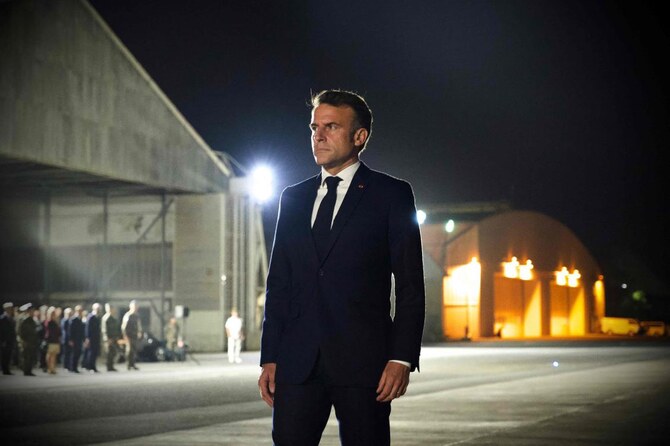
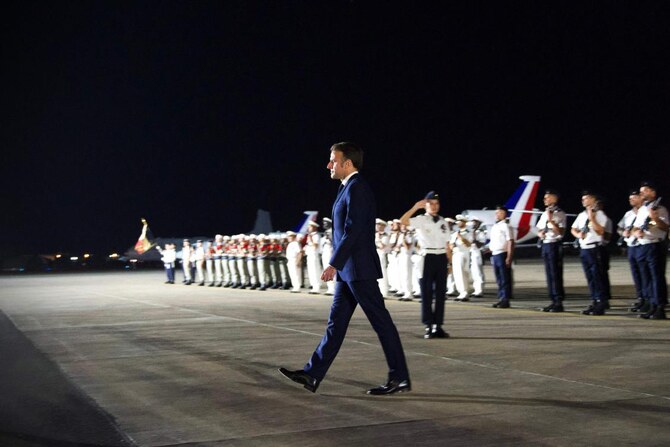
France's President Emmanuel Macron arrives to attend a Christmas dinner with French soldiers at an airbase in Djibouti. (AFP)
2 / 3
France's President Emmanuel Macron gives a speech to French soldiers at an airbase in Djibouti. (AFP)
3 / 3
France's President Emmanuel Macron arrives to attend a Christmas dinner with French soldiers at an airbase in Djibouti. (AFP)
Short Url
Updated 20 December 2024
Follow

Macron sees new role for French military base in Djibouti

  • Macron was speaking after France was forced to pull troops out of several other African countries

DJIBOUTI: French President Emmanuel Macron said Friday its military base in Djibouti could assume a greater role, speaking after Paris was forced to pull troops out of several other African countries.
“Our role is changing in Africa because the world is changing in Africa, because public opinion is changing, because governments are changing,” he said.
Macron was addressing French forces stationed at the strategic Horn of Africa nation before sitting down for a Christmas meal with the troops, a regular feature on the presidential calendar.
France had to change its past logic of having too many military bases in Africa, he said.
In recent years, Mali, Burkina Faso and Niger, all three under military rule, have told France to get its troops out.
They have turned instead to Russia for military support in their fight against the jihadist forces active in the region.
And on Friday, France also began withdrawing ground troops from Chad, after N’Djamena last month abruptly ended military cooperation with the former colonial power.
The central African country was the last Sahel nation to host French troops.
Its decision also came shortly after Senegal’s President Bassirou Diomaye Faye told AFP in an interview that France should close its military bases there.
Djibouti has in the past been part of France’s Indo-Pacific strategy, contributing to freedom of navigation in the Red Sea.
“It is also, and will also have to be reinvented as, a projection point for some of our African missions,” Macron said, without elaborating.
The French base at Djibouti currently hosts 1,500 soldiers.
That makes it France’s largest military contingent abroad and the only one untouched by the military draw-down African nations have imposed on Paris.
In July, Djibouti and France renewed their defense cooperation treaty.
As well as paying rent for the base, France also assumes responsibility for patrolling the airspace over the country.
The small east African state is a relative haven of stability. On the other side of the Red Sea lies Yemen, gripped in a devastating civil war.


US officials say Gaza stabilization force will not fight Hamas

Updated 8 sec ago
Follow

US officials say Gaza stabilization force will not fight Hamas

  • An American two-star general is under consideration to lead the ISF, but no decision has been made, officials said

NEW YORK: International troops could be deployed in the Gaza Strip as early as next month to form a UN-authorized stabilization force, two US officials said, but it remains unclear how Hamas will be disarmed.
Officials said the International Stabilization Force, or ISF, would not fight Hamas. 
They said many countries have expressed interest in contributing, and US officials are currently working out the size of the ISF, its composition, housing, training, and rules of engagement.

There is a lot of quiet planning that’s going on behind the scenes right now for phase two of the peace deal.

Karoline Leavitt, White House spokesperson

An American two-star general is under consideration to lead the ISF, but no decision has been made, officials said.
Deployment of the force is a key part of the next phase of US President Donald Trump’s Gaza peace plan. 
Under the first phase, a fragile ceasefire in the two-year war began on Oct.10, and Hamas released hostages, and Israel freed detained Palestinians.
“There is a lot of quiet planning that’s going on behind the scenes right now for phase two of the peace deal,” White House spokesperson Karoline Leavitt said. 
“We want to ensure an enduring and lasting peace.”
Indonesia has said it is prepared to deploy up to 20,000 troops to take on health and construction-related tasks in Gaza.
“It is still in the planning and preparation stages,” said Rico Sirait, spokesperson of the Indonesian Defense Ministry. 
“We are now preparing the organizational structure of the forces to be deployed.”

Israel still controls 53 percent of Gaza, while nearly all the 2 million people in the enclave live in the remaining Hamas-held area. The plan — which needs to be finalized by the so-called Board of Peace — is for the ISF to deploy in the area held by Israel, the US officials said.
Then, according to the Trump peace plan, as the ISF establishes control and stability, Israeli troops will gradually withdraw “based on standards, milestones, and timeframes linked to demilitarization.”
A UN Security Council resolution adopted on Nov. 17 authorized a Board of Peace and countries working with it to establish the ISF. 
Trump said on Wednesday that an announcement on which world leaders will serve on the Board of Peace will be made early next year.
The Security Council authorized the ISF to work alongside newly trained and vetted Palestinian police to stabilize security “by ensuring the process of demilitarizing the Gaza Strip, including the destruction and prevention of rebuilding of the military, terror, and offensive infrastructure, as well as the permanent decommissioning of weapons from non-state armed groups.”
However, it remains unclear exactly how that would work.
US Ambassador to the UN Mike Waltz noted on Thursday that the Security Council authorized the ISF to demilitarize Gaza by all means necessary, which means the use of force. 
“Obviously, that’ll be a conversation with each country,” he told Israel’s Channel 12, adding that discussions on rules of engagement were underway.
Hamas has said the issue of disarmament has not been discussed with them formally by the mediators — the US, Egypt, and Qatar — and the group’s stance remains that it will not disarm until a Palestinian state is established.
Israel’s Prime Minister Benjamin Netanyahu said in a speech on Sunday that the second phase would move toward demilitarization and disarmament.
“Now that raises a question: Our friends in America want to try and establish a multinational task force to do the job,” he said. “I told them I welcome it. Are volunteers here? Be my guest,” Netanyahu said.
“We know there are certain tasks that this force can perform ... but some things are beyond their abilities, and perhaps the main thing is beyond their abilities, but we will see about that,” he said.