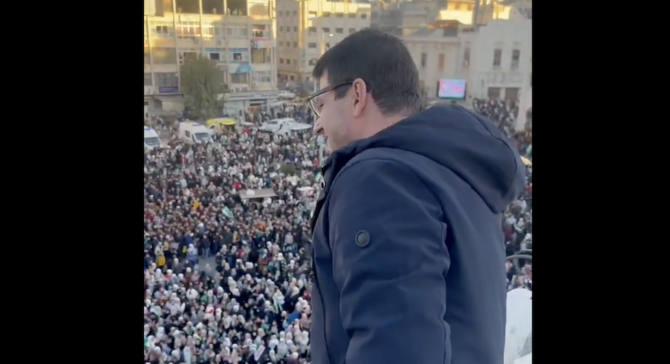
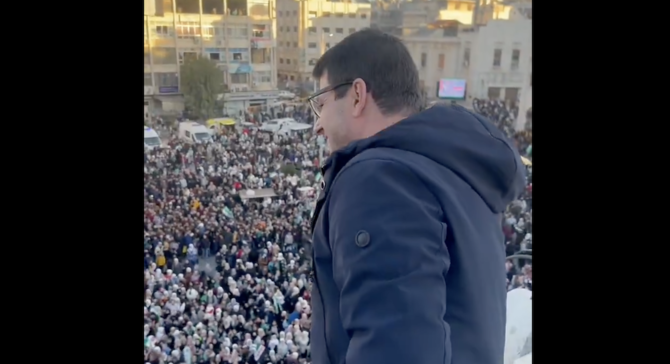
DUBAI: Syrian Al-Jazeera presenter Ahmad Fakhouri received an overwhelming welcome from crowds of hundreds of people as he returned to his hometown Hama after 12 years in exile.
In a video posted on his social media channels, Fakhouri is seen waving at huge crowds who gathered in the streets in a collective moment of celebration after the fall of Bashar Assad’s regime.
“Come to us, Fakhouri,” people cheered and chanted, inviting him to join the celebrations in the video which Fakhouri captioned: “The people of Hama. None but you are my family and my support.”
Fakhouri, a former presenter at the Syrian TV station, fled the country in 2012 after tight censorship was placed on the media during the days of the revolution.
During a 2013 interview with Al Jazeera, Fakhouri said he was not allowed to cover the protests, then later was asked to use derogatory terms, such as “terrorists, infiltrators, and enemies of the homeland,” to describe the demonstrators.
“I was naive enough to ask Bouthaina Shaaban (media advisor to the Syrian Presidency) during high-level meetings to allow us to conduct interviews with the opposition, thinking that Syrian television belonged to the people and not to a specific faction,” Fakhouri had told Al Jazeera at the time.
He also reported being under constant surveillance from security and intelligence officers as a presenter.
Rejecting the regime’s policies that insisted on denying the protests, Fakhouri said he refrained from presenting live news, limiting his work to the weekly news bulletin. When he first decided to leave Syria, he discovered he was banned from travelling.
Shortly afterwards, he was summoned for an interrogation at the State Security Department, facing charges of inciting sectarian divisions and cooperating with foreign entities to disrupt public security. He was also accused of receiving money from his expatriate brother “to fund armed terrorists.”
He reported being blindfolded, and hearing “sounds of torture” and insults directed at detainees across from his interrogation room.
When he was released at the request of the media minister, Fakhouri decided to head to Aleppo where he hid for several months before the Free Syrian Army facilitated his escape.
“I do not need to mention why I decided to leave the regime's grip as everyone is aware of Assad’s crimes against the Syrian people,” said Fakhouri, noting that several of his media colleagues were detained over extended periods, including some who were died under torture.
“I can confirm that most of those working in Syrian media are looking for an opportunity to escape like I did.”
Fakhouri begun his journey in the media at the state radio in 2004 before moving to become a presenter in the Syrian TV.
After he left Syria, he became known for hosting the “Trending” news bulletin at BBC Arabic until he joined Al Jazeera as a presenter and documentary maker in 2022.
Fakhouri was among many Syrian expats who returned to a nation where jubilation took over since Assad’s iron-fisted regime was toppled by a lightning 11-day rebel offensive spearheaded by the Hayat Tahrir Al-Sham group on Dec. 8.
Since the fall of Assad’s five-decade dynastic rule, harrowing accounts of torture and executions of political prisoners, activists, and regime critics in state prisons — most notably the infamous Sednaya — have emerged publicly.