KYIV: A Ukrainian attack Friday on a town in Russia’s Kursk border region using US-supplied missiles killed six people, including a child, a senior local official said. The attack came hours after Ukrainian authorities said a Russian ballistic missile strike on Kyiv killed at least one person and wounded 13.
Moscow claimed the Kyiv strike was in response to a Ukrainian strike on Russian soil using American-made weapons earlier this week.
Ten other people in the Kursk town of Rylsk, including a 13-year-old, were hospitalized after Friday’s strike with HIMARS missiles, Kursk acting Gov. Alexander Khinshtein said. He provided no further details.
Russia is trying to push back a Ukrainian incursion into Kursk that was launched in early August, but Ukraine’s troops are dug in.
The truck-mounted HIMARS launchers fire GPS-guided missiles capable of hitting targets up to 80 kilometers (50 miles) away. The mobile launchers are hard for the enemy to spot and can quickly change position after firing to escape airstrikes.
President Joe Biden last month authorized Ukraine to use US-supplied missiles to strike deeper inside Russia, easing limitations on the longer range weapons. The move was a response to Russia deploying thousands of North Korean troops to reinforce its war effort, officials said.
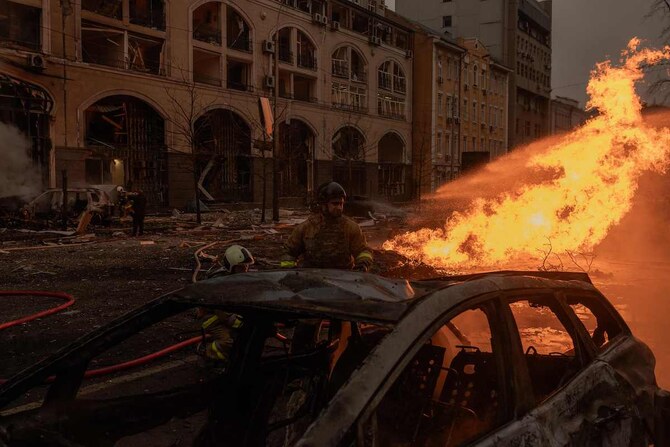
Shortly before sunrise Friday, at least three loud blasts were heard in Kyiv. Ukraine’s air force said it intercepted five Iskander short-range ballistic missiles fired at the city. The attack knocked out heating to 630 residential buildings, 16 medical facilities and 30 schools and kindergartens, the city administration said. Falling missile debris caused damage and sparked fires in three districts.
“We ask citizens to immediately respond to reports of ballistic attack threats, because there is very little time to find shelter,” the air force said.
During the nearly three years since the war began, Russia has regularly bombarded civilian areas of Ukraine, often in an attempt to cripple the power grid and unnerve Ukrainians. Ukraine, struggling to hold back Russia’s bigger army on the front line, has attempted to strike Russian infrastructure supporting the country’s war effort.
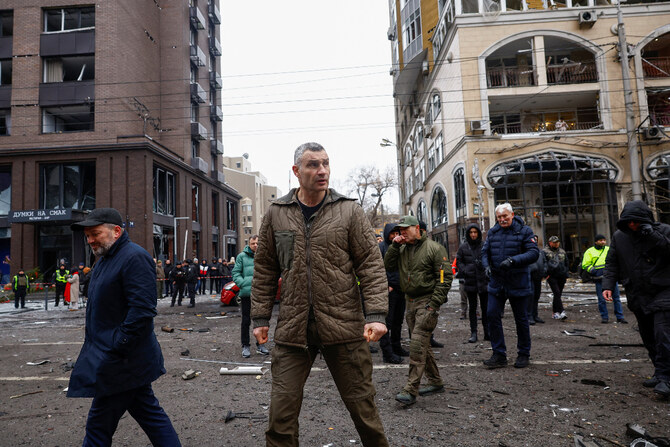
The falling debris in Kyiv caused damage to around two dozen high-rise office buildings in the city center as well as the landmark Catholic Church of St. Nicholas and the Kyiv National Linguistic University.
What may have been the blast wave from an intercepted low-flying missile also blew out windows and caused other damage at six embassies, the Ukrainian Foreign Ministry said.
About five hours later, air raid sirens rang out again. Valeriia Dubova, a 32-year-old photographer, took cover with many others in a crowded subway station.
She said that in the morning attack, she sheltered at home and could feel the walls shaking. Outside, fire engines and ambulances raced down city streets, she said.
“You could see that many buildings, high-rises, were damaged, with glass shards on the ground, far from the explosion epicenter,” she said.
The Russian Defense Ministry said that the strike was in response to a Ukrainian missile attack on Russia’s Rostov border region two days earlier. That attack used six American-made Army Tactical Missile System, known as ATACMS, missiles and four Storm Shadow air-launched missiles provided by the United Kingdom, it said.
That day, Ukraine claimed to have targeted a Rostov oil refinery as part of its campaign to strike Russian infrastructure supporting the country’s war effort.
The use of Western-supplied weapons to strike Russia has angered the Kremlin. Ukraine fired several American-supplied longer-range missiles into Russia for the first time on Nov. 19 after Washington eased restrictions on their use.
That development prompted Russia to use a new hypersonic missile, called Oreshnik, for the first time. Russian President Vladimir Putin suggested that the missile could be used to target government buildings in Kyiv, though there have been no reports of an Oreshnik being used for a second time.
Answering the Ukrainian attack on Rostov on Wednesday, the Russian Defense Ministry said that the military carried out a group strike with “high-precision, long-range weapons” on the command center of Ukraine’s military intelligence agency and another location where it said Ukraine’s Neptune missile systems are designed and produced.
The attack also targeted Ukrainian ground-based cruise missile systems and US-made Patriot air defense systems, the Russian Defense Ministry said.
“The objectives of the strike have been achieved. All objects are hit,” the ministry said in a Telegram post.
Its claims could not immediately be verified.
In other Russian attacks on civilian areas of Ukraine, six people, including a 15-year-old girl, were injured by missiles in Kryvyi Rih, regional authorities said. It was the second straight night of attacks in Ukrainian President Volodymyr Zelensky’s hometown.
Also, Russian artillery shelled the southern city of Kherson Friday morning, causing widespread damage and leaving around 60,000 people without power, regional Gov. Olesksandr Prokudin said.


![]()
![]()
![]()


Russian official says Ukrainian strike with US-supplied missiles kills 6

Short Url
https://arab.news/ytxwz
Russian official says Ukrainian strike with US-supplied missiles kills 6
- Acting governor in Russia's Kursk region says 10 other people injured in HIMARS missile strike
- Ukrainian authorities say Russian ballistic missile strike on Kyiv killed one, wounded 13


China’s top diplomat to visit Somalia on Africa tour
- Stop in Mogadishu provides diplomatic boost after Israel became the first country to formally recognize breakaway Somaliland
- Tour focusses on Beijing's strategic trade access across eastern and southern Africa
BEIJING: China’s top diplomat began his annual New Year tour of Africa on Wednesday, focusing on strategic trade access across eastern and southern Africa as Beijing seeks to secure key shipping routes and resource supply lines.
Foreign Minister Wang Yi will travel to Ethiopia, Africa’s fastest-growing large economy; Somalia, a Horn of Africa state offering access to key global shipping lanes; Tanzania, a logistics hub linking minerals-rich central Africa to the Indian Ocean; and Lesotho, a small southern African economy squeezed by US trade measures. His trip this year runs until January 12.
Beijing aims to highlight countries it views as model partners of President Xi Jinping’s flagship “Belt and Road” infrastructure program and to expand export markets, particularly in young, increasingly affluent economies such as Ethiopia, where the IMF forecasts growth of 7.2 percent this year.
China, the world’s largest bilateral lender, faces growing competition from the European Union to finance African infrastructure, as countries hit by pandemic-era debt strains now seek investment over loans.
“The real litmus test for 2026 isn’t just the arrival of Chinese investment, but the ‘Africanization’ of that investment. As Wang Yi visits hubs like Ethiopia and Tanzania, the conversation must move beyond just building roads to building factories,” said Judith Mwai, policy analyst at Development Reimagined, an Africa-focussed consultancy.
“For African leaders, this tour is an opportunity to demand that China’s ‘small yet beautiful’ projects specifically target our industrial gaps, turning African raw materials into finished products on African soil, rather than just facilitating their exit,” she added.
On his start-of-year trip in 2025, Wang visited Namibia, the Republic of Congo, Chad and Nigeria.
His visit to Somalia will be the first by a Chinese foreign minister since the 1980s and is expected to provide Mogadishu with a diplomatic boost after Israel became the first country to formally recognize the breakaway Republic of Somaliland, a northern region that declared itself independent in 1991.
Beijing, which reiterated its support for Somalia after the Israeli announcement in December, is keen to reinforce its influence around the Gulf of Aden, the entrance to the Red Sea and a vital corridor for Chinese trade transiting the Suez Canal to Europe.
Further south, Tanzania is central to Beijing’s plan to secure access to Africa’s vast copper deposits. Chinese firms are refurbishing the Tazara Railway that runs through the country into Zambia. Li Qiang made a landmark trip to Zambia in November, the first visit by a Chinese premier in 28 years.
The railway is widely seen as a counterweight to the US and European Union-backed Lobito Corridor, which connects Zambia to Atlantic ports via Angola and the Democratic Republic of the Congo.
By visiting the southern African kingdom of Lesotho, Wang aims to highlight Beijing’s push to position itself as a champion of free trade. Last year, China offered tariff-free market access to its $19 trillion economy for the world’s poorest nations, fulfilling a pledge by Chinese President Xi Jinping at the 2024 China-Africa Cooperation summit in Beijing.
Lesotho, one of the world’s poorest nations with a gross domestic product of just over $2 billion, was among the countries hardest hit by US President Donald Trump’s sweeping tariffs last year, facing duties of up to 50 percent on its exports to the United States.
Foreign Minister Wang Yi will travel to Ethiopia, Africa’s fastest-growing large economy; Somalia, a Horn of Africa state offering access to key global shipping lanes; Tanzania, a logistics hub linking minerals-rich central Africa to the Indian Ocean; and Lesotho, a small southern African economy squeezed by US trade measures. His trip this year runs until January 12.
Beijing aims to highlight countries it views as model partners of President Xi Jinping’s flagship “Belt and Road” infrastructure program and to expand export markets, particularly in young, increasingly affluent economies such as Ethiopia, where the IMF forecasts growth of 7.2 percent this year.
China, the world’s largest bilateral lender, faces growing competition from the European Union to finance African infrastructure, as countries hit by pandemic-era debt strains now seek investment over loans.
“The real litmus test for 2026 isn’t just the arrival of Chinese investment, but the ‘Africanization’ of that investment. As Wang Yi visits hubs like Ethiopia and Tanzania, the conversation must move beyond just building roads to building factories,” said Judith Mwai, policy analyst at Development Reimagined, an Africa-focussed consultancy.
“For African leaders, this tour is an opportunity to demand that China’s ‘small yet beautiful’ projects specifically target our industrial gaps, turning African raw materials into finished products on African soil, rather than just facilitating their exit,” she added.
On his start-of-year trip in 2025, Wang visited Namibia, the Republic of Congo, Chad and Nigeria.
His visit to Somalia will be the first by a Chinese foreign minister since the 1980s and is expected to provide Mogadishu with a diplomatic boost after Israel became the first country to formally recognize the breakaway Republic of Somaliland, a northern region that declared itself independent in 1991.
Beijing, which reiterated its support for Somalia after the Israeli announcement in December, is keen to reinforce its influence around the Gulf of Aden, the entrance to the Red Sea and a vital corridor for Chinese trade transiting the Suez Canal to Europe.
Further south, Tanzania is central to Beijing’s plan to secure access to Africa’s vast copper deposits. Chinese firms are refurbishing the Tazara Railway that runs through the country into Zambia. Li Qiang made a landmark trip to Zambia in November, the first visit by a Chinese premier in 28 years.
The railway is widely seen as a counterweight to the US and European Union-backed Lobito Corridor, which connects Zambia to Atlantic ports via Angola and the Democratic Republic of the Congo.
By visiting the southern African kingdom of Lesotho, Wang aims to highlight Beijing’s push to position itself as a champion of free trade. Last year, China offered tariff-free market access to its $19 trillion economy for the world’s poorest nations, fulfilling a pledge by Chinese President Xi Jinping at the 2024 China-Africa Cooperation summit in Beijing.
Lesotho, one of the world’s poorest nations with a gross domestic product of just over $2 billion, was among the countries hardest hit by US President Donald Trump’s sweeping tariffs last year, facing duties of up to 50 percent on its exports to the United States.
Latest updates





© 2026 SAUDI RESEARCH & PUBLISHING COMPANY, All Rights Reserved And subject to Terms of Use Agreement.