

NATO takes over coordination of military aid to Kyiv from US, source says

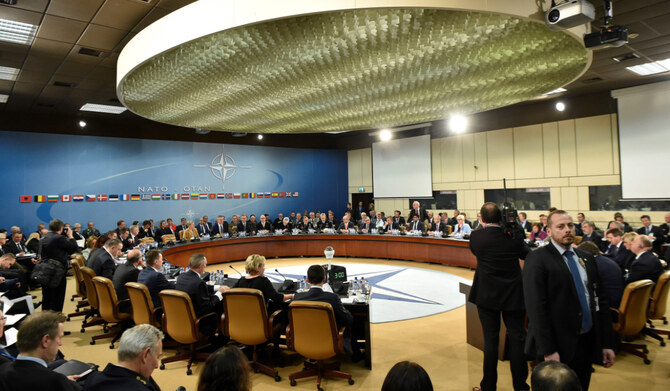
General view taken during a Defense ministers Council meeting at Nato headquarters in Brussels. (AFP file photo)
Short Url
Updated 18 December 2024
Follow

NATO takes over coordination of military aid to Kyiv from US, source says

  • The headquarters of NATO’s new Ukraine mission, dubbed NATO Security Assistance and Training for Ukraine (NSATU), is located at Clay Barracks, a US base in the German town of Wiesbaden

BERLIN: NATO has taken over coordination of Western military aid to Ukraine from the US as planned, a source said on Tuesday, in a move widely seen as aiming to safeguard the support mechanism against NATO skeptic US President-elect Donald Trump.
The step, coming after a delay of several months, gives NATO a more direct role in the war against Russia’s invasion while stopping well short of committing its own forces.
Diplomats, however, acknowledge that the handover to NATO may have a limited effect given that the US under Trump could still deal a major setback to Ukraine by slashing its support, as it is the alliance’s dominant power and provides the majority of arms to Kyiv.
Trump, who will take office in January, has said he wants to end the war in Ukraine swiftly but not how he aims to do so. He has long criticized the scale of US financial and military aid to Ukraine.
The headquarters of NATO’s new Ukraine mission, dubbed NATO Security Assistance and Training for Ukraine (NSATU), is located at Clay Barracks, a US base in the German town of Wiesbaden.
A person familiar with the matter told Reuters it was now fully operational. No public reason has been given for the delays.
NATO’s military headquarters SHAPE said its Ukraine mission was beginning to assume responsibilities from the US and international organizations.
“The work of NSATU ... is designed to place Ukraine in a position of strength, which puts NATO in a position of strength to keep safe and prosperous its one billion people in both Europe and North America,” said US Army General Christopher G. Cavoli, the Supreme Allied Commander Europe.
“This is a good day for Ukraine and a good day for NATO.”
In the past, the US-led Ramstein group, an ad hoc coalition of some 50 nations named after a US air base in Germany where it first met, has coordinated Western military supplies to Kyiv.
Trump threatened to quit NATO during his first term as president and demanded allies must spend 3 percent of national GDP on their militaries, compared with NATO’s target of 2 percent.
Meanwhile, the outgoing Biden administration in Washington is scrambling to ship as many weapons as possible to Kyiv amid fears that Trump may cut deliveries of military hardware to Ukraine.
NSATU is set to have a total strength of about 700 personnel, including troops stationed at NATO’s military headquarters SHAPE in Belgium and at logistics hubs in Poland and Romania.
Russia has condemned increases in Western military aid to Ukraine as risking a wider war.


What is Trump’s ‘Board of Peace’?

Updated 6 sec ago
Follow

What is Trump’s ‘Board of Peace’?

  • The Board of Peace’s charter does not appear to limit its role to the occupied Palestinian territory of Gaza
  • Trump will be chairman but also “separately serve as inaugural representative of the United States of America”

BRUSSELS: US President Donald Trump’s government has asked countries to pay $1 billion for a permanent spot on his “Board of Peace” aimed at resolving conflicts, according to its charter seen by AFP.
The board was originally conceived to oversee the rebuilding of war-torn Gaza, but the charter does not appear to limit its role to the occupied Palestinian territory.
What exactly will it do? And who has been invited?

- To what end? -

The Board of Peace will be chaired by Trump, according to its founding charter.
It is “an international organization that seeks to promote stability, restore dependable and lawful governance, and secure enduring peace in areas affected or threatened by conflict,” reads the preamble of the charter sent to countries invited to participate.
It will “undertake such peace-building functions in accordance with international law,” it adds.

- Who’s boss? -

Trump will be chairman but also “separately serve as inaugural representative of the United States of America.”
“The Chairman shall have exclusive authority to create, modify, or dissolve subsidiary entities as necessary or appropriate to fulfill the Board of Peace’s mission,” the document states.
He will pick members of an Executive Board to be “leaders of global stature” to “serve two-year terms, subject to removal by the Chairman.”
He may also, “acting on behalf of the Board of Peace,” “adopt resolutions or other directives.”
The chairman can be replaced only in case of “voluntary resignation or as a result of incapacity.”

- Who can be a member? -

Member states have to be invited by the US president, and will be represented by their head of state or government.
Each member “shall serve a term of no more than three years,” the charter says.
But “the three-year membership term shall not apply to Member States that contribute more than USD $1,000,000,000 in cash funds to the Board of Peace within the first year of the Charter’s entry into force,” it adds.
The board will “convene voting meetings at least annually,” and “each member State shall have one vote.”
But while all decisions require “a majority of Member States present and voting,” they will also be “subject to the approval of the Chairman, who may also cast a vote in his capacity as Chairman in the event of a tie.”

- Who’s already in? -

The White House has said its members will include:
US President Donald Trump, chair
US Secretary of State Marco Rubio
Steve Witkoff, Trump’s special negotiator
Jared Kushner, Trump’s son-in-law
Tony Blair, former UK prime minister
Marc Rowan, billionaire US financier
Ajay Banga, World Bank president
Robert Gabriel, loyal Trump aide on the National Security Council

- Who’s been invited? -

The list of countries and leaders who say they have been invited include, but are not limited to:
Russia’s President Vladimir Putin
Canada’s Prime Minister Mark Carney
Egypt’s President Abdel Fattah El-Sisi
Argentina’s President Javier Milei
Jordan
Brazil
Paraguay
India
Pakistan
Germany
France
Italy
Hungary
Romania
Uzbekistan
Belarus
Greece
Morocco
Slovenia
Poland

- When does it start? -

The charter says it enters into force “upon expression of consent to be bound by three States.”