

Modi to visit Kuwait for first trip by Indian PM in four decades

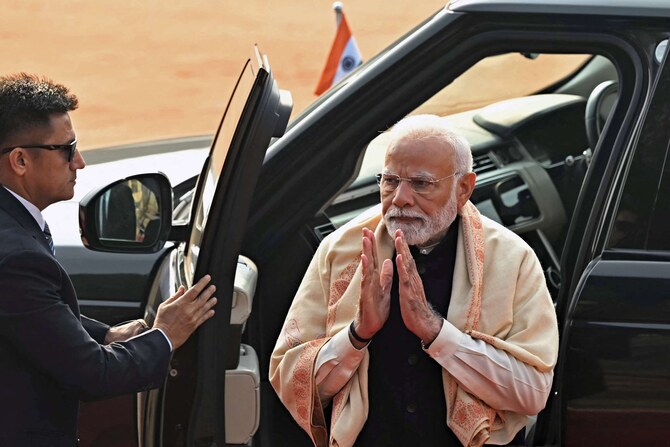
India’s Prime Minister Narendra Modi gestures as he arrives at the presidential palace Rashtrapati Bhavan in New Delhi on Dec. 16, 2024. (AFP)
Short Url
Updated 19 December 2024
Follow

Modi to visit Kuwait for first trip by Indian PM in four decades

  • Indian nationals make up the largest expatriate community in Kuwait 
  • Modi’s visit will likely focus on strengthening economic ties, say experts

NEW DELHI: Prime Minister Narendra Modi will visit Kuwait on Saturday, marking the first trip to the Gulf state by an Indian premier in more than four decades.

With more than 1 million Indian nationals living and working in Kuwait they are the largest expatriate community in the country, making up around 21 percent of its 4.3 million population and 30 percent of its workforce.

Modi’s two-day visit is at the invitation of the Emir of Kuwait, Sheikh Mishal Al-Ahmad Al-Jaber Al-Sabah.

“This will be the first visit of an Indian prime minister to Kuwait in 43 years,” the Indian Ministry of External Affairs said in a statement.

“During the visit, the prime minister will hold discussions with the leadership of Kuwait. (The) prime minister will also interact with the Indian community in Kuwait.”

India is among Kuwait’s top trade partners, with bilateral trade valued at around $10.4 billion in 2023-24.

Experts expect the visit to focus on strengthening economic ties between the two countries.

“Kuwait has a strong Indian expatriate community who have contributed to the economic development of the country,” Muddassir Quamar, associate professor at the Center for West Asian Studies in Delhi’s Jawaharlal Nehru University, told Arab News.

“In my view, the focus would be on the economy. Politically, it underlines that Kuwait is an important regional country and remains an important partner of India.”

Quamar said that trade and economic ties will likely get a boost from the visit, as well as cooperation in energy, infrastructure, financial technology, education and culture.

Modi’s visit reflects how India’s engagement with Arab states has increasingly focused on the economy, said Kabir Taneja, a deputy director with the Strategic Studies program at the Observer Research Foundation.

“India’s engagement with Arab states is increasingly rooted in a ‘new’ Middle East, that is, it is economy-led,” he told Arab News.

“This visit is a good opportunity for India to expand beyond its good relations with UAE and Saudi Arabia and explore opportunities with the smaller Arab states, which includes Kuwait.”


Carney says Canada has no plans to pursue free trade agreement with China as Trump threatens tariffs

Updated 26 January 2026
Follow

Carney says Canada has no plans to pursue free trade agreement with China as Trump threatens tariffs

TORONTO: Canadian Prime Minister Mark Carney said Sunday his country has no intention of pursuing a free trade deal with China. He was responding to US President Donald Trump’s threat to impose a 100 percent tariff on goods imported from Canada if America’s northern neighbor went ahead with a trade deal with Beijing.
Carney said his recent agreement with China merely cuts tariffs on a few sectors that were recently hit with tariffs.
Trump claims otherwise, posting that “China is successfully and completely taking over the once Great Country of Canada. So sad to see it happen. I only hope they leave Ice Hockey alone! President DJT”
The prime minister said under the free trade agreement with the US and Mexico there are commitments not to pursue free trade agreements with nonmarket economies without prior notification.
“We have no intention of doing that with China or any other nonmarket economy,” Carney said. “What we have done with China is to rectify some issues that developed in the last couple of years.”
In 2024, Canada mirrored the United States by putting a 100 percent tariff on electric vehicles from Beijing and a 25 percent tariff on steel and aluminum. China had responded by imposing 100 percent import taxes on Canadian canola oil and meal and 25 percent on pork and seafood.
Breaking with the United States this month during a visit to China, Carney cut its 100 percent tariff on Chinese electric cars in return for lower tariffs on those Canadian products.
Carney has said there would be an initial annual cap of 49,000 vehicles on Chinese EV exports coming into Canada at a tariff rate of 6.1 percent, growing to about 70,000 over five years. He noted there was no cap before 2024. He also has said the initial cap on Chinese EV imports was about 3 percent of the 1.8 million vehicles sold in Canada annually and that, in exchange, China is expected to begin investing in the Canadian auto industry within three years.
Trump posted a video Sunday in which the chief executive of the Canadian Vehicle Manufacturers’ Association warns there will be no Canadian auto industry without US access, while noting the Canadian market alone is too small to justify large scale manufacturing from China.
“A MUST WATCH. Canada is systematically destroying itself. The China deal is a disaster for them. Will go down as one of the worst deals, of any kind, in history. All their businesses are moving to the USA. I want to see Canada SURVIVE AND THRIVE! President DJT,” Trump posted on social media.
Trump’s post on Saturday said that if Carney “thinks he is going to make Canada a ‘Drop Off Port’ for China to send goods and products into the United States, he is sorely mistaken.”
“We can’t let Canada become an opening that the Chinese pour their cheap goods into the U.S,” US Treasury Secretary Scott Bessent said on ABC’s “This Week.”
“We have a , but based off — based on that, which is going to be renegotiated this summer, and I’m not sure what Prime Minister Carney is doing here, other than trying to virtue-signal to his globalist friends at Davos.”
Trump’s threat came amid an escalating war of words with Carney as the Republican president’s push to acquire Greenland strained the NATO alliance.
Carney has emerged as a leader of a movement for countries to find ways to link up and counter the US under Trump. Speaking in Davos before Trump, Carney said, “Middle powers must act together because if you are not at the table, you are on the menu” and he warned about coercion by great powers — without mentioning Trump’s name. The prime minister received widespread praise and attention for his remarks, upstaging Trump at the World Economic Forum.
Trump’s push to acquire Greenland has come after he has repeatedly needled Canada over its sovereignty and suggested it also be absorbed into the United States as a 51st state. He posted an altered image on social media this week showing a map of the United States that included Canada, Venezuela, Greenland and Cuba as part of its territory.