

Imran Khan’s party temporarily calls off civil disobedience movement in Pakistan

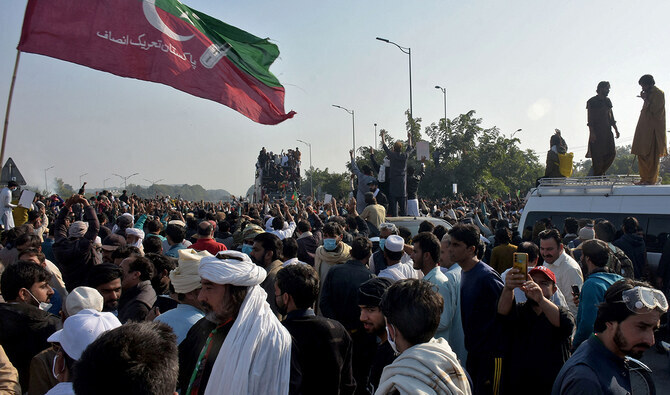
Supporters of jailed former Pakistani Prime Minister Imran Khan’s party Pakistan Tehreek-e-Insaf (PTI) attend a rally demanding his release, in Islamabad on November 26, 2024. (REUTERS/File)
Short Url
Updated 18 December 2024
Follow

Imran Khan’s party temporarily calls off civil disobedience movement in Pakistan

  • Demands government release political prisoners, set up judicial commissions to investigate two protests
  • Khan has been in jail since August 2023 on charges he says are motivated to keep him away from politics

ISLAMABAD: Jailed former Prime Minister Imran Khan has instructed his party to temporarily postpone a planned civil disobedience movement in Pakistan, his sister said on Tuesday, calling on the government to release all political prisoners and set up judicial commissions to investigate what his party says were arrests and killings of supporters during two protests.

On Dec. 5, Khan, jailed since August 2023 on charges he says are politically motivated to keep him away from power, said in a message to supporters that he was setting up a five-member negotiations committee to hold talks with the federal government for the release of political prisoners. He also demanded judicial commissions to investigate protests on May 9 last year and Nov. 24 this year in which the government says supporters of Khan’s Pakistan Tehreek-e-Insaf (PTI) party partook in violence and caused vandalism. If the two demands were not met, Khan said, the party would launch a civil disobedience movement from Dec. 14.

However, speaking to reporters on Tuesday after meeting Khan in prison, his sister Aleema Khan said the jailed leader had been advised by aides that a civil disobedience movement, including a call to overseas Pakistanis who largely support Khan to stop sending remittances, would damage the economy. 

“Party leaders have said this will really affect the economy so Imran Khan has said, “I will wait for a few days, the government should meet these two demands’,” Aleema told the media outside Adiala jail. “Otherwise, if these demands are not met, he will announce a call to stop remittances.”

Pressure on Khan’s PTI party, already at loggerheads with the government and military, has increased since last month when thousands of its supporters stormed Islamabad, demanding Khan’s release. 

The government says protesters killed four security officers in clashes while the PTI says at least 12 of its supporters died and “hundreds” were injured and arrested as security agencies used live ammunition rounds to disperse protesters, which authorities deny. The Prime Minister Shehbaz Sharif coalition government says it will take legal action against the rioters and bring to justice suspects behind what it has described as a “malicious campaign” to spread fake online news, images and video content against the state and security forces.

Previously, the government and military have accused Khan supporters of attacking and damaging government and military buildings after his brief arrest on May 9, 2023.

Hundreds of PTI supporters and dozens of leaders were subsequently arrested while police registered cases against the party’s top leaders, including Khan. The army is also holding military trials of over a 100 people arrested in connection with the May riots.


World Bank approves $700 million for Pakistan’s economic stability

Updated 20 December 2025
Follow

World Bank approves $700 million for Pakistan’s economic stability

  • Of this, $600 million will go for federal programs and $100 million will ⁠support a provincial program in Sindh
  • The results-based design ensures that resources are only disbursed once program objectives are achieved

ISLAMABAD: The World Bank has approved $700 million in ​financing for Pakistan under a multi-year initiative aimed at supporting the country’s macroeconomic stability and service delivery, the bank said on Friday.

The funds will be released under the bank’s Public ‌Resources for Inclusive ‌Development — Multiphase ‌Programmatic ⁠Approach (PRID-MPA) that ‌could provide up to $1.35 billion in total financing, according to the lender.

Of this amount, $600 million will go for federal programs and $100 million will ⁠support a provincial program in ‌the southern Sindh province. The results-based design ensures that resources are only disbursed once program objectives are achieved.

“Pakistan’s path to inclusive, sustainable growth requires mobilizing more domestic resources and ensuring they are used efficiently and transparently to deliver results for people,” World Bank country director Bolormaa Amgaabazar said in a statement.

“Through this MPA, we are working with the Federal and Sindh governments to deliver tangible impacts— more predictable funding for schools and clinics, fairer tax systems, and stronger data for decision‑making— while safeguarding priority social and climate investments and strengthening public trust.”

The approval ‍follows a $47.9 ‍million World Bank grant ‍in August to improve primary education in Pakistan’s most populous Punjab province.

In November, an IMF-World Bank ​report, uploaded by Pakistan’s finance ministry, said Pakistan’s fragmented ⁠regulation, opaque budgeting and political capture are curbing investment and weakening revenue.

Regional tensions may surface over international financing for Pakistan. In May, Reuters reported that India would oppose World Bank funding for Pakistan, citing a senior government ‌source in New Delhi.

“Strengthening Pakistan’s fiscal foundations is essential to restoring macroeconomic stability, delivering results and strengthening institutions,” said Tobias Akhtar Haque, Lead Country Economist for the World Bank in Pakistan.

“Through the PRID‑MPA, we are launching a coherent nationwide approach to support reforms that expand fiscal space, bolster investments in human capital and climate resilience, and strengthen revenue administration, budget execution, and statistical systems. These reforms will ensure that resources reach the frontline and deliver better outcomes for people across Pakistan with greater efficiency and accountability.”

In Sindh, the program is expected to increase provincial revenues, enhance the speed and transparency of payments, and broaden the use of data to guide provincial decision making. The program will directly support the increase of public resources for inclusive development, including more equitable and responsive financing for primary health care facilities and more funding for schools.