

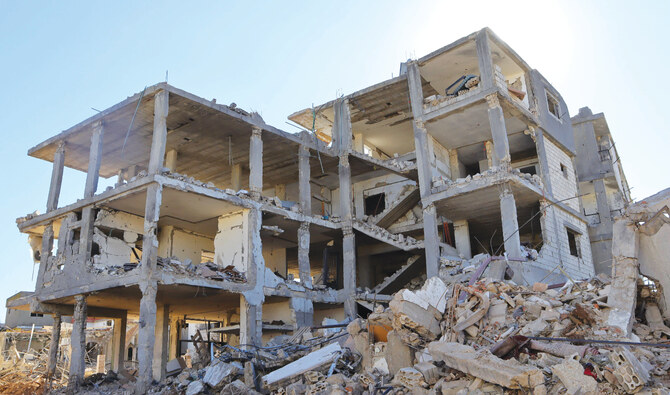

BEIRUT: Israeli forces bulldozed roads and destroyed houses early on Tuesday in the village of Naqoura, near the southern Lebanese border.
Troops continued to violate the ceasefire agreement, firing bursts of machine-gun fire inside the coastal town, while bulldozing local landmarks.
Remaining houses in the border village of Kfarkila were also bulldozed.
Israeli forces invaded the Lebanese southern border region on Oct. 1 as part of their expanded war against Hezbollah.
Troops are slowly withdrawing from the area, taking advantage of the 60 days agreed in the ceasefire deal for their complete withdrawal.
The agreement took effect three weeks ago.
Israeli artillery on Monday targeted the outskirts of Halta, Kfarshouba, and Shebaa, while reconnaissance planes continued around-the-clock flights over the south and Beirut, mainly the southern suburbs.
The Lebanese army in coordination with UNIFIL is set to retrieve the bodies of 37 Hezbollah fighters killed in confrontations in the border villages of Odaisseh and Taybeh.
Hezbollah-affiliated Al-Manar TV said that the army is waiting on communications from UNIFIL before entering the towns. No implementation date has been set, it added.
The network also said Israel’s slow withdrawal from Al-Hamames Hill is delaying the Lebanese army’s entry into Khiam.
The withdrawal was part of the first phase of the agreement with UNIFIL.
Maj. Gen. Patrick Gauchat, head of the UN Truce Supervision Organization, held talks with Lebanese officials, including caretaker Foreign Minister Abdullah Bou Habib, in a bid to solve disputes over the withdrawal.
Habib emphasized the importance of clearly establishing the borders between Lebanon and Israel.
Six sections of the 120 km border between the two countries are still disputed.
Meanwhile, Jean-Christophe Carret, World Bank country director for the Middle East, met with Lebanese officials to discuss reconstruction programs, and the rebuilding and repair of infrastructure.
Carret said the bank wanted to ensure the “effective operation, implementation, and sustainability of the work.”
Lebanon’s government is still discussing possible disposal sites for debris from Israeli attacks on residential buildings and facilities.
Environment Minister Nasser Yassin said that the rubble is likely to be taken to quarries around the country.
Interior Minister Bassam Mawlawi told governors in southern Lebanon and Nabatieh, Bekaa, Baalbek-Hermel, and other municipalities to ensure the Litani River and its tributaries area protected during reconstruction work.
Debris must not be dumped in the river or left on open land overlooking the waterway, he said.
On Monday, two Lebanese lawyers, Majd Harb and Eli Kirolos, submitted a complaint to the judiciary accusing the Al-Qard Al-Hassan Association, affiliated with Hezbollah, of violating monetary and credit laws.
Al-Qard Al-Hassan Association offices in various locations around Lebanon were hit by Israeli attacks during the final two weeks of the conflict.
Hezbollah announced the resumption of operations in some of the offices following the ceasefire.


