

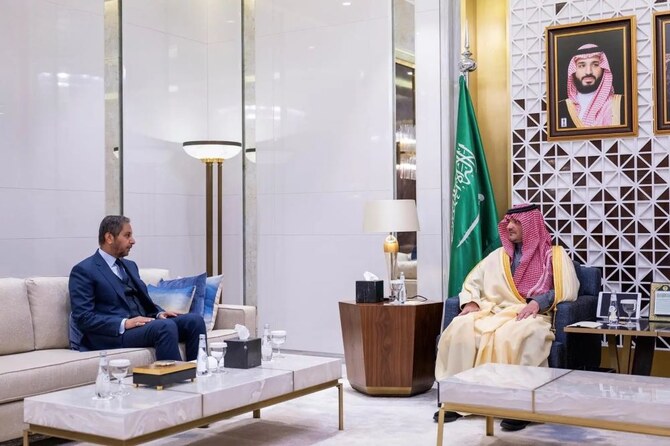
Djibouti envoy, Saudi interior minister discuss security ties

1 / 2
Dean of the Diplomatic Corps and Ambassador of Djibouti in Riyadh Dya-Eddine Said Bamakhrama meets Saudi Minister of Interior Prince Abdulaziz bin Saud bin Naif. (Supplied)
2 / 2
Dean of the Diplomatic Corps and Ambassador of Djibouti in Riyadh Dya-Eddine Said Bamakhrama meets Saudi Minister of Interior Prince Abdulaziz bin Saud bin Naif. (Supplied)
Short Url
Updated 17 December 2024
Follow

Djibouti envoy, Saudi interior minister discuss security ties

  • Said Bamakhrama held discussions with Prince Abdulaziz bin Saud bin Naif
  • Nations have agreed to launch a maritime trade initiative

RIYADH: Senior officials from Djibouti and Saudi Arabia have held talks to strengthen security ties between the two countries. 

Dean of the Diplomatic Corps and Ambassador of Djibouti in Riyadh Dya-Eddine Said Bamakhrama had discussions here recently with Saudi Arabia’s Interior Minister Prince Abdulaziz bin Saud bin Naif. 

Bamakhrama told Arab News that they discussed several issues of common interest including “security cooperation and ways to strengthen them between the relevant sectors.” 

He said the two nations hold discussions annually under a Joint Security Committee. The third meeting of the body was in Jeddah in September last year, and it will meet in Djibouti next February. 

In August this year, the two nations agreed to launch a maritime trade initiative. This includes new shipping lines to boost connectivity with East African markets, which serve a consumer base of around 500 million people.


AlUla announces discovery of rare 465 million-year-old crab fossils

Updated 6 sec ago
Follow

AlUla announces discovery of rare 465 million-year-old crab fossils

  • Work being carried out to study, characterize the fossils
  • AlUla was likely closer to shore, but today 100km inland

RIYADH: The Royal Commission for AlUla announced on Thursday the discovery of rare horseshoe crab fossils estimated to be 465 million years old.

Work is being carried out to study and characterize the fossils, which have not yet been scientifically classified, the RCU said in a post on X.

All of the fossils were found in an upside-down position, an unprecedented preservation pattern for this species.

The discovery was also notable in that the fossils were larger than other known species typically found from the same period.

The RCU also said that trace fossils were found, suggesting that the specimens were moving.

The commission said on X that this was a “one-of-a-kind discovery published scientifically at an international level, enhancing AlUla’s standing as a leading global site for geological research.”

A study on the findings was published in the peer-reviewed journal Gondwana Research, in a paper titled “Ordovician horseshoe crab body and trace fossil association preserved in a unique taphonomic setting.”

It notes that the finding suggests that AlUla was historically much closer to the shore, whereas today it is more than 100 km inland.

Archaeological research in Saudi Arabia in recent years has uncovered vast troves of ancient artefacts.

In October 2025, the Heritage Commission’s Al-Yamamah Archaeological Project survey announced the discovery of 337 new archaeological sites in the Kingdom, including sites for stone tool manufacturing, water facilities and circular stone structures.

In September, the commission discovered the oldest architectural settlement in the Arabian Peninsula, dating back to the pre-pottery Neolithic period of 10,300 to 11,000 years ago, near Tabuk.