

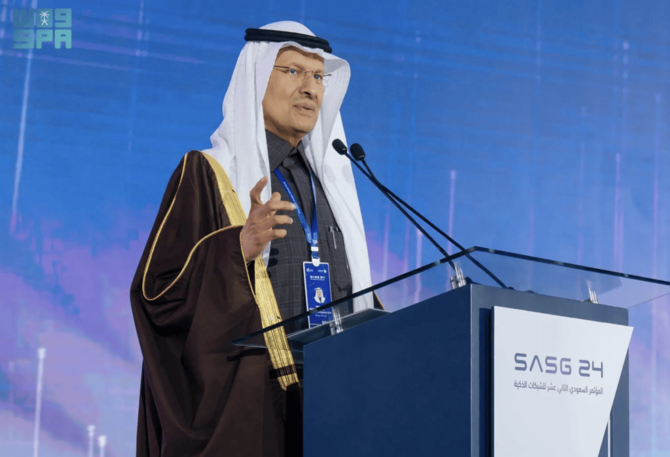

RIYADH: Saudi Arabia is working to automate 40 percent of its electricity distribution network by the end of 2025, having already achieved 32 percent of this target, according to the minister of energy.
Prince Abdulaziz bin Salman made the announcement at the opening of the 12th Saudi Arabia Smart Grid 2024 Conference in Riyadh, held under the theme “Energy and Sustainability.”
Automating an electricity distribution network uses technologies like smart meters and real-time monitoring to improve efficiency, and also facilitates the integration of renewable energy – which aligns with Vision 2030 goals of producing 50 percent of the Kingdom’s electricity using renewable sources.
In his opening remarks, Prince Abdulaziz highlighted the key role of smart grid technologies in transforming energy systems, focusing on smart meters, automation, and enhanced communication to improve electricity production, transmission, and consumption.
The minister highlighted Saudi Arabia’s progress under Vision 2030 saying: “More than 11 million smart meters have been installed across the Kingdom since 2021, contributing to improved energy consumption efficiency and enabling consumers to track their consumption in real time through smart applications, thereby enhancing their ability to make more informed decisions about electricity conservation.”
This large-scale deployment has empowered consumers with the ability to monitor their real-time energy consumption through advanced applications, enabling them to make informed decisions to optimize electricity use and promote energy conservation, SPA reported.
Similar efforts were seen in different nations in the Gulf Cooperation Council with the UAE’s Dubai Electricity and Water Authority and Qatar’s Kahramaa advancing smart grid initiatives to enhance energy infrastructure.
DEWA’s multi-billion project integrates AI, blockchain, and IoT for seamless communication and automation, supporting smart city goals. Meanwhile, Kahramaa’s smart meters, covering 450,000 units, improve monitoring, reduce operational costs, and support sustainability by optimizing energy use and integrating clean energy.
Discussing automation efforts, Prince Abdulaziz revealed that the ministry is advancing plans to establish nine control centers by 2026.
These facilities will be equipped with state-of-the-art technologies to enable real-time monitoring and precision management of the electricity distribution network.
These developments aim to enhance network stability and performance, ensuring Saudi Arabia remains at the forefront of technological innovation in energy management.
The minister also addressed the challenges posed by renewable energy sources, particularly their sensitivity to weather conditions. To mitigate these challenges and maintain grid reliability, the Kingdom is enhancing its energy storage capabilities.
Current plans target a battery storage capacity of 26 gigawatt-hours, with the goal of increasing this to 48 GWh by 2030.
Regarding the efforts to enhance the stability and efficiency of the national grid, which is the largest in the Middle East and Africa, the minister said: “We continue to expand transmission and distribution networks and develop flexible transmission system technologies that contribute to enhancing energy exchange and reducing losses.”
He added: “Additionally, four regional control centers have been established, along with a national control center, whose advanced systems enable efficient monitoring and operation of the networks, thereby strengthening the security and resilience of the electrical grid.”
Following the inauguration of the conference, Prince Abdulaziz oversaw the signing of several agreements and memorandums of understanding aimed at further advancing energy solutions across the Kingdom.
He also honored the winners of the Energy Hackathon, which saw participation from more than 60 participants. The contestants presented creative and innovative projects focused on energy storage efficiency and sustainability, reflecting the growing emphasis on nurturing talent and fostering innovation in the energy sector.
The three-day conference is set to host discussions on over 40 scientific papers, showcasing the latest research, technologies, and sustainable solutions in the field of smart grids.
These talks will spotlight the role of smart grid systems in enabling digital transformation, enhancing renewable energy solutions, and creating new opportunities for private sector participation.
Launched in Jeddah in 2011, SASG began as the first specialized event on smart grid technologies with global participation. Now an annual fixture in Saudi Arabia, it has attracted over 55,000 participants and 280 sponsors and exhibitors, offering a platform to showcase products, services, and innovations.


