

Greece confirms commitment to maintaining ceasefire agreement despite Israeli violations

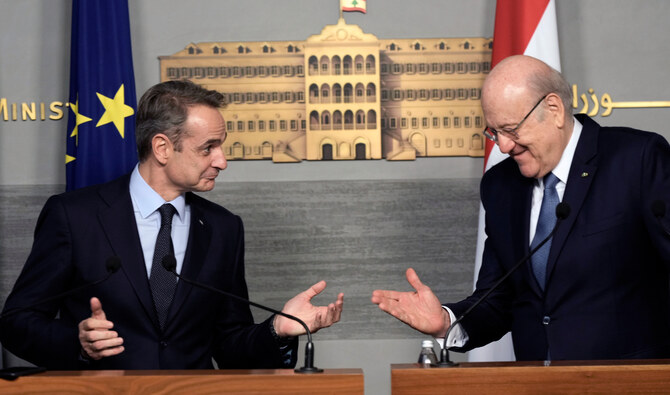
Greek Prime Minister Kyriakos Mitsotakis and Lebanese caretaker Prime Minister Najib Mikati address a joint press conference at the government palace in Beirut. (AP)
Short Url
Updated 16 December 2024
Follow

Greece confirms commitment to maintaining ceasefire agreement despite Israeli violations

  • Popular dissatisfaction grows over delay in compensation distribution by Hezbollah and Lebanese authorities

BEIRUT: Greek Prime Minister Kyriakos Mitsotakis emphasized in Beirut on Monday that implementing the ceasefire agreement to halt hostilities between Israel and Lebanon is crucial for the well-being and stability of the region.

The visiting prime minister also said Greece “and the international community are taking all necessary measures to uphold the ceasefire in southern Lebanon and to implement UN Resolution 1701, which safeguards Lebanese sovereignty.”

His statement came as the Israeli military once again violated the ceasefire by launching a drone to target a valley in the towns of Musayleh and Najariyah in the Sidon district of southern Lebanon, resulting in three injuries, according to the Lebanese Health Ministry.

Mitsotakis met with Lebanese officials and welcomed the fall of the regime of former Syrian President Bashar Assad, stressing the importance of upholding human rights.

He said that the political process must encompass all groups and address all disparities and issues.

Mitsotakis expressed hope for “the return of millions of refugees to Syria with the stabilization of the country.”

The Israeli army, however, demolished homes in Naqoura following the incursion of its forces into the area with tanks.

An infantry unit conducted a sweep of Naqoura using heavy machine guns.

Israeli army spokesman Avichay Adraee reiterated a warning to Lebanese residents against returning to the border area where Israeli forces are present until further notice.

The Israeli army is expected to withdraw from the border area, which includes more than 50 towns, within 60 days from the commencement of the ceasefire that began 19 days ago.

Israeli forces continued to demolish homes and facilities, hindering the deployment of the Lebanese army, which entered the border town of Khiam in southern Lebanon.

In a meeting on Monday, a gathering of Lebanese Christians known as the Lady of the Mountain advanced the position that the region, including Lebanon, had entered a new era and that implementing the approved resolution on the cessation of hostilities is a crucial step toward building the state.

“The Lebanese people will no longer accept the coexistence of the Lebanese republic and illegitimate weapons,” the group said.

Meanwhile, areas hit by Israeli airstrikes in the south, the southern suburbs of Beirut, and the Baalbek-Hermel region are facing unrest as Lebanese authorities and Hezbollah are being blamed for delays in the reconstruction of destroyed infrastructure.

The Nabatieh Traders Association demanded compensation for the region’s workers and businesses.

The traders will hold a demonstration on Thursday in the city’s public square.

The association said a wide range of people were affected by the “Hezbollah-initiated war on the southern front, which escalated into an extensive and destructive Israeli war across various regions.”

Compensation for demolished and damaged homes, institutions, and agricultural lands represents one of the most urgent issues requiring attention, as estimated damages are significantly greater than those recorded following the 2006 war.

Damage assessment committees from Jihad Al-Bina — affiliated with Hezbollah — and the Council of South Lebanon, mandated by the Lebanese government, are surveying towns and villages in southern Lebanon to evaluate the extent of damage.

Those whose homes were destroyed entirely have received specific financial aid, including a rental allowance of $4,000 per year and a furniture allowance of $8,000.

However, Hezbollah is facing criticism for delaying the start of reconstruction efforts. Instead of taking immediate action, the party has requested that citizens with partially damaged homes repair them at their own expense. They can then submit invoices for compensation to Jihad Al-Bina, along with photographs documenting the damage.

During a meeting held in the south with engineers and surveyors, Jihad Al-Bina’s restoration coordinator, Hussein Kheir Al-Din, said that the initial compensation would cover repairs for glass, aluminum, solar panels, bricks, and exterior stones.

In far-eastern Lebanon, the town of Hermel has begun to bear the burden of new Syrian refugees who fled after the fall of Assad’s regime.

Hezbollah facilitated the entry of thousands of Syrians into Lebanon through illegal crossings, with many taking refuge in religious buildings.

Additionally, Lebanese families who had lived in Syria since Hezbollah’s involvement in the Syrian war in 2012 also returned.

In Beirut, senior official Hamid Al-Khafaf announced that he had visited several Syrian shelters in the Beqaa region, including those in Al-Qasr, Hermel, the Sayyida Khawla Shrine in Baalbek, and other centers in the Zahle district.

“We learned about their needs and listened to their problems. We have already addressed some of them and decided to provide food aid vouchers in the coming days,” he said.

Hezbollah MP Hassan Fadlallah commented: “We are facing a difficult period, but we know how to overcome it.

“Israel is exploiting the opportunity that the 60 days present to carry out attacks and assassinations.

“At this stage, we say there are state and international resolutions.

“We also tell those who used to talk about the ability to protect Lebanon without the resistance to try their luck in this regard,” he said.

The MP stressed that Hezbollah was following up on the issue of Israeli violations with the government for it to assume its role through the institutions, the army, UN peacekeeping force UNIFIL, and the monitoring committee.

“All concerned parties bear this responsibility. Efforts are being exerted, but without leading to the desired result. Israel is taking advantage of the tense situation and the state of worry,” he added.

“We are monitoring the events and how they will stabilize. We want Syria to remain united and for its people to determine its fate and safety without it being under US hegemony and Israeli occupation.”


Beirut’s Commodore Hotel, a haven for journalists during Lebanon’s civil war, shuts down

Updated 58 min 45 sec ago
Follow

Beirut’s Commodore Hotel, a haven for journalists during Lebanon’s civil war, shuts down

  • The hotel, located in Beirut’s Hamra district, shut down over the weekend
  • Officials have not commented on the decision

BEIRUT: During Lebanon’s civil war, the Commodore Hotel in western Beirut’s Hamra district became iconic among the foreign press corps.
For many, it served as an unofficial newsroom where they could file dispatches even when communications systems were down elsewhere. Armed guards at the door provided some sense of protection as sniper fights and shelling were turning the cosmopolitan city to rubble.
The hotel even had its own much-loved mascot: a cheeky parrot at the bar.
The Commodore endured for decades after the 15-year civil war ended in 1990 — until this week, when it closed for good.
The main gate of the nine-story hotel with more than 200 rooms was shuttered Monday. Officials at the Commodore refused to speak to the media about the decision to close.
Although the country’s economy is beginning to recover from a protracted financial crisis that began in 2019, tensions in the region and the aftermath of the Israel-Hezbollah war that was halted by a tenuous ceasefire in November 2024 are keeping many tourists away. Lengthy daily electricity cuts force businesses to rely on expensive private generators.
The Commodore is not the first of the crisis-battered country’s once-bustling hotels to shut down in recent years.
But for journalists who lived, worked and filed their dispatches there, its demise hits particularly hard.
“The Commodore was a hub of information — various guerrilla leaders, diplomats, spies and of course scores of journalists circled the bars, cafes and lounges,” said Tim Llewellyn, a former BBC Middle East correspondent who covered the civil war. “On one occasion (late Palestinian leader) Yasser Arafat himself dropped in to sip coffee with” with the hotel manager’s father, he recalled.
A line to the outside world
At the height of the civil war, when telecommunications were dysfunctional and much of Beirut was cut off from the outside world, it was at the Commodore where journalists found land lines and Telex machines that always worked to send reports to their media organizations around the globe.
Across the front office desk in the wide lobby of the Commodore, there were two teleprinters that carried reports of The Associated Press and Reuters news agencies.
“The Commodore had a certain seedy charm. The rooms were basic, the mattresses lumpy and the meal fare wasn’t spectacular,” said Robert H. Reid, the AP’s former Middle East regional editor, who was among the AP journalists who covered the war. The hotel was across the street from the international agency’s Middle East head office at the time.
“The friendly staff and the camaraderie among the journalist-guests made the Commodore seem more like a social club where you could unwind after a day in one of the world’s most dangerous cities,” Reid said.
Llewellyn remembers that the hotel manager at the time, Yusuf Nazzal, told him in the late 1970s “that it was I who had given him the idea” to open such a hotel in a war zone.
Llewellyn said that during a long chat with Nazzal on a near-empty Middle East Airlines Jumbo flight from London to Beirut in the fall of 1975, he told him that there should be a hotel that would make sure journalists had good communications, “a street-wise and well-connected staff running the desks, the phones, the teletypes.”
During Israel’s 1982 invasion of Lebanon and a nearly three-month siege of West Beirut by Israeli troops, journalists used the roof of the hotel to film fighter jets striking the city.
The parrot at the bar
One of the best-known characters at the Commodore was Coco the parrot, who was always in a cage near the bar. Patrons were often startled by what they thought was the whiz of an incoming shell, only to discover that it was Coco who made the sound.
AP’s chief Middle East correspondent Terry Anderson was a regular at the hotel before he was kidnapped in Beirut in 1985 and held for seven years, becoming one of the longest-held American hostages in history.
Videos of Anderson released by his kidnappers later showed him wearing a white T-shirt with the words “Hotel Commodore Lebanon.”
With the kidnapping of Anderson and other Western journalists, many foreign media workers left the predominantly-Muslim western part of Beirut, and after that the hotel lost its status as a safe haven for foreign journalists.
Ahmad Shbaro, who worked at different departments of the hotel until 1988, said the main reason behind the Commodore’s success was the presence of armed guards that made journalists feel secure in the middle of Beirut’s chaos as well as functioning telecommunications.
He added that the hotel also offered financial facilities for journalists who ran out of money. They would borrow money from Nazzal and their companies could pay him back by depositing money in his bank account in London.
Shbaro remembers a terrifying day in the late 1970s when the area of the hotel was heavily shelled and two rooms at the Commodore were hit.
“The hotel was full and all of us, staffers and journalists, spent the night at Le Casbah,” a famous nightclub in the basement of the building, he said.
In quieter times, journalists used to spend the night partying by the pool.
“It was a lifeline for the international media in West Beirut, where journalists filed, ate, drank, slept, and hid from air raids, shelling, and other violence,” said former AP correspondent Scheherezade Faramarzi. “It gained both fame and notoriety,” she said, speaking from the Mediterranean island of Cyprus.
The hotel was built in 1943 and kept functioning until 1987 when it was heavily damaged in fighting between Shiite and Druze militiamen at the time. The old Commodore building was later demolished and a new structure was build with an annex and officially opened again for the public in 1996.
But Coco the parrot was no longer at the bar. The bird went missing during the 1987 fighting. Shbaro said it is believed he was taken by one of the gunmen who stormed the hotel.