

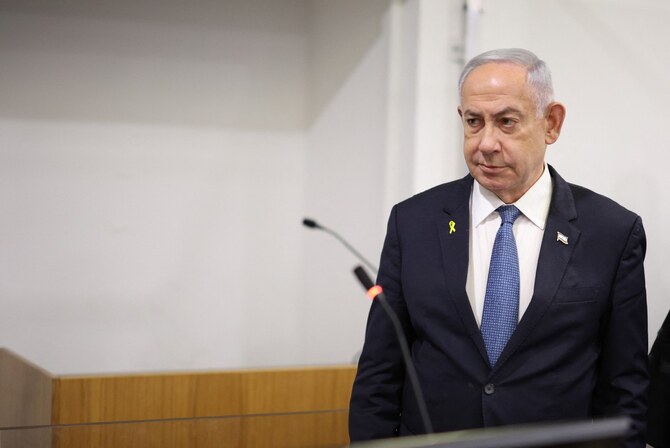
Netanyahu enforces media blackout on potential prisoner swap negotiations

Critics have accused Netanyahu and his coalition partners of undermining potential agreements to prolong the conflict, allegedly for political gain. (AFP/File)
Short Url
Updated 16 December 2024
Follow

Netanyahu enforces media blackout on potential prisoner swap negotiations

  • Israeli newspaper Israel Hayom says PM’s office urged military censor to tighten restrictions on information related to possible deal

LONDON: Israeli Prime Minister Benjamin Netanyahu has ordered stricter military censorship on media coverage of ongoing prisoner swap negotiations with Hamas, Israeli newspaper Israel Hayom reported on Sunday.

Citing political sources, the report revealed that Netanyahu’s office instructed the military censor to impose tighter restrictions than usual on information related to the potential deal.

A statement from Netanyahu’s office emphasized the importance of confidentiality, saying: “The prime minister has instructed ministers and security officials to fully adhere to information security protocols during security discussions.”

The decision reflects cautious optimism in Tel Aviv that a breakthrough might be reached by the Jewish festival of Hanukkah, starting on Dec. 25.

However, no official details of the talks have been disclosed due to concerns that public debate or leaks could jeopardize the negotiations.

“There is significant compartmentalization and also a heavy blackout compared to previous times over the past year — so that we can succeed in bringing about a deal,” a political source was quoted as saying.

Despite months of war, previous efforts to negotiate with Hamas have repeatedly failed.

Critics have accused Netanyahu and his coalition partners of undermining potential agreements to prolong the conflict, allegedly for political gain.

Netanyahu’s personal legal battles have also fueled skepticism.

The prime minister, currently standing trial for bribery, fraud, and breach of trust, has faced allegations that the ongoing war serves as a distraction from his legal woes.

His trial, which has already been delayed due to the war, is expected to extend well into next year, with potential appeals likely to dominate Israeli politics for the foreseeable future.


Grok faces more scrutiny over deepfakes as Irish regulator opens EU privacy investigation

Updated 59 min 35 sec ago
Follow

Grok faces more scrutiny over deepfakes as Irish regulator opens EU privacy investigation

  • The regulator says Grok has created and shared sexualized images of real people, including children. Researchers say some examples appear to involve minors
  • X also faces other probes in Europe over illegal content and user safety

LONDON: Elon Musk’s social media platform X faces a European Union privacy investigation after its Grok AI chatbot started spitting out nonconsensual deepfake images, Ireland’s data privacy regulator said Tuesday.
Ireland’s Data Protection Commission said it notified X on Monday that it was opening the inquiry under the 27-nation EU’s strict data privacy regulations, adding to the scrutiny X is facing in Europe and other parts of the world over Grok’s behavior.
Grok sparked a global backlash last month after it started granting requests from X users to undress people with its AI image generation and editing capabilities, including putting females in transparent bikinis or revealing clothing. Researchers said some images appeared to include children. The company later introduced some restrictions on Grok, though authorities in Europe weren’t satisfied.
The Irish watchdog said its investigation focuses on the apparent creation and posting on X of “potentially harmful” nonconsensual intimate or sexualized images containing or involving personal data from Europeans, including children.
X did not respond to a request for comment.
Grok was built by Musk’s artificial intelligence company xAI and is available through X, where its responses to user requests are publicly visible.
The watchdog said the investigation will seek to determine whether X complied with the EU data privacy rules known as GDPR, or the General Data Protection Regulation. Under the rules, the Irish regulator takes the lead on enforcing the bloc’s privacy rules because X’s European headquarters is in Dublin. Violations can result in hefty fines.
The regulator “has been engaging” with X since media reports started circulating weeks earlier about “the alleged ability of X users to prompt the @Grok account on X to generate sexualized images of real people, including children,” Deputy Commissioner Graham Doyle said in a press statement.
Spain’s government has ordered prosecutors to investigate X, Meta and TikTok for alleged crimes related to the creation and proliferation of AI-generated child sex abuse material on their platforms, Spanish Prime Minister Pedro Sánchez said on Tuesday.
“These platforms are attacking the mental health, dignity and rights of our sons and daughters,” Sánchez wrote on X.
Spain announced earlier this month that it was pursuing a ban on access to social media platforms for under-16s.
Earlier this month, French prosecutors raided X’s Paris offices and summoned Musk for questioning. Meanwhile, the data privacy and media regulators in Britain, which has left the EU, have opened their own investigations into X.
The platform is already facing a separate EU investigation from Brussels over whether it has been complying with the bloc’s digital rulebook for protecting social media users that requires platforms to curb the spread of illegal content such as child sexual abuse material.
