

Saudi Arabia spotlights private sector’s role in driving logistics transformation 

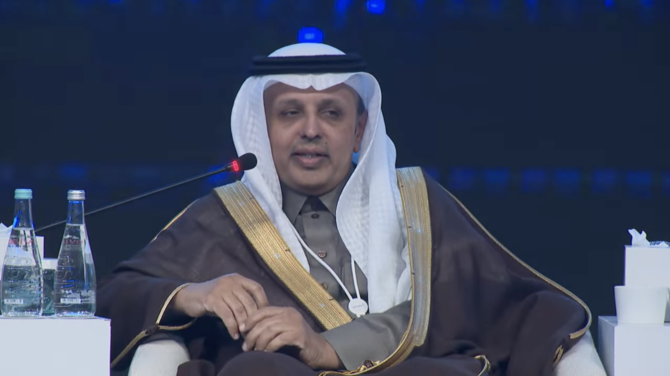
Rumaih Al-Rumaih, vice minister of transport and logistics services and president of the Transport General Authority. Screenshot
Short Url
Updated 16 December 2024
Follow

Saudi Arabia spotlights private sector’s role in driving logistics transformation 

  • Kingdom is seeking to become a global logistics hub by leveraging its strategic location at the crossroads of Asia, Africa, and Europe
  • Saudi Arabia currently ranks first globally for road connectivity

RIYADH: Saudi Arabia’s private sector is playing a pivotal role in driving the Kingdom’s transformation into a global logistics hub, a top official said.

Speaking at the sixth edition of the Supply Chain And Logistics Conference in Riyadh, Rumaih Al-Rumaih, vice minister of transport and logistics services and president of the Transport General Authority, highlighted the critical contributions from businesses. 

“The main player in achieving anything in the logistics sector is the private sector. Truly, the private sector is the one delivering results. The government’s role is to enable,” Al-Rumaih said. 

He added: “If we visit the exhibition, we’ll see the private sector at the forefront, not the government because they are the real achievers.” 

Saudi Arabia is seeking to become a global logistics hub by leveraging its strategic location at the crossroads of Asia, Africa, and Europe. Through its Vision 2030 plan, the Kingdom is investing in transport, infrastructure, and technology to reduce oil dependence and modernize supply chains. 

Al-Rumaih credited the economic diversification initiative for providing a structured roadmap, stating: “This did not happen by chance; it was a clear vision and target. The Kingdom’s strategic location connects three continents, making it a natural global logistics hub.” 

He also emphasized the private sector’s role in forging strategic partnerships with major global players, saying: “The private sector responded to Vision 2030 by growing rapidly and forming partnerships with major players like CEVA, DSV, and DB Schenker.” 

Building infrastructure 

Bader Al-Dulami, vice minister of transport and logistics services for road affairs, underscored the importance of infrastructure in enabling success. 

“The road sector is undoubtedly one of the most significant enablers of the logistics sector. There is no logistics sector without roads that connect various destinations,” Al-Dulami said. 

He added: “There is no successful logistics sector without a network of safe, high-quality roads that can accommodate the increasing demand in this sector.” 
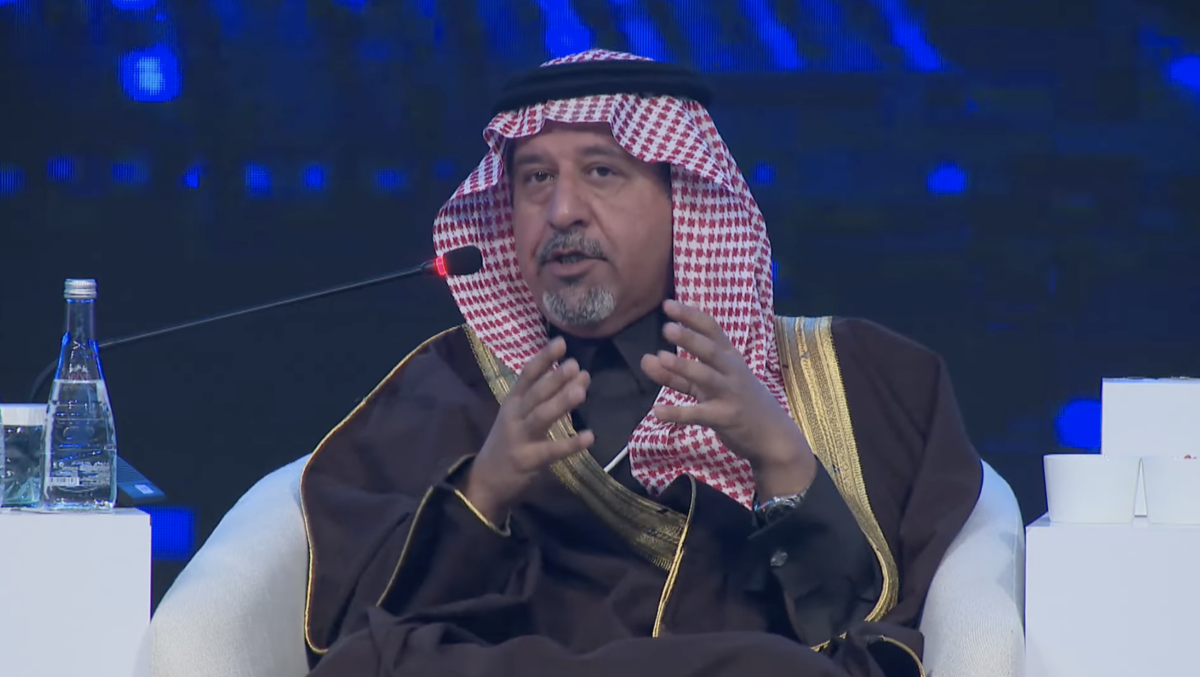


Bader Al-Dulami, vice minister of transport and logistics services for road affairs. Screenshot

Saudi Arabia currently ranks first globally for road connectivity, a milestone Al-Dulami attributed to sustained investment and strategic planning. 

“Through joint efforts, we have managed to reduce accident rates significantly. From 2016 to the present, the accident rate has decreased by more than half — a 50 percent reduction,” he said. 

The vice minister continued: “In 2016, there were 28 deaths per 100,000 people; today, it is less than 13 deaths per 100,000. However, our journey is far from over, as we aim to achieve the target of reducing this number to five by 2030” 

Road maintenance 

Al-Dulami announced plans for phase two of performance-based maintenance contracts, which will incorporate advanced technologies to enhance road sustainability. 

“The private sector will play a key role, especially in the operation and maintenance of roads. By the end of this month, we will launch phase two of performance-based maintenance contracts,” he said. 

“These contracts will incorporate a wide range of modern technologies that will be applied to roads. Many privatization projects have also been initiated,” Al-Dulami added. 

He emphasized the importance of collaboration with the private sector, describing it as a reliable and dynamic partner. 

“The private sector is a true partner that communicates its needs to us. We are not rigid when it comes to making changes that could benefit this sector,” Al-Dulami said. 

He continued: “On the contrary, we are extremely agile, and what you see today in terms of change and development is a result of this openness to everything new and everything that contributes to advancing this sector.” 

Ambitious goals 

Concluding the session, Al-Rumaih reaffirmed the Kingdom’s ambitious goals. 

“We will not stop here. Our aspirations are sky-high, and the journey to position Saudi Arabia as the top global logistics hub continues,” he said. 

The two-day Supply Chain And Logistics Conference brought together industry leaders, government officials, and stakeholders to showcase Saudi Arabia’s achievements and explore further opportunities for public-private collaboration in the logistics sector. 

In his keynote speech on the conference’s second day, Ahmed Al-Hassan, assistant minister of transport and logistics services, highlighted the ministry’s expanded role. 

“The ministry has transitioned from executing projects to supervising strategies that align with national goals and enhance global competitiveness,” he said. 

Al-Hassan praised initiatives like the Global Logistics Forum – held in Riyadh in October – describing it as a key platform for attracting international investments and strengthening Saudi Arabia’s role as a leader in the sector. 


Saudi Arabia set to lead $500bn wave of GCC debt maturities: Kamco Invest 

Updated 6 sec ago
Follow

Saudi Arabia set to lead $500bn wave of GCC debt maturities: Kamco Invest 

RIYADH: The Gulf Cooperation Council region is expected to see elevated levels of fixed-income maturities over the next five years, driven primarily by Saudi Arabia and the UAE, a new analysis showed. 

In its latest report, Kamco Invest said fixed-income maturities in Saudi Arabia are projected to total $174.5 billion between 2026 and 2030, closely followed by the UAE at $171.8 billion.  

Saudi Arabia’s debt market has recorded robust growth in recent years, attracting strong investor interest in fixed-income instruments amid a global environment of elevated interest rates. 

In October, Kuwait Financial Center — also known as Markaz — said Saudi Arabia dominated the GCC’s primary debt market in the third quarter, raising $20.32 billion through 36 issuances, a 62.7 percent year-on-year increase in value. 

“The bulk of the maturities in Saudi Arabia are for bonds and sukuk issued by the government at $106.4 billion, while in the case of the UAE, the lion’s share of maturities are for instruments issued by corporates at $136.2 billion,” said Kamco Invest. 

Over the next five years, fixed-income maturities in Qatar are expected to reach $85.6 billion, while Kuwait, Bahrain and Oman are each projected to record maturities of around $25 billion. 

Citing Bloomberg data, the report showed that GCC sovereign maturities stand at $244.8 billion over the 2026–2030 period, while corporate maturities are higher at $263.3 billion. 
 
“Both bond and sukuk maturities are expected to remain elevated starting from 2026 until 2030 and then gradually taper for the rest of the tenor. The higher maturities during the next five years reflects deficit financing issuances from GCC governments as well as investment and refinancing related issuances from the corporates,” said Kamco Invest. 

The report added that the majority of maturities are denominated in US dollars, accounting for 64.7 percent, followed by local-currency issuances in Saudi riyals and Qatari riyals at 10.6 percent and 6.3 percent, respectively. 

Owing to the strong credit profiles of GCC governments, most maturities fall within the high investment-grade category. A-rated instruments account for $208.7 billion, while total investment-grade maturities stand at $239.1 billion. 

In terms of instruments, conventional bonds dominate, with maturities of $317.6 billion over the next five years, compared with $190.5 billion for sukuk. Corporate bond maturities, at $173.4 billion, exceed government bond maturities of $144.2 billion. 
 
By sector, banks and other financial services firms account for $210.4 billion in maturities through 2030, representing 79.9 percent of total corporate maturities and 41.4 percent of overall GCC maturities. The energy sector follows with $21.8 billion, or 8.3 percent, of corporate maturities, while utilities and industrials account for $13.6 billion and $5.4 billion, respectively. 

Real estate maturities are concentrated mainly in the UAE and Saudi Arabia, at $11.2 billion and $4.3 billion, respectively, through 2030. 
 
Issuances in 2025 

Aggregate bond and sukuk issuances in the GCC reached $206.6 billion through the third week of December 2025, broadly unchanged from $206.8 billion in the same period a year earlier.

However, issuance patterns shifted markedly. Government issuances declined sharply to $77.9 billion in 2025, from $98.6 billion in 2024, while corporate issuances rose to a record $128.6 billion, up from $108.2 billion. 

In terms of type of issuances, sukuk issuances witnessed a sharp decline during 2025, whereas bond issuances showed a healthy growth. 

“Aggregate GCC bond issuances stood at $125.2 billion in 2025, the highest on record, compared to $106.2 billion during 2024, whereas sukuk issuances declined by 19.1 percent to reach $81.4 billion this year as compared to issuances of $100.6 Bn during 2024,” said Kamco Invest. 

Despite an 18.3 percent decline, Saudi Arabia remained the region’s largest fixed-income issuer, with total issuance of $82.0 billion in 2025, down from $100.3 billion the previous year. 

Issuances from Qatar fell 21.7 percent to $22.1 billion, while the UAE recorded modest growth, with total issuance rising to $64.9 billion from $63.4 billion. Kuwait posted the sharpest increase, with issuance surging to $20.5 billion from $2.6 billion in 2024 following the approval of its debt law. 
 
Green issuances 

Green-instrument issuance in the GCC rose sharply in 2025, though it remained below the record levels seen in 2023. Total green issuance reached $12.5 billion, up from $4.6 billion in 2024 but below $17.3 billion recorded in 2023. 

The UAE led the region with $5.6 billion in green issuance, compared with $3.8 billion a year earlier. Saudi Arabia followed with $5.1 billion, after recording no green issuances in 2024. 

Green sukuk are Shariah-compliant instruments designed to finance environmentally sustainable projects, including renewable energy, clean transportation and climate-resilient infrastructure. 
 
Outlook 

Kamco Invest expects higher issuance levels in 2026, particularly among GCC countries facing fiscal deficits. The UAE and Qatar are also projected to see elevated corporate issuance. 

A potential decline in interest rates could further support issuance activity, especially early in the year, as borrowers seek to lock in lower funding costs. 

“Maturity refinancing is expected to result in approximately $85.4 billion in issuances during the year, while government deficit financing led by lower average oil prices would also contribute to the overall trend during the rest of the year,” the report said.  

Based on IMF forecasts, deficit financing could result in issuance of close to $60 billion in 2026, it added.