Japan, GCC strengthen economic ties with 1st round of FTA talks

The conclusion of this first round of negotiations marks the beginning of a broader process aimed at strengthening trade relations and fostering economic cooperation between the GCC and Japan. SPA
Short Url
Updated 15 December 2024
Follow

Japan, GCC strengthen economic ties with 1st round of FTA talks

  • Talks covered trade in goods and services, customs procedures, digital trade, rules of origin, intellectual property, and general provisions
  • It marks the beginning of a broader process aimed at strengthening trade relations

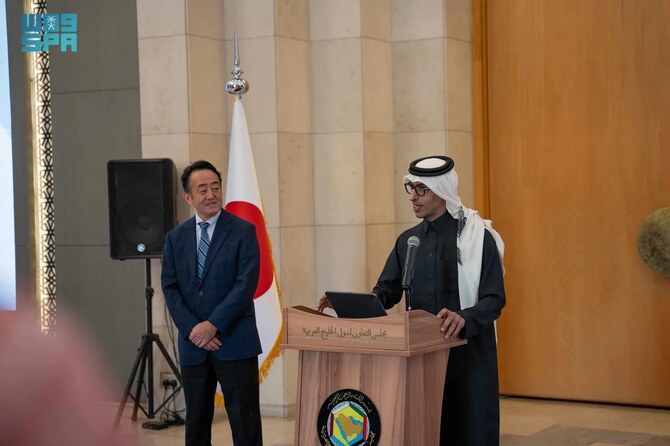
RIYADH: Economic ties between Japan and the Gulf Cooperation Council advanced with the successful completion of the first round of Free Trade Agreement negotiations in Riyadh on Dec. 12.

Led by Saudi Arabia’s General Authority for Foreign Trade, the discussions aimed to lay the groundwork for future trade agreements, covering key areas such as trade in goods and services, customs procedures, digital trade, rules of origin, intellectual property, and general provisions.

This milestone marks a significant step towards deeper economic collaboration between the two regions. Fareed Al-Asaly, deputy governor of International Organizations and Agreements at GAFT, underscored the importance of the talks, emphasizing that the agreement could lead to increased trade volumes and closer economic integration. He also noted that Japan is a key market for GCC exports.

The Saudi delegation included representatives from multiple ministries and government bodies, such as the ministries of energy, investment, environment, water and agriculture, industry and mineral resources, economy and planning, and interior.

Additionally, officials from the Saudi Authority for Intellectual Property, the Zakat, Tax, and Customs Authority, the National Cybersecurity Authority, the Saudi Export Development Authority, and the Saudi Central Bank participated in the discussions.

The conclusion of this first round of negotiations marks the beginning of a broader process aimed at strengthening trade relations and fostering economic cooperation between the GCC and Japan.

This year has already seen significant strides in the economic partnership between Saudi Arabia and Japan. In May, both nations agreed to collaborate on building global supply chains for clean energy resources, including hydrogen and ammonia. The goal is to establish a robust international network for clean energy.

In July, during Japanese Prime Minister Fumio Kishida’s visit to Saudi Arabia, the two countries exchanged 26 pre-signed economic agreements covering sectors such as healthcare, clean energy, mining, and digital innovation. Energy Minister Prince Abdulaziz bin Salman highlighted the long-standing energy partnership, noting that Saudi Arabia supplied around 40 percent of Japan’s oil in 2021.

In October, the Saudi Public Investment Fund signed five memorandums of understanding with Japanese financial institutions, with agreements worth up to $51 billion.

These deals aim to boost bilateral capital flows through both debt and equity, further solidifying the financial relationship between the two nations.

This continued collaboration signals a growing and mutually beneficial partnership between Japan and the GCC, with the potential to reshape regional economic dynamics and create new opportunities for growth and innovation.


Saudi Arabia, Japan trade rises 38% between 2016 and 2024, minister says

Updated 11 January 2026
Follow

Saudi Arabia, Japan trade rises 38% between 2016 and 2024, minister says

RIYADH: Trade between Saudi Arabia and Japan has increased by 38 percent between 2016 and 2024 to reach SR138 billion ($36 billion), the Kingdom’s investment minister revealed.

Speaking at the Saudi-Japanese Ministerial Investment Forum 2026, Khalid Al-Falih explained that this makes the Asian country the Kingdom’s third-largest trading partner, according to Asharq Bloomberg.

This falls in line with the fact that Saudi Arabia has been a very important country for Japan from the viewpoint of its energy security, having been a stable supplier of crude oil for many years.

It also aligns well with how Japan is fully committed to supporting Vision 2030 by sharing its knowledge and advanced technologies.

“This trade is dominated by the Kingdom's exports of energy products, specifically oil, gas, and their derivatives. We certainly look forward to the Saudi private sector increasing trade with Japan, particularly in high-tech Japanese products,” Al-Falih said.

He added: “As for investment, Japanese investment in the Kingdom is good and strong, but we look forward to raising the level of Japanese investments in the Kingdom. Today, the Kingdom offers promising opportunities for Japanese companies in several fields, including the traditional sector that links the two economies: energy.”

The minister went on to note that additional sectors that both countries can also collaborate in include green and blue hydrogen, investments in advanced industries, health, food security, innovation, entrepreneurship, among others.

During his speech, Al-Falih shed light on how the Kingdom’s pavilion at Expo 2025 in Osaka achieved remarkable success, with the exhibition receiving more than 3 million visitors, reflecting the Japanese public’s interest in Saudi Arabia.

“The pavilion also organized approximately 700 new business events, several each day, including 88 major investment events led by the Ministry of Investment. Today, as we prepare for the upcoming Expo 2030, we look forward to building upon Japan’s achievements,” he said.

The minister added: “During our visit to Japan, we agreed to establish a partnership to transfer the remarkable Japanese experience from Expo Osaka 2025 to Expo Riyadh 2030. I am certain that the Japanese pavilion at Expo Riyadh will rival the Saudi pavilion at Expo Osaka in terms of organization, innovation, and visitor turnout.”

Al-Falih also shed light on how Saudi-Japanese relations celebrated their 70th anniversary last year, and today marks the 71st year of these relations as well as how they have flourished over the decades, moving from one strategic level to an even higher one.