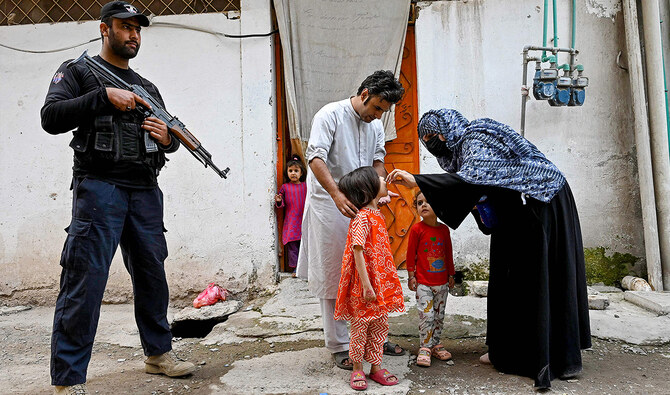
PESHAWAR: Pakistani authorities have postponed a planned anti-polio vaccination campaign in the northwestern Kurram district, a senior health official said on Friday, citing a fragile security situation after weeks of deadly sectarian clashes in the region.
The development came as the South Asian country reported four new cases of the polio virus that brought the nationwide tally to 63 this year. Pakistan and the neighboring Afghanistan are the only two countries in the world where polio remains an endemic.
Kurram, a former semi-autonomous tribal region bordering Afghanistan, has a long history of violent conflicts and the recent clashes between Shiite and Sunni communities, which began on Nov. 21, killed 133 people in the restive region.
Though a council of tribal elders, or jirgah, backed by the Khyber Pakhtunkhwa provincial government, this month managed a ceasefire between the warring tribes, security situation remains fragile in the district where road closures have led to shortage of medicines and food.
“Yes, the anti-polio campaign in Kurram has been postponed delayed for now. After improvement in the security environment and reopening of roads, new dates for polio eradication campaign will be announced for the district,” Dr. Qaisar Khan, the Kurram district health officer (DHO), told Arab News.
Pakistan will launch its next anti-polio vaccination campaign from Dec. 16 till Dec. 22 to reach more than 44 million children under the age of five in 143 districts across the country, according to the official.
Pakistan is a Sunni-majority country, but Kurram has a large Shiite population, and the communities have clashed for decades. Provincial authorities last Sunday dispatched a batch of essential medicines via helicopter to the volatile district to ease the suffering of residents.
Pakistan’s chief health officer said on Nov. 10 an estimated 500,000 children had missed polio vaccination during the last countrywide inoculation drive.
This year, the country’s polio program has confirmed 26 polio cases in Balochistan, 18 in Khyber Pakhtunkhwa, 17 in Sindh, and one each in Punjab and the federal capital of Islamabad.
Poliovirus, which can cause crippling paralysis particularly in young children, is incurable and remains a threat to human health as long as it has not been eradicated. Immunization campaigns have succeeded in most countries and have come close in Pakistan, but persistent problems remain.
In the early 1990s, Pakistan reported around 20,000 cases annually but in 2018 the number dropped to eight cases. Six cases were reported in 2023 and only one in 2021.
Pakistan’s polio program began in 1994 but efforts to eradicate the virus have since been undermined by vaccine misinformation and opposition from some religious hard-liners who say immunization is a foreign ploy to sterilize Muslim children or a cover for Western spies. Militant groups also frequently attack and kill members of polio vaccine teams.
In July 2019, a vaccination drive in Khyber Pakhtunkhwa was thwarted after mass panic was created by rumors that children were fainting or vomiting after being immunized.
Public health studies in Pakistan have shown that a lack of knowledge about vaccines, together with poverty and rural residency, are also factors that commonly influence whether parents vaccinate their children against polio.


Pakistan postpones anti-polio drive in northwestern district amid fragile security situation
https://arab.news/8ywmc
Pakistan postpones anti-polio drive in northwestern district amid fragile security situation

- Kurram has a long history of violent conflicts and recent clashes between Shiite, Sunni communities, which began on Nov. 21, killed 133 people
- The development comes as the South Asian country reports four new cases of the polio virus that have brought the nationwide tally to 63 this year

At Islamabad conference, Pakistan pitches agriculture as next frontier for Chinese investment
- Hundreds of Chinese and Pakistani firms attended the event focusing on fertilizers, seeds, smart farming and irrigation techniques
- PM Sharif urges Pakistani farmers, businesses and universities to engage with Chinese institutions and experts to modernize agriculture
ISLAMABAD: Prime Minister Shehbaz Sharif on Monday pitched Pakistan’s agriculture sector as the next major frontier for Chinese investment, highlighting opportunities in agri-business, food processing and farming technologies.
The prime minister said this while addressing the Pakistan-China Agriculture Investment Conference, which brought together Chinese and Pakistani agriculturists, entrepreneurs, experts, academicians and government officials.
Hundreds of Chinese and Pakistani firms attended the event that focused on fertilizers, seed varieties, machinery, precision farming and smart irrigation systems, according to the organizers.
Sharif said China had never shied away from providing Pakistan with best possible expertise and technologies, and both sides had signed several memorandums of understanding (MoUs) at similar summits in Shandong and Beijing in last two years.
“I was very happy to express my satisfaction over the progress we are making in terms of converting these MOUs into agreements,” he said. “Today’s conference is a clear indication that Chinese business houses are more than willing to shake hands with Pakistani business houses.”
The conference was billed by Pakistan’s Ministry of National Food Security and Research as a platform for deepening bilateral agricultural ties and supporting broader economic engagement between the two countries.
Sharif called on Pakistani farmers, agribusinesses and universities to actively engage with Chinese institutions and experts to modernize the agriculture sector, which accounts for 24 percent of Pakistan’s GDP and employs over 37 percent of its labor force.
“Chinese experts are there to assist us and support us all the way to achieve this wonderful target [of becoming a surplus agricultural economy],” he said. “Now it’s up to us to generate this trade surplus through higher yields, comparative cost and, of course, highest quality.”
Pakistan and China have been expanding cooperation in agriculture under the China-Pakistan Economic Corridor framework, with a focus on mechanization, high-yield seeds, livestock development and value-added food processing.
Officials say stronger agricultural ties could help Pakistan boost exports, ensure food security and create jobs, while offering Chinese companies access to a large farming market and new investment opportunities.
The prime minister noted that Pakistan’s policy rate was down to 10.5 percent down from 22 percent two years ago, exports were gradually increasing and macroeconomic indicators were stable.
“Now we have to move toward growth,” he said. “But then it requires solid, hard work, untiring efforts, blood and sweat. Without that, you will not be able to achieve your targets.”
The Pakistan-China Agriculture Investment Conference focused on technology transfer and joint ventures in farming, food processing and agricultural research.
“I would urge upon Pakistani farmers, Pakistani agri-houses, experts, professors, technicians, that please come forward and show your best to your [Chinese] brothers and sisters,” Sharif said.
“China is ready, ladies and gentlemen, to support Pakistan like always in the past. Let us make use of this opportunity. Let us stand up and accept this challenge and make Pakistan great through untiring efforts, through hard work.”