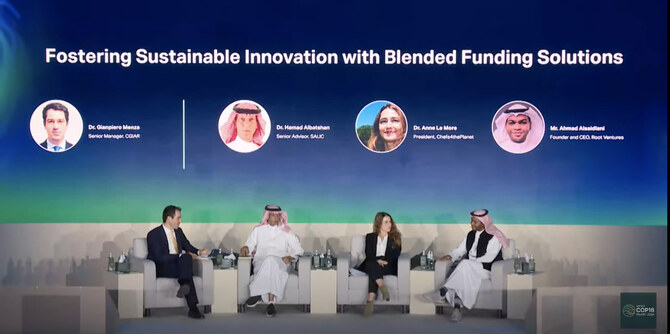

RIYADH: Saudi Arabia’s innovative use of blended financing is playing a key role in advancing sustainable agricultural practices and addressing food security challenges, a senior executive said at COP16 in Riyadh.
During a panel session, Hamad Al-Batshan, senior adviser at Saudi Agricultural and Livestock Investment Co., discussed the importance of blended financing as a tool for de-risking investments in agriculture and technology.
“Blended financing is a significant step forward into the future, adopting new technology and mitigating risks within Saudi Arabia,” he said, emphasizing its role in supporting high-risk sectors such as climate technology.
Al-Batshan added: “Without having this enablement tool, it will be more challenging to mobilize capital from private sector or traditional investors toward riskier domains.”
Al-Batshan also praised the creation of the Research, Development and Innovation Authority, which he believes is crucial for linking government and private sector efforts.
“De-risking investment is the way to go,” he said, highlighting SALIC’s alignment with the RDI strategy to drive sustainable innovation in health, sustainability, energy, and future economies.
SALIC, a Public Investment Fund-owned entity, has expanded its focus beyond global food security to also strengthen local gross domestic product and address Saudi Arabia’s trade deficit.
Al-Batshan stressed the need to “transform the local agriculture sector to mitigate the risks of water security and to utilize state-of-the-art technology” to achieve these goals.
Ahmad Al-Saidalani, founder and CEO of ROOTS, also emphasized the importance of blended financing in advancing early-stage innovations.
“Blended finance is an incredible tool to de-risk investments for investors in solutions and technologies that address these challenges,” Al-Saidalani said.
Anne Le More, a UN Food Systems Champion, described blended finance as a niche but essential mechanism for impact investment.
“Blended finance can really be a useful tool, especially in areas which are more impact investment, where we only look at risks and benefits,” Le More said. She added that concessional loans and technical assistance, especially for startups, make blended financing particularly valuable.
“The beauty about blended finance is that it really can bring the best of the public world and the private sector world,” she said.
Panelists also discussed the importance of government incentives to encourage private sector participation.
“The government clearly needs to incentivize the private sector... sometimes not necessarily through financing, but by improving the investment ecosystem,” Al-Batshan said, suggesting measures such as tax cuts and concessional loans.
Reflecting on lessons learned from the COVID-19 pandemic, Al-Batshan stressed the urgency of bolstering Saudi Arabia’s supply chain.
“It’s very important for us to look seriously about the interruption in the world market and try to invest locally to mitigate this type of risk,” he said.
Addressing hurdles in sustainability investments
In another panel session, Hasan Al-Abdulgader, head of produced water treatment R&D at Saudi Aramco, outlined the challenges faced by startups and small to medium enterprises in Saudi Arabia’s sustainability sector, particularly in funding and regulatory compliance.
“SMEs and businesses here in Saudi have been facing a constantly evolving regulatory environment,” he said.
While he praised the government’s progress in developing robust regulations, he noted that regulatory maturity in the sustainability sector remains a challenge for smaller businesses.
Al-Abdulgader pointed out that these challenges also present opportunities for innovation, such as Saudi startups using generative AI to help businesses comply with changing regulations and stay competitive in the sustainability sector.
On the funding side, Al-Abdulgader highlighted the scarcity of venture capital firms in the region that specialize in environmental, social, and governance investments.
“Private equities don’t have the appetite to wait for 10-plus years to reap the benefits and returns of these technologies,” he said.
He called for a hybrid approach, involving collaboration among government, universities, and the private sector to de-risk investment and support commercialization.
“We need more investment, more awareness when it comes to ESG in general, but also a more top-down approach to really incentivize these investment firms and universities to start with low TRL levels,” he added, emphasizing the critical need to sustain startups through the piloting and demonstration stages.
Jamil Wayne, co-founder of Riffle Ventures, echoed these sentiments, highlighting the long timelines required for high-impact climate technology investments, such as green cement.
“To create, though, the solutions that are going to be needed to replace the current assets that we use in cement production, we have to almost take a completely different mindset when it comes to investing and waiting for returns,” he said.
He added: “We’ve gotten spoiled as investors by the software period, where, in that same amount of time, you can have about five to 10 unicorns created and many IPOs. For climate technology, that same timeframe is just the starting point for a solution to reach the market.”
Wayne emphasized the need for a tailored investment strategy, combining patient capital and government support, to allow climate technology solutions to scale and achieve commercial viability.
Panelists agreed on the need for innovative funding mechanisms, regulatory clarity, and public-private partnerships to overcome these challenges and accelerate progress in the sustainability sector.