

Saudi POS spending reaches $3.78bn, driven by surge in utilities and jewelry

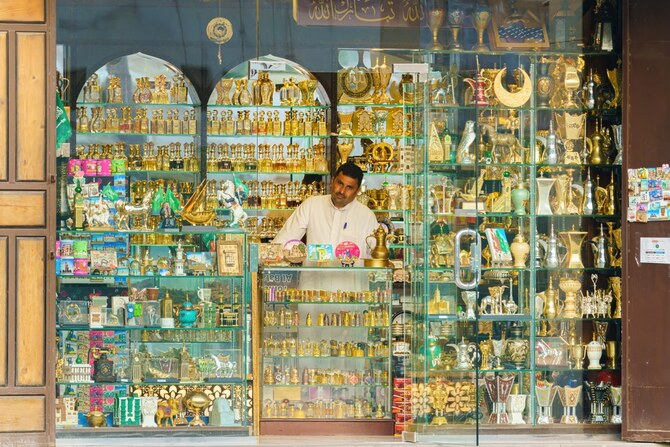
Jewelry sales recorded the second-largest growth, rising 8.2 percent to SR288.13 million. Shutterstock
Short Url
Updated 18 December 2024
Follow

Saudi POS spending reaches $3.78bn, driven by surge in utilities and jewelry

  • Spending on public utilities rose by 11.5% to SR63.32 million
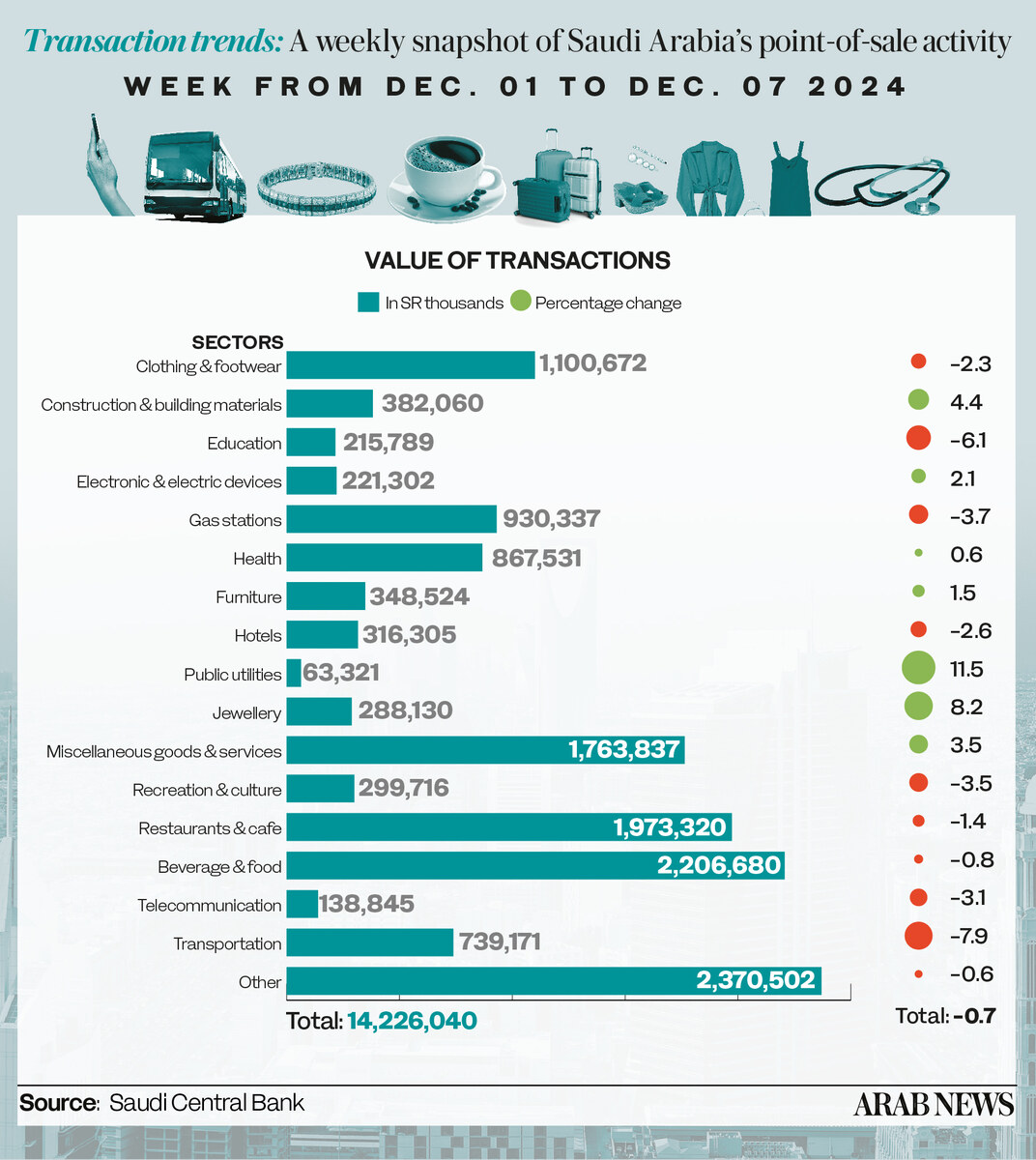
  • Total POS transactions in the Kingdom reached SR14.22 billion, a 0.7% decrease from the previous week

RIYADH: Saudis have increased their spending on utilities and jewelry during the first week of December, while food and beverage sales showed a slight decline, according to the latest data from the Saudi Central Bank. 

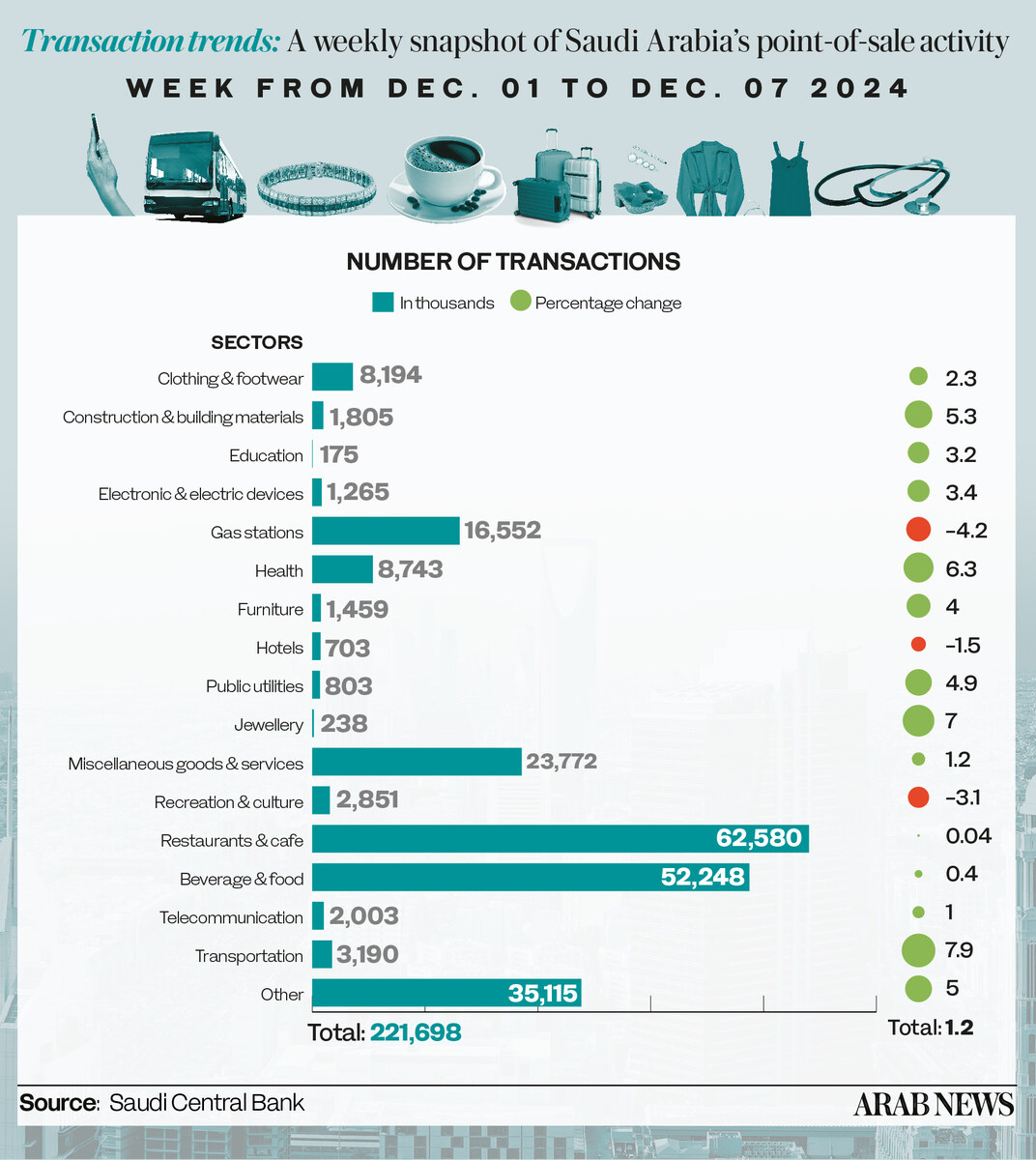
In the week from Dec. 1 to 7, spending on public utilities rose by 11.5 percent to SR63.32 million ($16.85 million), driven by higher demand for essential services. The sector also saw a rise in transactions, which climbed 4.9 percent to SR803,000. 

Data from the weekly point-of-sale reports showed that jewelry sales recorded the second-largest growth, rising 8.2 percent to SR288.13 million, followed by an uptick in spending on construction materials, which grew by 4.4 percent to SR382 million. 

Total POS transactions in the Kingdom reached SR14.22 billion, a 0.7 percent decrease from the previous week. 
This comes as spending on food and beverages experienced a modest decline. Expenditures fell by 0.8 percent to SR2.20 billion, still maintaining the largest share of total POS value. Restaurant and cafe spending also dipped by 1.4 percent to SR1.97 billion, representing the second-largest category by value. 

Certain sectors saw positive growth, such as electronics, which rose by 2.1 percent to SR221.30 million, and miscellaneous goods and services, which jumped by 3.5 percent to SR1.76 billion. 

Telecommunications spending declined by 3.1 percent, amounting to SR138.84 million. Health sector spending remained relatively flat with a 0.6 percent increase, reaching SR867.53 million. Furniture expenditures grew by 1.5 percent to SR348.52 million, marking the second-smallest increase. 
Riyadh accounted for the largest share of POS transactions, making up 34.7 percent of the total with SR4.94 billion in spending, though this was down 1.1 percent compared to the previous week. 

Jeddah saw a 3.1 percent increase, reaching SR1.92 billion, while Dammam recorded a slight decline of 0.1 percent to SR719.3 million. 

Among smaller cities, Tabuk saw the steepest drop in spending, down 5.1 percent to SR281 million, followed by Hail and Abha, which declined by 2.9 percent to SR234.71 million and 1.3 percent to SR166.55 million, respectively. 

In terms of transaction volumes, Makkah and Jeddah experienced the most significant increases, with transaction numbers up 3.8 percent and 2.3 percent, respectively. Makkah recorded 8.97 million transactions, while Jeddah saw 26.31 million. 

Hail and Tabuk reported the largest decreases, with transactions falling by 1.5 percent 3.93 million and 1.1 percent 4.82 million, respectively. 


Saudi Arabia leads outcome-based education to prepare future-ready generations: Harvard Business Review

A Harvard sign is seen at the Harvard University campus in Boston, Massachusetts, on May 27, 2025. (AFP)
Updated 10 February 2026
Follow

Saudi Arabia leads outcome-based education to prepare future-ready generations: Harvard Business Review

  • The Riyadh-based school group developed a strategy that links every classroom activity to measurable student competencies, aiming to graduate learners equipped for the digital economy and real-world contexts

RIYADH: Saudi Arabia’s education system is undergoing a sweeping transformation aligned with Vision 2030, shifting from traditional, input-focused methods to outcome-based education designed to equip students with future-ready skills, Harvard Business Review Arabic reported.

The transformation is being adopted and spearheaded by institutions such as Al-Nobala Private Schools, which introduced the Kingdom’s first national “learning outcomes framework,” aimed at preparing a generation of leaders and innovators for an AI-driven future, the report said.

Al-Nobala has leveraged international expertise to localize advanced learning methodologies.

The Riyadh-based school group developed a strategy that links every classroom activity to measurable student competencies, aiming to graduate learners equipped for the digital economy and real-world contexts. The school’s group approach combines traditional values with 21st-century skills such as critical thinking, communication, innovation and digital fluency.

According to the report, the shift addresses the growing gap between outdated models built for low-tech, resource-constrained environments and today’s dynamic world, where learners must navigate real-time information, virtual platforms, and smart technologies.

“This is not just about teaching content, it’s about creating impact,” the report noted, citing how Al-Nobala’s model prepares students to thrive in an AI-driven world while aligning with national priorities.

The report noted that Saudi Arabia’s Ministry of Education has paved the way for this shift by transitioning from a centralized controller to a strategic enabler, allowing schools such as Al-Nobala to tailor their curriculum to meet evolving market and societal needs. This is part of the long-term goal to place the Kingdom among the top 20 global education systems.

Al-Nobala’s work, the report stated, has succeeded in serving the broader national effort to link education outcomes directly to labor market demands, helping to fulfill the Vision 2030 pillar of building a vibrant society with a thriving economy driven by knowledge and innovation.

Last February, Yousef bin Abdullah Al-Benyan, Saudi Arabia’s minister of education, said that the Kingdom was making “an unprecedented investment in education,” with spending aligned to the needs of growth and development. He said that in 2025, education received the second-largest share of the state budget, totaling $53.5 billion.
