

Israeli jets pound ‘strategic weapons systems’ across Syria

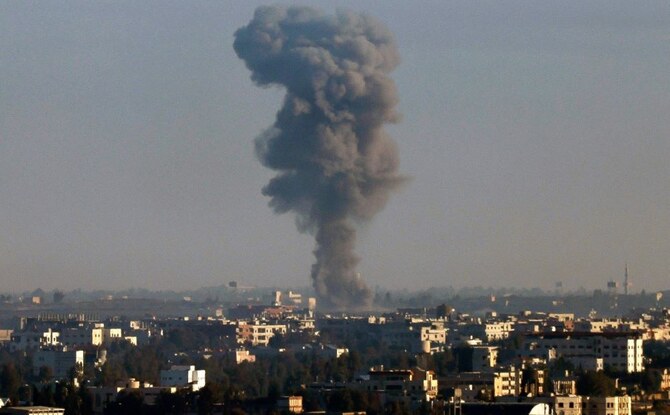
Smoke billows above the Syrian Governorate of Quneitra, as seen from the Israeli-annexed Golan Heights, during Israeli bombardment, Dec. 9, 2024. (AFP)
Short Url
Updated 10 December 2024
Follow

Israeli jets pound ‘strategic weapons systems’ across Syria

  • UK-based Syrian Observatory for Human Rights said that it has documented more than 310 strikes by the IDF since Sunday
  • Israel FM Gideon Sa’ar: ‘That’s why we attack strategic weapons systems like chemical weapons, or long-range missiles, in order that they will not fall into the hands of extremists’

LONDON: Israeli jets have reportedly carried out hundreds of airstrikes on “strategic weapons systems” across Syria since the fall of the Assad regime.

The UK-based Syrian Observatory for Human Rights said that it has documented more than 310 strikes by the IDF since Sunday.

The strikes have targeted military facilities of the Syrian Army, including weapon warehouses, ammunition depots, airports, naval bases and research centers.

Israel claimed its actions aim to prevent weapons falling “into the hands of extremists” as Syria transitions into a post-Assad era.

The SOHR reported that the attacks spanned Aleppo, Damascus and Hama, with more than 60 taking place overnight between Monday and Tuesday alone.

Reports said that many of the facilities hit have not merely been damaged, but completely destroyed.

Rami Abdul Rahman, SOHR’s founder, described the impact of the strikes as destroying “all the capabilities of the Syrian army” and said that “Syrian lands are being violated.”

The IDF denied that its troops had strayed into Syrian territory and said that reports of tanks near Damascus are “false.”

A spokesperson said: “IDF troops are stationed within the buffer zone, as stated in the past.”

The IDF seized Syrian positions in the buffer zone as a “temporary defensive position until a suitable arrangement is found,” Israeli Prime Minister Benjamin Netanyahu said.

“If we can establish neighborly relations and peaceful relations with the new forces emerging in Syria, that’s our desire. But if we do not, we will do whatever it takes to defend the state of Israel and the border of Israel,” he said on Monday.

Asked about the IDF strikes on Monday night, Israeli Foreign Minister Gideon Sa’ar said that Israel is only concerned with defending its citizens.

“That’s why we attack strategic weapons systems like, for example, remaining chemical weapons or long-range missiles and rockets in order that they will not fall into the hands of extremists,” he added.

It is not known where or how many chemical weapons Syria has, but it is believed that former president Bashar Assad kept stockpiles.

Israel’s attacks come after Syrian rebel fighters captured the capital, Damascus, and toppled the Assad regime over the weekend. He and his father had been in power in the country since 1971.

Forces led by the Islamist opposition group Hayat Tahrir Al-Sham entered Damascus in the early hours of Sunday, before appearing on state television to declare that Syria was now “free.”


Fledgling radio station aims to be ‘voice of the people’ in Gaza

Updated 15 February 2026
Follow

Fledgling radio station aims to be ‘voice of the people’ in Gaza

  • The electricity crisis is one of the most serious and difficult problems in the Gaza Strip, says Shereen Khalifa Broadcaster

DEIR EL-BALAH: From a small studio in the central city of Deir El-Balah, Sylvia Hassan’s voice echoes across the Gaza Strip, broadcast on one of the Palestinian territory’s first radio stations to hit the airwaves after two years of war.

Hassan, a radio host on fledgling station “Here Gaza,” delivers her broadcast from a well-lit room, as members of the technical team check levels and mix backing tracks on a sound deck. “This radio station was a dream we worked to achieve for many long months and sometimes without sleep,” Hassan said.

“It was a challenge for us, and a story of resilience.”

Hassan said the station would focus on social issues and the humanitarian situation in Gaza, which remains grave in the territory despite a US-brokered ceasefire between Israel and Hamas since October.

“The radio station’s goal is to be the voice of the people in the Gaza Strip and to express their problems and suffering, especially after the war,” said Shereen Khalifa, part of the broadcasting team.

“There are many issues that people need to voice.” Most of Gaza’s population of more than 2 million people were displaced at least once during the gruelling war.

Many still live in tents with little or no sanitation.

The war also decimated Gaza’s telecommunications and electricity infrastructure, compounding the challenges in reviving the territory’s local media landscape. “The electricity problem is one of the most serious and difficult problems in the Gaza Strip,” said Khalifa.

“We have solar power, but sometimes it doesn’t work well, so we have to rely on an external generator,” she added.

The station’s launch is funded by the EU and overseen by Filastiniyat, an organization that supports Palestinian women journalists, and the media center at the An-Najah National University in Nablus, in the occupied West Bank.

The station plans to broadcast for two hours per day from Gaza and for longer from Nablus. It is available on FM and online.

Khalifa said that stable internet access had been one of the biggest obstacles in setting up the station, but that it was now broadcasting uninterrupted audio.

The Gaza Strip, a tiny territory surrounded by Israel, Egypt, and the Mediterranean Sea, has been under Israeli blockade even before the attack on Oct. 7, 2023, which sparked the war. Despite the ceasefire, Israel continues to strictly control the entry of all goods and people to the territory.

“Under the siege, it is natural that modern equipment necessary for radio broadcasting cannot enter, so we have made the most of what is available,” she said.