

Charred cars, burning trees after deadly Israeli strikes on Syria

1 / 4
The carcass of a turtle sits amongst the ash after overnight Israeli strikes on the outskirts of Masyaf in Syria's central Hama province on September 9, 2024. (AFP)
2 / 4
A wounded man receives treatment after overnight Israeli strikes on the outskirts of Masyaf in Syria's central Hama province on September 9, 2024. (AFP)
3 / 4
Syrians inspect the damage at the site of overnight Israeli strikes on the outskirts of Masyaf in Syria's central Hama province on September 9, 2024. (AFP)
4 / 4
Syrians inspect the damage at the site of overnight Israeli strikes on the outskirts of Masyaf in Syria's central Hama province on September 9, 2024. (AFP)
Short Url
Updated 10 September 2024
Follow

Charred cars, burning trees after deadly Israeli strikes on Syria

  • The “Israeli strikes... targeted the area of the scientific research center in Masyaf” in Hama province and other sites, destroying “buildings and military centers,” the group said

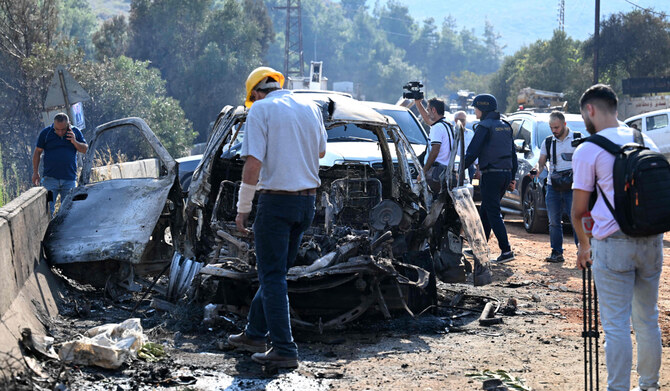
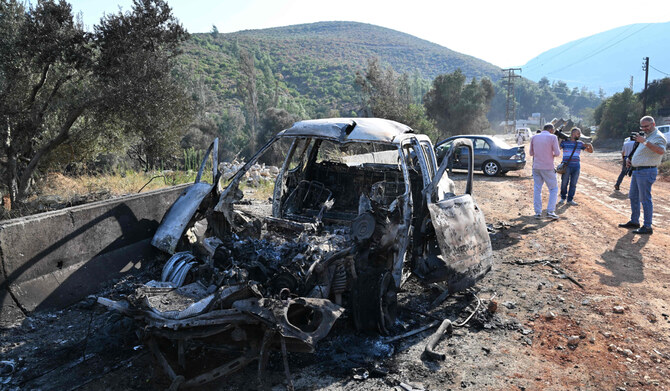
MASYAF, Syria: Near the usually quiet Syrian town of Masyaf smoke was still billowing from trees while burnt-out cars stood nearby, a day after authorities reported deadly Israeli strikes on military sites.
Syrian health minister Hassan Al-Ghabash told AFP the overnight “Israeli aggression” killed 18 people and wounded 37 others, during a media tour organized by the authorities.
At the entrance to the mountainous town, about 220 kilometers (135 miles) north of the capital Damascus, a partially burned sign read “Masyaf.”
Fire-damaged cars were visible on both sides of the road, with nearby trees still burning and electric cables damaged and tangled, reported an AFP correspondent at the scene.
The raids also blew five large craters in the main road to Masyaf, the correspondent said.
Ambulances were still moving around the area, where one car had been burnt down to its metal frame and a yellow bulldozer was flipped upside down.
Mohammed Akkari, 47, who lives near the site of the strikes with his wife and two children, said they were gripped by fear when their house shook near midnight.
“We had never heard such a sound, a terrifying explosion, my children were terrified,” he told AFP.
At the Masyaf hospital, firefighter Mohammed Shmeil, 36, was being treated for his injured leg and foot.
“What we saw during that incident was something else,” he said, wincing in pain.
The Syrian Observatory for Human Rights war monitor said 26 people were killed in what its chief Rami Abdel Rahman said was “one of the most violent Israeli attacks” in years.

The Britain-based Observatory, which relies on a network of sources inside Syria, said the strikes targeted sites “where pro-Iran groups and weapons development experts are stationed.”
The “Israeli strikes... targeted the area of the scientific research center in Masyaf” in Hama province and other sites, destroying “buildings and military centers,” the group said.
He said Iranian experts “developing arms including precision missiles and drones” worked in the government scientific research center that was hit.
Israeli strikes on Syria since 2011 have mainly targeted army positions and Iran-backed fighters including from Lebanon’s Hezbollah group.
Israeli authorities rarely comment on individual strikes in Syria, but have repeatedly said they will not allow arch-enemy Iran, a Damascus ally, to expand its presence in the country.
Israeli raids on Syria surged after Hamas’s October 7 attack on Israel sparked war in Gaza, then eased somewhat after an April 1 strike blamed on Israel hit the Iranian consular building in Damascus.
In late August, several pro-Iranian fighters were killed in Syria’s central Homs region in strikes attributed to Israel, the Observatory had said.
Days later, the Israeli military said it killed an unspecified number of fighters belonging to Hamas ally Islamic Jihad in a strike in Syria near the Lebanese border.


Hamas to hold leadership elections in coming months: sources

Updated 13 January 2026
Follow

Hamas to hold leadership elections in coming months: sources

  • A Hamas member in Gaza said Hayya is a strong contender due to his relations with other Palestinian factions, including rival Fatah, which dominates the Palestinian Authority, as well as his regional standing

GAZA CITY, Palestinian Territories: Hamas is preparing to hold internal elections to rebuild its leadership following Israel’s killing of several of the group’s top figures during the war in Gaza, sources in the movement said on Monday.
“Internal preparations are still ongoing in order to hold the elections at the appropriate time in areas where conditions on the ground allow it,” a Hamas leader told AFP.
The vote is expected to take place “in the first months of 2026.”
Much of the group’s top leadership has been decimated during the war, which was sparked by Hamas’s unprecedented attack on Israel in October 2023.
The war has also devastated the Gaza Strip, leaving its more than two million residents in dire humanitarian conditions.
The leadership renewal process includes the formation of a new 50-member Shoura Council, a consultative body dominated by religious figures.
Its members are selected every four years by Hamas’ three branches: the Gaza Strip, the occupied West Bank and the movement’s external leadership.
Hamas prisoners in Israeli prisons are also eligible to vote.
During previous elections, held before the war, members across Gaza and the West Bank used to gather at different locations including mosques to choose the Shoura Council.
That council is responsible, every four years, for electing the 18-member political bureau and its chief, who serves as Hamas’s overall leader.
Another Hamas source close to the process said the timing of the political bureau elections remains uncertain “given the circumstances our people are going through.”
After Israel killed former Hamas chief Ismail Haniyeh in Tehran in July 2024, the group chose its then-Gaza chief Yahya Sinwar as his successor.
Israel accused Sinwar of masterminding the October 7 attack.
He too was killed by Israeli forces in the southern Gaza city of Rafah, three months after Haniyeh’s assassination.
Hamas then opted for an interim five-member leadership committee based in Qatar, postponing the appointment of a single leader until elections are held and given the risk of being targeted by Israel.
According to sources, two figures have now emerged as frontrunners to be the head of the political bureau: Khalil Al-Hayya and Khaled Meshaal.
Hayya, 65, a Gaza native and Hamas’s chief negotiator in ceasefire talks, has held senior roles since at least 2006, according to the US-based NGO the Counter-Extremism Project (CEP).
Meshaal, who led the Political Bureau from 2004 to 2017, has never lived in Gaza. He was born in the West Bank in 1956.
He joined Hamas in Kuwait and later lived in Jordan, Syria and Qatar. The CEP says he oversaw Hamas’s evolution into a political-military hybrid.
He currently heads the movement’s diaspora office.
A Hamas member in Gaza said Hayya is a strong contender due to his relations with other Palestinian factions, including rival Fatah, which dominates the Palestinian Authority, as well as his regional standing.
Hayya also enjoys backing from both the Shoura Council and Hamas’s military wing, the Ezzedine Al-Qassam Brigades.
Another source said other potential candidates include West Bank Hamas leader Zaher Jabarin and Shoura Council head Nizar Awadallah.