


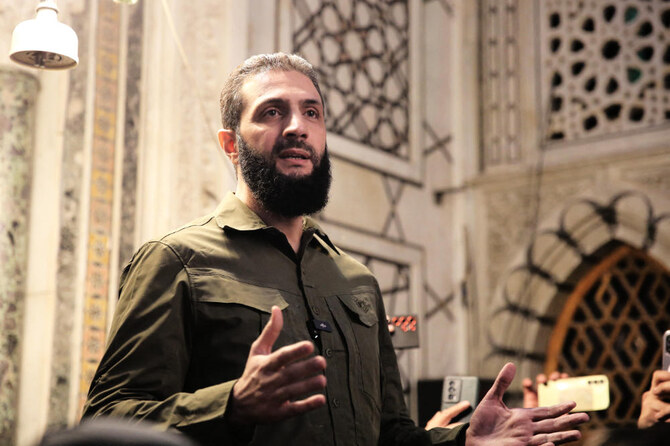

LONDON: In the tumultuous landscape of the Syrian conflict, one figure has remained persistently prominent: Abu Mohammed Al-Golani. Now, with the fall of the Bashar Assad regime after 13 gruelling years of civil war, he has emerged as kingmaker.
As leader of Hay’at Tahrir Al-Sham (HTS), an Islamist group long active in Syria’s northwest, Al-Golani has evolved from a shadowy militant figure with a $10 million bounty on his head into a revolutionary nationalist and widely recognized political actor.
Born Ahmad Hussein Al-Shar’a in 1981 in Idlib, Al-Golani’s journey into militancy began during the 2003 Iraq war, where he joined the insurgency against US forces and fell in with networks associated with Al-Qaeda.
By 2011, as Syria was plunged into civil war, Al-Golani returned to his home country to establish Jabhat Al-Nusra as Syria’s Al-Qaeda affiliate, which quickly gained a reputation for its battlefield prowess and hardline tactics.

Under Al-Golani’s leadership, HTS aimed to present itself not only as a militant organization but as a legitimate governing entity. (AFP)
A pivotal shift occurred in 2016 when Jabhat Al-Nusra broke ties with Al-Qaeda, rebranding first as Jabhat Fatah Al-Sham and later as HTS. This strategic realignment was designed to more closely integrate the group with the local opposition and distance it from its extremist roots.
“The Syrian opposition has a huge image problem,” Nadim Shehadi, an economist and political adviser who has held positions in academia and think tanks in Europe and the US, told Arab News.
“At one stage it had even lost confidence in itself. It has been described as fundamentalist and associated with Al-Qaeda and Daesh on the one hand and its leadership gave the impression of fragmented and corrupt.
Opinion
This section contains relevant reference points, placed in (Opinion field)
“The regime and its supporters and allies were masters of disinformation and were successful in convincing the world that there was no credible alternative and that after it will come chaos. Russian and Iranian sponsored media played an important role.”
Under Al-Golani’s leadership, HTS aimed to present itself not only as a militant organization but as a legitimate governing entity. In Idlib, which remained under HTS control over the course of the conflict, the group established the Syrian Salvation Government.
This governance structure allowed the group to take on civil administrative roles, providing services and infrastructure repairs, while ensuring some level of order in an area scarred by conflict.

HTS will now play a crucial role in the dynamics of the region. (AFP)
Al-Golani’s public appearances and outreach efforts showcase his ambition to redefine HTS as a nationalist force, engaging with local communities and presenting the group as a viable alternative to both the Assad regime and foreign terrorist organizations.
In 2021, Al-Golani conducted interviews with various media outlets, including Western platforms, aiming to shift perceptions of HTS and express a willingness to engage with broader political processes.
This strategy reflected a calculated attempt to distance his group from operating as a purely extremist entity while emphasizing its commitment to local governance and plurality.
“Al-Golani is trying to change his image with a surprisingly efficient social media campaign focusing on HTS itself as much as on his own personality,” said Shehadi.
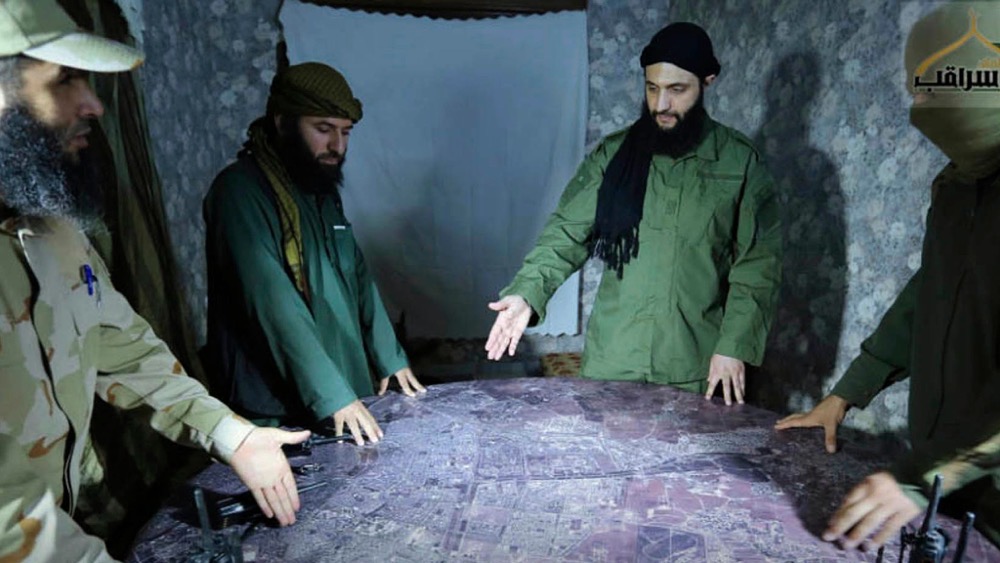
Al-Golani established Jabhat Al-Nusra as Syria’s Al-Qaeda affiliate during the civil war. (Supplied)
“We see them forgiving regime soldiers and releasing prisoners. This is far more effective than one promoting him as a leader or a personality. It would be an emulation of the Assads.
“They are specifically countering rumors about the persecution of minorities. It feels like a professionally run strategic communications campaign. Except for the odd slip here and there.”
Experts view these efforts as indicative of Al-Golani’s understanding that governance and political legitimacy can provide stability and potentially foster reconciliation.

Syria’s neighbors are still unsure what to make of Al-Golani. (AFP)
“Al-Golani’s outreach reflects an ambition to redefine HTS as a nationalistic force, seeking to align with local and possibly even regional interests,” said Lina Khatib, director of the Middle East and North Africa Programme at Chatham House.
Syria’s neighbors are still unsure what to make of Al-Golani. The perspectives of Arab governments concerning HTS are complex and multifaceted, with the spectrum of opinions ranging from staunch opposition to cautious engagement.
Many Arab countries officially condemn extremist groups, especially those with Islamist roots. However, the geopolitical realities often force these nations to engage pragmatically.
Countries such as Turkiye have interacted with HTS, long recognizing its influence over bordering Idlib and its potential role as a counterbalance to both the Assad regime and the Kurdish forces in control of northeast Syria.
However, many remain wary of the group’s true intentions, fearing the emergence of a regime akin to the Taliban in Afghanistan.

President Bashar Assad fled Syria after his military collapsed against rebels. (AFP)
“Is Al-Golani’s pragmatism genuine, and more importantly, is it widely accepted within the ranks of his group?” Ammar Abdulhamid, Syrian-American pro-democracy activist, said in a series of posts on X.
“Can he maintain enough influence to contain radical factions advocating for the imposition of Sharia law or pushing for aggressive campaigns against Israel and Saudi Arabia?”
Israel in particular is acutely aware of the potential threat posed by the collapse of the Assad regime and the emergence of a powerful hostile force on its doorstep.
“With Israel now actively bombing military bases and airports and creating a buffer zone inside Syrian territories, how will Al-Golani respond?” asked Abdulhamid.

Syria’s neighbors are still unsure what to make of Al-Golani. (AFP)
“He will likely face pressure from radical groups to take action or at least issue a defiant statement. However, even rhetorical escalation risks inviting further strikes and dragging Syria into a broader conflict it cannot afford.”
He added: “Will Al-Golani eventually pursue peace with Israel, if not now, then at some point in the future?”
There is also the question of how he will handle ongoing crises within Syria itself, such as that playing out between Turkiye and Turkish-backed opposition groups and the US-backed Syrian Democratic Forces, which control the Kurdish-majority Autonomous Administration of North and East Syria.
“How does he plan to handle the Kurdish issue, knowing that Turkish-backed factions are dedicated to fighting the Kurds?” said Abdulhamid. “With battles ongoing and the potential for further escalation, navigating this remains a critical and delicate challenge.”
He added: “These challenges will test Al-Golani’s leadership, his pragmatism, and his ability to balance internal and external pressures.
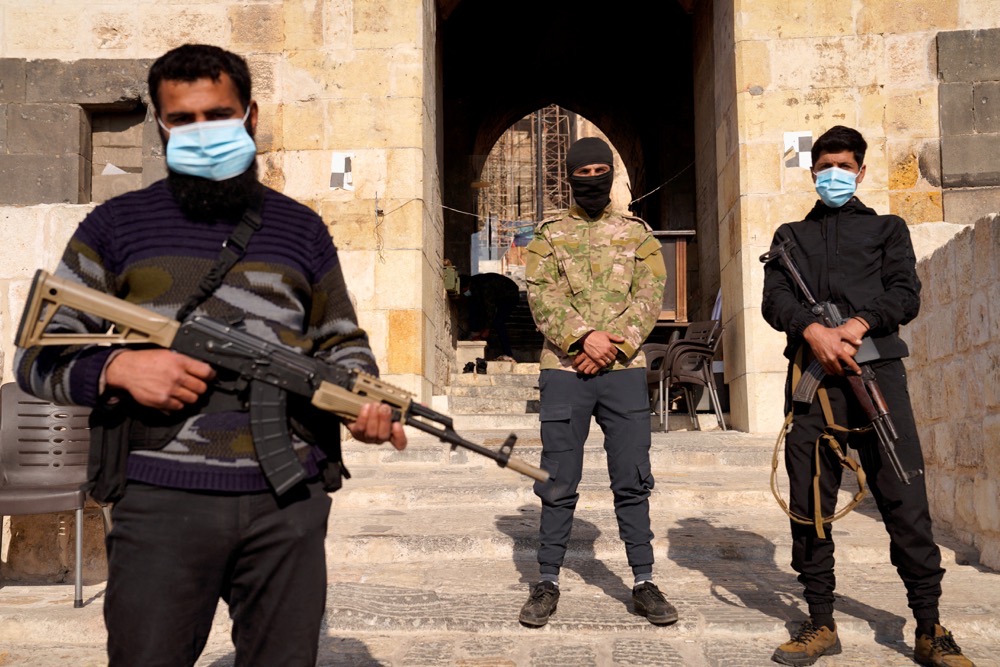
Many remain wary of the group’s true intentions, fearing the emergence of a regime akin to the Taliban in Afghanistan. (AFP)
“They will also shape his vision for Syria’s future. The Syrian people, as well as regional neighbors and the international community, will need clear reassurances on all these fronts.”
Although it is officially classified as a terrorist organization by several nations, HTS will now play a crucial role in the dynamics of the region, complicating the response of Arab states eager to restore some measure of stability to Syria.
“Abu Muhammad Al-Golani remains a figure surrounded by skepticism, even as he attempts to reshape his public image,” Faisal Ibrahim Al-Shammari, a political analyst and commentator, told Arab News.
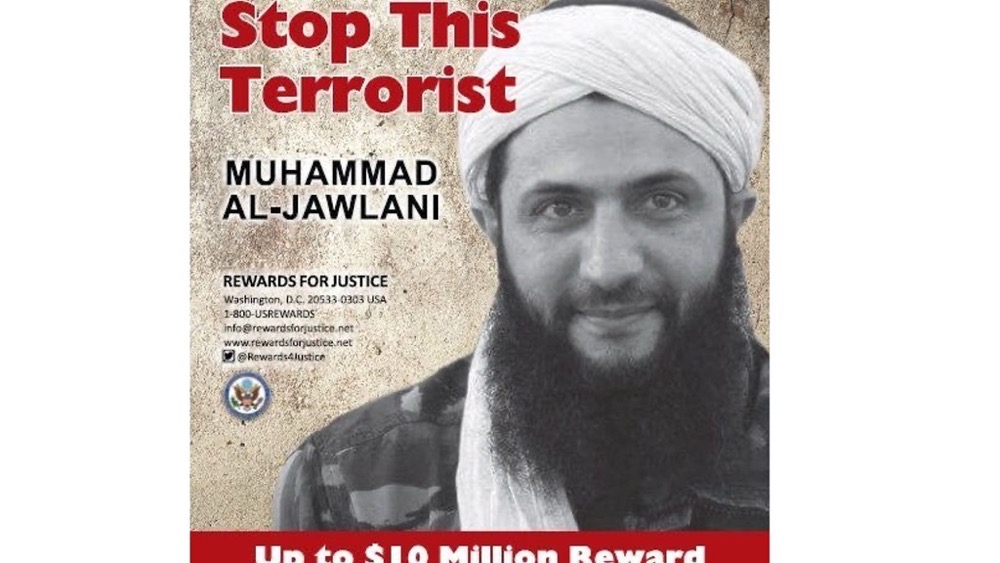
Al-Golani’s journey into militancy began during the 2003 Iraq war. (Supplied)
“While his rhetoric and actions in recent years signal a departure from his extremist beginnings, it is difficult to fully separate his current persona from his well-documented past.
“The skepticism stems from his history with Al-Qaeda and his role in creating Al-Nusra Front, which terrorized Syria during its affiliation with the global terror network. Rebranding as HTS might appear as a strategic pivot, but is it a genuine ideological transformation or simply an act of convenience to appeal to international observers?
“Yet, hope cannot be entirely discounted. Leaders evolve under pressure, and contexts change. If Al-Golani is sincere in his stated commitment to a more inclusive and democratic Syria, this shift would be a remarkable turn. But history warns us against naivety. True change must be proven by sustained action, not just rebranding or tactical concessions.

There is also the question of how Al-Golani will handle ongoing crises within Syria itself. (AFP)
“The question of trust lingers. Can someone with a history of extremism and violence truly reform? The optimist would say yes, given the right circumstances. The realist, however, must insist on vigilance, demanding not just words but concrete actions that demonstrate a commitment to peace, justice, and inclusion.
“Until then, hope must be tempered with caution, as the stakes for Syria and the region are far too high to afford misplaced trust.”

Al-Golani’s future, and that of his organization, will depend on the broader regional approach to Syria’s enduring crisis. (AFP)
Abu Mohammad Al-Golani’s journey from militant to political actor illustrates the adaptability required in the complex Syrian context. His efforts to maintain relevance amid a chaotic landscape have hinged on navigating both local dynamics and regional geopolitical interests.
His future, and that of his organization, will depend on the broader regional approach to Syria’s enduring crisis, marked by shifting allegiances, and intricate political calculations.
His legacy will ultimately be shaped by these complex interplays, as regional stakeholders grapple with the implications of HTS’s evolving role in national and regional affairs.


