

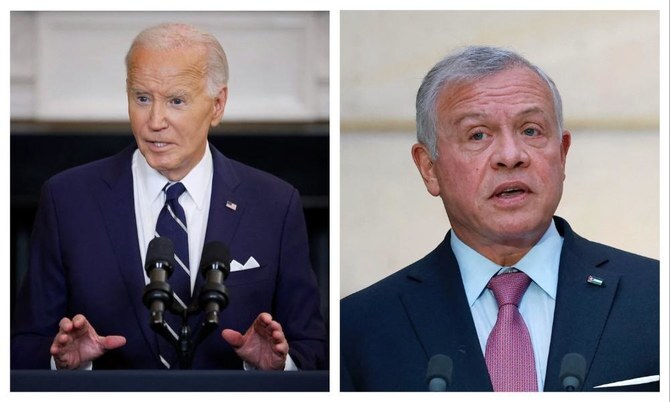
King Abdullah and US President Biden discuss regional crises during phone call

Jordan's King Abdullah II and US President Joe Biden held a phone conversation on Monday to discuss key regional developments, with a particular focus on the situations in Syria and Palestine. (AFP/File Photos)
Short Url
Updated 09 December 2024
Follow

King Abdullah and US President Biden discuss regional crises during phone call

  • King Abdullah emphasized the importance of safeguarding Syria's security and the well-being of its citizens following the fall of Bashar Assad

LONDON: Jordan’s King Abdullah II and US President Joe Biden held a phone conversation on Monday to discuss key regional developments, focusing on the situations in Syria and Palestine, the Jordan News Agency reported.

King Abdullah emphasized the importance of safeguarding Syria’s security and the well-being of its citizens following the fall of Bashar Assad, according to a statement from the Jordanian Royal Court.

He urged swift international action to stabilize the country amid ongoing challenges.

The king also called for intensified global efforts to end the Israeli war on Gaza and facilitate the urgent delivery of humanitarian aid to the besieged enclave.

Highlighting the fragility of the region, he stressed the need to ensure the success of the ceasefire in Lebanon to prevent further escalation of the conflict.

King Abdullah expressed his deep concern over extremist settler violence targeting Palestinians in the West Bank, and condemned violations of Muslim and Christian holy sites in Jerusalem. He underscored the critical need to preserve the rights and sanctity of these religious sites amid rising tensions.

The call reinforced Jordan’s ongoing diplomatic efforts to address regional conflicts and to promote stability and security, the Jordan News Agency added.


Lebanon urges UNSC delegation to press Israel to respect ceasefire

Updated 57 min 56 sec ago
Follow

Lebanon urges UNSC delegation to press Israel to respect ceasefire

  • Israel has kept up strikes on Lebanon and has also maintained troops in five south Lebanon areas it deems strategic

BEIRUT: Lebanese President Joseph Aoun urged a United Nations Security Council delegation on Friday to pressure Israel to respect a year-old ceasefire and to support his army’s efforts to disarm Hezbollah.
Despite a November 2024 ceasefire that was supposed to end more than a year of hostilities between Israel and the Iran-backed militant group, Israel has kept up strikes on Lebanon and has also maintained troops in five south Lebanon areas it deems strategic.
Aoun “stressed the need to pressure the Israeli side to implement the ceasefire and withdraw, and expressed his hope for pressure from the delegation,” according to a statement from the presidency.
He also noted “Lebanon’s commitment to implementing international resolutions” and asked the envoys to support the Lebanese army’s efforts to disarm non-government groups.
The Lebanese government ordered its military to fully disarm Hezbollah in August, and the army expects to complete the first phase of its plan by the end of the year.
The UN delegation visited Damascus on Thursday and after its meeting with Aoun was due to inspect the border area in southern Lebanon on Saturday, accompanied by US envoy Morgan Ortagus.
The visit comes as Lebanese and Israeli civilian representatives held their first direct talks in decades.
On Thursday, Information Minister Paul Morcos quoted Aoun calling the initial negotiations “positive” and stressing “the need for the language of negotiation — not the language of war — to prevail.”
That same day, Israel struck four southern Lebanese towns, saying it was targeting Hezbollah infrastructure including weapons depots to stop the group from rearming.
UN peacekeepers called the strikes “clear violations of Security Council resolution 1701,” which ended the 2006 war between Hezbollah and Israel.
The peacekeepers also said their vehicles were fired on by six men on three mopeds near Bint Jbeil on Thursday. There were no injuries in the incident.
“Attacks on peacekeepers are unacceptable and serious violations of resolution 1701,” the international force added.
Hezbollah refuses to disarm but has not responded to Israeli attacks since the ceasefire. It has, however, promised a response to the killing of its military chief in a strike on Beirut’s southern suburbs last month.