Tech and tourism under discussion at Saudi-Slovenia business forum

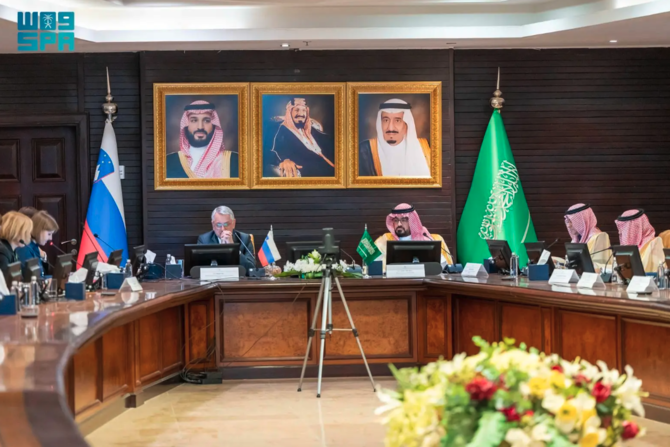
The Federation of Saudi Chambers hosted the Saudi-Slovenian Business Forum on Dec. 8. SPA
Short Url
Updated 09 December 2024
Follow

Tech and tourism under discussion at Saudi-Slovenia business forum

  • Forum brought together over 60 Slovenian companies from nine key sectors and a delegation from the Saudi Chamber of Commerce and Industry
  • Two countries enjoy strong trade ties, with exports from Slovenia to Saudi Arabia rising from $18.4 million in 1995 to $133 million in 2021

JEDDAH: Saudi Arabia and Slovenia are set to deepen economic ties in technology, tourism, and automotive industries following discussions at a business forum in Riyadh.

The Federation of Saudi Chambers hosted the Saudi-Slovenian Business Forum on Dec. 8, with participation from the Kingdom’s Minister of Economy and Planning Faisal Al-Ibrahim, and the European country’s Minister of Economic Development and Technology Matjaz Han.

The forum also brought together over 60 Slovenian companies from nine key sectors and a delegation from the country’s Chamber of Commerce and Industry, all seeking to tap into investment opportunities under the Kingdom’s Vision 2030 economic diversification initiative, and foster new business collaborations, according to the Saudi Press Agency.

The two countries enjoy strong trade ties, with exports from Slovenia to Saudi Arabia rising from $18.4 million in 1995 to $133 million in 2021, according to the Observatory of Economic Complexity trade data platform.

Al-Ibrahim highlighted progress since last year’s visit to Slovenia, including a memorandum establishing a joint business council and opening new avenues for economic cooperation and investment, SPA reported.

The Kingdom’s minister underscored the synergies between the two economies and encouraged Slovenian businesses to engage in Saudi Arabia’s transformative Vision 2030 initiatives.

He also emphasized the vital role of the private sector and called for a sustainable roadmap for economic cooperation to unlock additional investment opportunities.

For his part, Han underlined his country’s strong export-driven economy, highlighting that exports account for 80 percent of its gross domestic product. He also emphasized the country’s expertise in the automotive industry, engineering, infrastructure, and its vibrant tech ecosystem, encompassing 2,000 companies specializing in artificial intelligence, digitization, and cybersecurity.

The Slovenian minister went on to underscore opportunities in his country’s sports and tourism sectors, encouraging Saudi investors to explore these fields.

Waleed Al-Orainan, secretary-general of the FSC, affirmed that establishing the Joint Business Council reflects both nations’ commitment to strengthening economic ties, remarking that trade between Saudi Arabia and Slovenia grew by 192 percent in 2023, reaching $230 million.

The forum featured presentations on investment opportunities in the Kingdom and Slovenia, success stories of Slovenian businesses in the Saudi market, and insights into the European country’s tourism and biotechnology sectors.


Oil falls on report of IEA proposing biggest oil release ever

Updated 9 sec ago
Follow

Oil falls on report of IEA proposing biggest oil release ever

TOKYO: Oil prices fell further on Wednesday, as reports of the International Energy Agency proposing the largest release of oil reserves in ​its history due to potential supply disruptions from the U.S.-Israeli conflict with Iran dragged on sentiment.

Brent futures traded down 88 cents, or 1 percent, ‌at $86.92 a barrel by 07:51 a.m. Saudi time. US West Texas Intermediate traded 35 cents lower, or 0.4 percent, at $83.1 a barrel.

US crude prices leapt 5 percent at the market open after both contracts plunged more than 11 percent on Tuesday, the steepest percentage drop since 2022, a day after Trump predicted a quick end to the war. On Monday, WTI surged to more than $119 a barrel, its highest ​since June 2022.

The IEA’s proposed drawdown would exceed the 182 million barrels of oil that IEA member countries put onto the market in two releases in ​2022 when Russia launched its full-scale invasion of Ukraine, the WSJ said, citing officials familiar with the matter.

A stockpile release ⁠of that size would offset 12 days of the investment bank's estimated 15.4 million barrel-per-day Gulf exports disruption, Goldman Sachs analysts said in a note.

The US and ​Israel pounded Iran on Tuesday with what the Pentagon and Iranians on the ground called the most intense airstrikes of the war.

The US military also “eliminated” 16 Iranian mine-laying vessels ​near the Strait of Hormuz on Tuesday, the US Central Command said, as US President Donald Trump warned any mines laid in the Strait by Iran must be removed immediately.

Trump has repeatedly said the US is prepared to escort tankers through the Strait of Hormuz when necessary. However, sources told Reuters the US Navy has refused requests from the shipping industry for military escorts as ​the risk of attacks is too high for now.

“Oil prices continued to normalise lower in a volatile fashion following Monday’s sharp spike,” said UOB analysts in a ​client note, adding that markets are expected to keep their focus on developments in the Middle East as investors gauge how long energy prices may stay elevated.

G7 officials have since gathered ‌online to discuss ⁠a potential release of emergency oil stockpiles to soften the market blow.

French President Emmanuel Macron will host a video call with other G7 country leaders on Wednesday to discuss the impact of the conflict in the Middle East on energy and measures to address the situation.

Some analysts were sceptical about the IEA’s proposal.

“No release has yet been formally announced, and there are doubts around the ultimate pace of any drawdowns from those reserves,” said Philip Jones-Lux, senior analyst at Sparta Commodities, in a client note, ​adding that “the core issue is not the ​size of reserves, it is the ⁠achievable draw rates.”

SUPPLY CONCERNS REMAIN

Abu Dhabi state oil giant ADNOC has shut its Ruwais refinery in response to a fire at a facility within the complex following a drone strike, according to a source, marking the latest energy infrastructure disruption due to ​the US-Israeli war on Iran.

Saudi Arabia, the world’s largest oil exporter, is seen boosting supplies via the Red Sea, although ​they are still far ⁠below the levels needed to compensate for the drop in flows from the Strait of Hormuz, shipping data showed.

The Kingdom is relying on the Red Sea port of Yanbu to help it boost exports to avert steep production cuts as its neighbours Iraq, Kuwait and the UAE have already reduced output.

Energy consultancy Wood Mackenzie said the war ⁠is currently ​cutting Gulf oil and oil products supply to the market by some 15 million barrels per day, ​which could raise crude prices to $150 per barrel.

“Even a quick resolution probably implies weeks of disruption for energy markets yet,” Morgan Stanley said in a note.

Reflecting higher demand, US crude, gasoline and distillate stocks fell ​last week, market sources said, citing American Petroleum Institute figures on Tuesday.