

Fake news witnessed massive surge in Pakistan during ex-PM Khan party protest in Islamabad — report

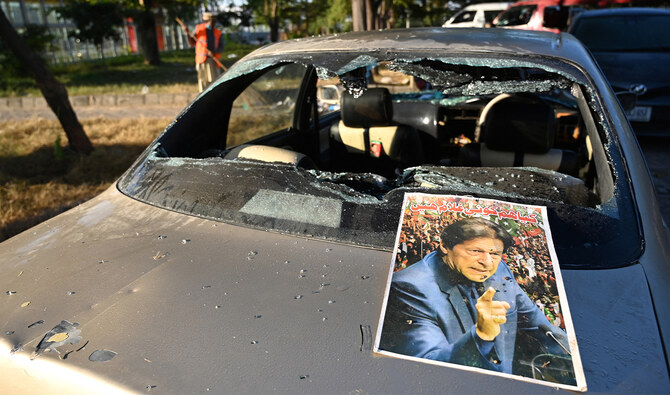
A poster of jailed former Pakistan's prime minister Imran Khan is pictured on a damaged vehicle after an overnight security forces operation against the supporters of Khan's Pakistan Tehreek-e-Insaf (PTI) party in Islamabad on November 27, 2024. (AFP)
Short Url
Updated 09 December 2024
Follow

Fake news witnessed massive surge in Pakistan during ex-PM Khan party protest in Islamabad — report

  • Khan’s party on Nov. 24 led thousands of supporters to Islamabad, seeking to pressure the government to release the ex-premier from jail
  • The protests resulted in clashes that government says killed four law enforcers, while the party says 12 supporters were killed in crackdown

ISLAMABAD: A massive surge in fake news was witnessed during last month’s protest by former prime minister Imran Khan’s Pakistan Tehreek-e-Insaf (PTI) party in Islamabad, the Fake News Watchdog said in its report on Sunday.
Khan’s party on Nov. 24 led thousands of supporters to Islamabad, seeking to pressure the government to release the ex-premier from jail and order an audit of Feb. 8 national election results. The protests resulted in clashes that Pakistan’s government says killed four law enforcers and injured hundreds of others.

The PTI has named 12 people and says it has evidence they lost their lives during the crackdown, however, several PTI members have given varied accounts of casualties during the protests. Pakistani authorities have denied the deaths, saying security personnel had not been carrying live ammunition during the protest.

Fake News Watchdog, an Islamabad-based non-profit organization fighting disinformation and misinformation, said in its report released on Sunday the Islamabad protest was marked by a “significant role of information warfare in shaping the narrative,” with dissemination of fake news and misinformation across print media, social media and television.

“The events surrounding the PTI protests from 24–27 November 2024 underscored the profound impact of fake news on political, social, and institutional dynamics in Pakistan. Misinformation during this period did not merely serve as a byproduct of political unrest; it actively shaped the narrative, inflamed tensions, and influenced public actions,” the report read.

“Fabricated content — whether through manipulated images, doctored videos, or false statements attributed to key figures — spread rapidly across social media and traditional news platforms, magnifying confusion and mistrust. This phenomenon revealed vulnerabilities in the country’s information ecosystem, where unverified claims gained traction in the absence of effective countermeasures.”

The watchdog said the role of social media was particularly significant, acting as both a tool for mobilization and a breeding ground for misinformation.

“The platform’s speed and reach allowed false narratives to proliferate unchecked, with emotionally charged content exploiting public sentiment,” it said in the report.

“At the same time, lapses in journalistic standards by mainstream media contributed to the problem, as unverified reports from influential outlets further legitimized misleading information.”

It said the widespread misinformation eroded public trust in media and government institutions, deepened political polarization, and led to exaggerated claims of violence, arrests and fatalities, contributing to unnecessary confrontations between protesters and law enforcers.

The coalition government of Prime Minister Shehbaz Sharif formed two task forces in the aftermath of the Islamabad protest: one to identify and take legal action against rioters and another to track and bring to justice suspects behind what the government described as a “malicious campaign” to spread “concocted, baseless and inciting” online news, images and video content against the state and security forces.

Last week, Pakistan’s army also called for action against “political elements” using “fake news for vested interests.”

“This pre-planned coordinated and premeditated propaganda reflects continuity of a sinister design by certain political elements as an attempt to drive a wedge between the public & Armed Forces and institutions of Pakistan,” the army said in what was a clear reference to Khan’s PTI party, following a meeting of its top commanders.

“This futile attempt, fueled and abetted by external players, will never be successful.”

Khan, who remains a popular figure in Pakistan despite being in prison and facing several court cases, has led a campaign of unprecedented defiance against the Sharif coalition and the all-powerful military, which he accuses of being behind his ouster from office in 2022. The army denies it interferes in politics.

Last week, the ex-premier also threatened to launch a civil disobedience movement and asked supporters to converge on Dec. 13 in Peshawar, the capital of the Khyber Pakhtunkhwa (KP) province which is ruled by his party.


IMF warns against policy slippage amid weak recovery as it clears $1.2 billion for Pakistan

Updated 11 December 2025
Follow

IMF warns against policy slippage amid weak recovery as it clears $1.2 billion for Pakistan

  • Pakistan rebuilt reserves, cut its deficit and slowed inflation sharply over the past one year
  • Fund says climate shocks, energy debt, stalled reforms threaten stability despite recent gains

ISLAMABAD: Pakistan’s economic recovery remains fragile despite a year of painful stabilization measures that helped pull the country back from the brink of default, the International Monetary Fund (IMF) warned on Thursday, after it approved a fresh $1.2 billion disbursement under its ongoing loan program.

The approval covers the second review of Pakistan’s Extended Fund Facility (EFF) and the first review of its climate-focused Resilience and Sustainability Facility (RSF), bringing total disbursements since last year to about $3.3 billion.

Pakistan entered the IMF program in September 2024 after years of weak revenues, soaring fiscal deficits, import controls, currency depletion and repeated climate shocks left the economy close to external default. A smaller stopgap arrangement earlier that year helped avert immediate default, but the current 37-month program was designed to restore macroeconomic stability through strict monetary tightening, currency adjustments, subsidy rationalization and aggressive revenue measures.

The IMF’s new review shows that Pakistan has delivered significant gains since then. Growth recovered to 3 percent last year after shrinking the year before. Inflation fell from over 23 percent to low single digits before rising again after this year’s floods. The current account posted its first surplus in 14 years, helped by stronger remittances and a sharp reduction in imports. And the government delivered a primary budget surplus of 1.3 percent of GDP, a key program requirement. Foreign exchange reserves, which had dropped dangerously low in 2023, rose from US$9.4 billion to US$14.5 billion by June.

“Pakistan’s reform implementation under the EFF arrangement has helped preserve macroeconomic stability in the face of several recent shocks,” IMF Deputy Managing Director Nigel Clarke said in a statement after the Board meeting.

But he warned that Islamabad must “maintain prudent policies” and accelerate reforms needed for private-sector-led and sustainable growth.

The Fund noted that the 2025 monsoon floods, affecting nearly seven million people, damaging housing, livestock and key crops, and displacing more than four million, have set back the recovery. The IMF now expects GDP growth in FY26 to be slightly lower and forecasts inflation to rise to 8–10 percent in the coming months as food prices adjust.

The review warns Pakistan against relaxing monetary or fiscal discipline prematurely. It urges the State Bank to keep policy “appropriately tight,” allow exchange-rate flexibility and improve communication. Islamabad must also continue raising revenues, broadening the tax base and protecting social spending, the Fund said.

Despite the progress, Pakistan’s structural weaknesses remain severe.

Power-sector circular debt stands at about $5.7 billion, and gas-sector arrears have climbed to $11.3 billion despite tariff adjustments. Reform of state-owned enterprises has slowed, including delays in privatizing loss-making electricity distributors and Pakistan International Airlines. Key governance and anti-corruption reforms have also been pushed back.

The IMF welcomed Pakistan’s expansion of its flagship Benazir Income Support Program, which raises cash transfers for low-income families and expands coverage, saying social protection is essential as climate shocks intensify. But it warned that high public debt, about 72 percent of GDP, thin external buffers and climate exposure leave the country vulnerable if reform momentum weakens.

The Fund said Pakistan’s challenge now is to convert short-term stabilization into sustained recovery after years of economic volatility, with its ability to maintain discipline, rather than the size of external financing alone, determining the durability of its gains.