BEIRUT: The Lebanese Cabinet on Saturday approved the deployment of the army south of the Litani River during an exceptional meeting at a military base in Tyre.
The plan is “part of a broader strategy that aims to ensure security in southern areas adjacent to the border with Israel,” Information Minister Ziad Makary said.
He added that the army had begun sending its forces to the south.
“However, the military institution needs additional support in terms of personnel and supplies, as well as modern equipment, to carry out its duties effectively,” Makary said.
The decision came 10 days after the ceasefire agreement between Israel and Hezbollah went into effect following a destructive two-month war.
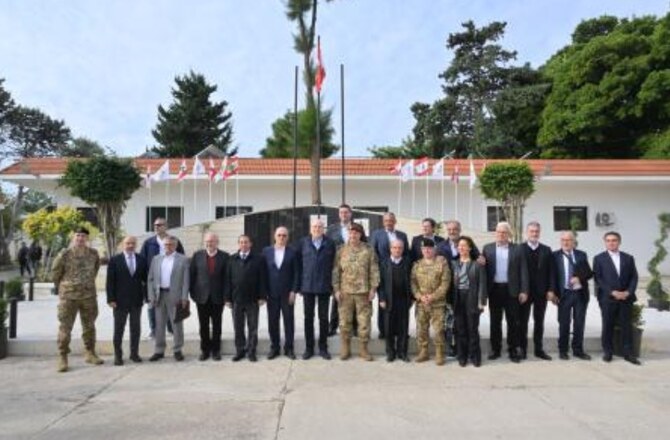
The ministers met in the Benoit Barakat barracks in the coastal city of Tyre, south of the Litani.
They were briefed by Lebanese Army chief Joseph Aoun, who delivered a presentation on strengthening the army’s deployment.
Ministers discussed a draft law to rebuild destroyed homes, put in place an agriculture damage survey mechanism and remove rubble created by Israeli raids in the south, Bekaa, as well as Beirut and its southern suburbs.
Caretaker Prime Minister Najib Mikati reiterated Lebanon’s commitment to UN Resolution 1701 in a statement delivered before the ministers.
He said that the Lebanese Army would uphold the resolution south of the Litani River, in cooperation and coordination with the UNIFIL, as it is the basis for the ceasefire and Israel’s withdrawal from “our occupied land.”
He said: “We are kilometers from the ongoing operations of Israel’s army and its repetitive ceasefire violations.
“We are also near the location of the committee tasked with monitoring the implementation of the arrangements agreed upon under US and French guarantees.”
Mikati called on the international community, primarily the entities overseeing the security arrangements, to put an end to Israeli violations of the ceasefire.
He paid tribute to slain Lebanese Army soldiers and those who sacrificed themselves for the country.
“All the threats and attacks aiming to confuse or push us to change our national beliefs and choices will not scare us,” he said.
“We fully trust the wise army command, which assumes considerable responsibilities with professionalism, discipline and ethics, preserving every inch of our territory and safeguarding our national sovereignty.”
Mikati said that stability in the south and its reconstruction are key to stability in the Middle East, which will only return to security and safety through the implementation of international resolutions.
Makary said after the meeting that the Lebanese Army commander informed the ministers that the debris and ruins of destroyed buildings will be removed, along with the cleaning of areas in the south from cluster bombs.
The army will also deploy along the northern and eastern borders of Syria and take appropriate measures in response to events in the country, he added.
The cabinet allocated 4 trillion Lebanese pounds ($44 million) for the removal of debris, rubble and cluster munitions.
It is part of a comprehensive plan to restore the regions impacted by the war.
Mikati and the ministers, accompanied by Aoun, toured several military centers in Shawakir and Qleileh, as well as the headquarters of the Fifth Brigade in Bayada.
They met military personnel at the Qleileh center who were injured during an Israeli airstrike on the facility.
Also on Saturday, Israeli forces that penetrated the Lebanese border area continued their violations of the ceasefire agreement.
A military drone targeted a motorcycle in the town of Deir Siriane, killing its rider.
The Lebanese Army is observing the activities of Israeli forces in Kfar Kila and Khiam, where soldiers are demolishing buildings and residences.
In other developments, Wadad Halawani, the head of the Committee of Families of Kidnapped and Disappeared in Lebanon, addressed a press conference on Friday.
It followed developments in neighboring Syria and the long-running issue of missing and abducted Lebanese citizens.
Halawani called on the Lebanese state to assume its responsibilities on the issue.
She called for the establishment of a joint emergency committee that includes the relevant ministerial, security and judicial bodies, and the National Commission for the Missing and Forcibly Disappeared.
Its goal should be to negotiate with Syrian parties to identify released people and ensure their safe return to their families in Lebanon, along with providing health care and psychological support.
“What was circulated on social media concerning the release of a Lebanese among the prisoners who were freed from the Hama central prison stirred the emotions of the families of the missing,” Halawani said.
She added that Ali Hassan Al-Ali from Akkar — arrested by Syrian forces in 1986 and not seen until this week — appeared in a social media clip asking an activist who filmed him how to reach his family in Lebanon.
Halawani added that several Syrian organizations are following up on the issue of detainees and missing people.
The Syrian state had repeatedly denied that Lebanese political prisoners were jailed in the country, she added.
The most recent denial came from President Bashar Assad and former foreign minister Walid Muallem.


![]()

PM: ‘Stability and reconstruction of southern Lebanon key to regional stability’
Short Url
https://arab.news/n85gd
PM: ‘Stability and reconstruction of southern Lebanon key to regional stability’
- Cabinet approves army deployment plan south of Litani
- Govt must take action on Lebanese political prisoners detained in Syria, says committee chief


Latest updates


© 2026 SAUDI RESEARCH & PUBLISHING COMPANY, All Rights Reserved And subject to Terms of Use Agreement.