

More Bangladeshis choose to leave Lebanon as Israel violates ceasefire

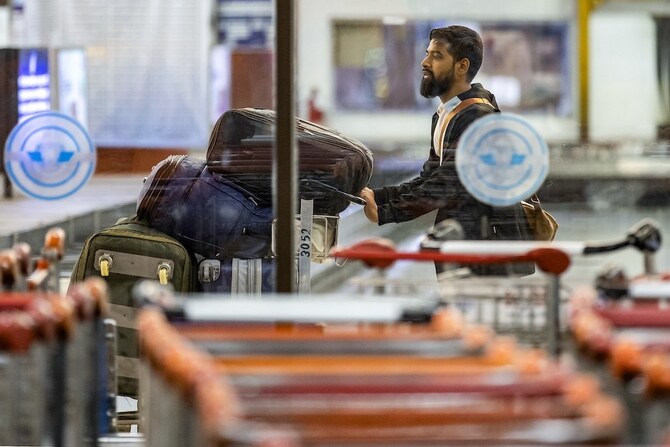
A Bangladeshi national carries luggage on a trolley upon his arrival from Lebanon, at the Hazrat Shahjalal International Airport in Dhaka on October 21, 2024. (AFP file photo)
Short Url
Updated 07 December 2024
Follow

More Bangladeshis choose to leave Lebanon as Israel violates ceasefire

  • Almost 1,000 Bangladeshis have returned to their country on special flights
  • Bangladeshis in Lebanon are the largest group of migrants from Asia

DHAKA: Bangladeshis living and working in Lebanon continue to return home, saying they fear Israeli attacks that have not stopped despite last week’s ceasefire agreement between the two countries.

There are about 100,000 Bangladeshis in Lebanon — the largest group of migrants from Asia. Thousands have been displaced since the beginning of Israel’s invasion of the country’s south in October and strikes on other cities.

Last month, a Bangladeshi man was killed by an Israeli strike while he stopped at a coffee shop on his way to work in Beirut.

Almost 1,000 Bangladeshis have since returned to their country on special repatriation flights financed by the Bangladeshi government and the International Organization for Migration. The latest flight reached Dhaka on Thursday night.

“The number of intended returnees is increasing,” Mohammad Anwar Hossain, first secretary of the Bangladeshi embassy in Beirut, told Arab News.

“Despite the ceasefire agreement, a tense situation still persists in Lebanon. We have observed Israeli surveillance drones over Beirut.”

Although a US-brokered ceasefire has been in place since last week, it has been repeatedly breached by Israel. A source from the UN’s peacekeeping force told CNN on Monday that Israeli forces had violated the agreement “approximately 100 times.”

Shahnaz Begum, who was among 105 Bangladeshis evacuated on Thursday, decided to leave her domestic helper job behind despite being her family’s sole breadwinner.

“Israel started bombing maybe one or two days after the announcement of the ceasefire,” she said.

“For over two months, we’ve been counting the days until we can return home. I can’t remember the last time I had a good night’s sleep. Every moment felt like it could be the last.”

Israeli air and ground raids, many of which have targeted civilian and medical infrastructure, have killed more than 4,000 people since October, according to Lebanese Health Ministry estimates. More than 16,000 have been injured.

Liton Rahman, who for the past seven years worked as a driver in Jezzine, southern Lebanon, was hopeful that the ceasefire would allow him to stay longer in Lebanon. But the wait was “in vain,” he said.

“I had been considering staying for a few more months if the ceasefire had truly been effective. But, unfortunately, Israel continues its attacks on various parts of southern Lebanon ... I am forced to return home. Otherwise, I might end up being counted as collateral damage.”


Activist Peter Tatchell arrested over ‘globalize the intifada’ placard

Updated 4 sec ago
Follow

Activist Peter Tatchell arrested over ‘globalize the intifada’ placard

  • Arrest in London during Saturday protest an ‘attack on free speech,’ his foundation says
  • Intifada ‘does not mean violence and is not antisemitic,’ veteran campaigner claims

LONDON: Prominent activist Peter Tatchell was arrested at a pro-Palestine march in central London, The Independent reported.

According to his foundation, the 74-year-old was arrested for holding a placard that said: “Globalize the intifada: Nonviolent resistance. End Israel’s occupation of Gaza & West Bank.”

The Peter Tatchell Foundation said in a statement that the activist labeled his Saturday arrest as an “attack on free speech.”

It added: “The police claimed the word intifada is unlawful. The word intifada is not a crime in law. The police are engaged in overreach by making it an arrestable offense.

“This is part of a dangerous trend to increasingly restrict and criminalize peaceful protests.”

Tatchell described the word “intifada,” an Arab term, as meaning “uprising, rebellion or resistance against Israel’s occupation of the West Bank and Gaza.

“It does not mean violence and is not antisemitic. It is against the Israeli regime and its war crimes, not against Jewish people.”

According to his foundation, Tatchell was transported to Sutton police station to be detained following his arrest.

In December last year, London’s Metropolitan Police said that pro-Palestine protesters chanting “globalize the intifada” would face arrest, attributing the new rules to a “changing context” in the wake of the Bondi Beach attack in Australia.

“Officers policing the Palestine Coalition protest have arrested a 74-year-old man on suspicion of a public order offense. He was seen carrying a sign including the words ‘globalize the intifada’,” the Metropolitan Police said on X.

According to a witness, Tatchell had been marching near police officers with the placard for about a mile when the group came across a counterprotest.

He was then stopped and “manhandled by 10 officers,” said Jacky Summerfield, who accompanied Tatchell at the protest.

“I was shoved back behind a cordon of officers and unable to speak to him after that,” she said.

“I couldn’t get any closer to hear anything more than that; it was for Section 5 (of the Public Order Act).

“There had been no issue until that. He was walking near the police officers. Nobody had said or done anything.”